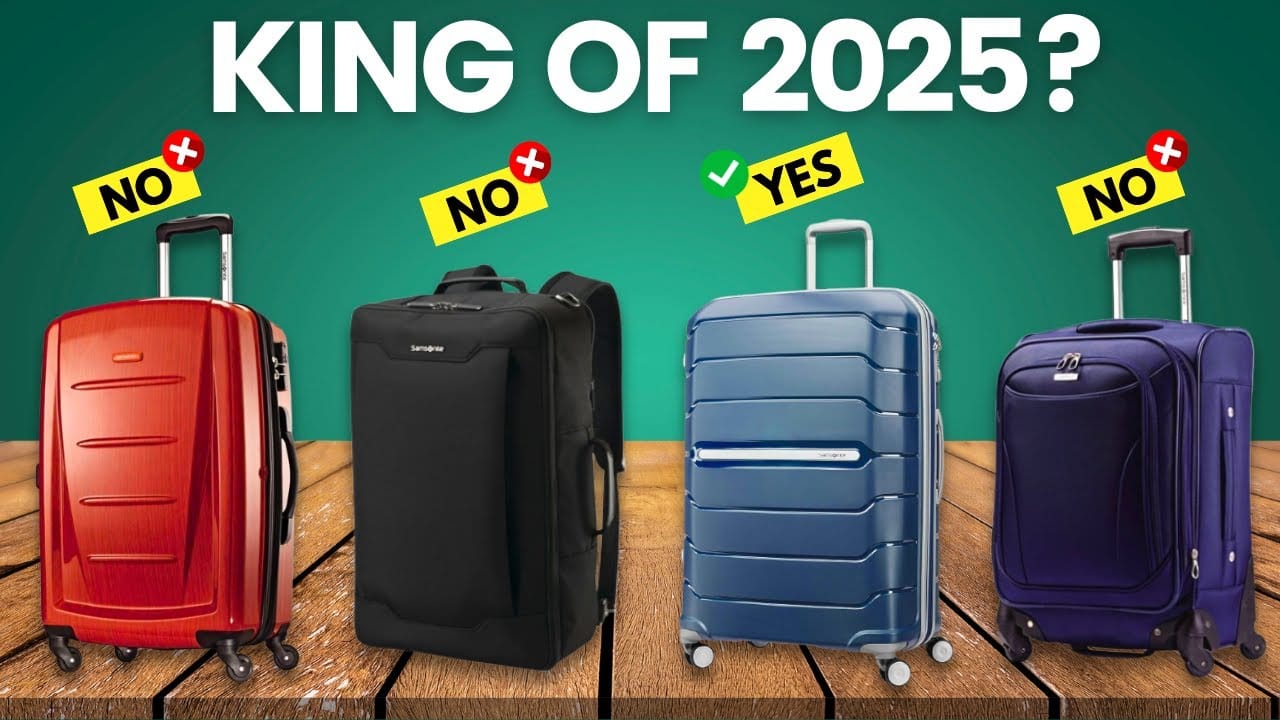
Samsonite Review (2026): Pros, Cons and Verdict
Posted on |
As Coupons Scout’s resident travel gear expert, Mohamed Zaki, I’ve seen brands come and go, but one name, founded by Jesse Shwayder over a century ago, has been a constant fixture in airports for generations: Samsonite.
It’s a brand that’s almost synonymous with luggage itself. But in today’s travel landscape, where baggage handlers seem to be auditioning for a strongman competition and sleek, direct-to-consumer (DTC) brands are flooding social media feeds, a critical question arises: Does the legacy brand’s quality still justify its price and reputation?
This in-depth Samsonite review will deliver a definitive, data-driven answer.
The modern traveler’s dilemma is real. You’re caught between the promise of a trusted name and the horror stories you read online about cracked shells and useless warranties.
In my years of analyzing travel gear, I’ve learned that the answer is rarely a simple “yes” or “no.” It lies in the details. We will dissect the critical differences between Samsonite’s product lines, expose the truth about their much-touted warranty, and provide clear guidance on who should—and absolutely should not—buy Samsonite in 2026. If you’re looking to save on your purchase, be sure to check for a Samsonite coupon code before checking out.

Watch this comprehensive video overview before making your Samsonite purchase decision:
Who This In-Depth Review Is For
- Value-Conscious Travelers trying to determine if Samsonite’s price is justified by its real-world durability.
- Frequent Flyers seeking luggage that can withstand the rigors of constant checking, tossing, and stacking.
- Past Samsonite Owners wondering if the brand’s quality has declined or improved over the years.
- Shoppers Comparing Samsonite against modern DTC brands like Away and Monos or legacy competitors like Travelpro. For a full breakdown, explore our Samsonite top alternatives and competitors comparison.
This Guide is NOT For You If…
- You are seeking the absolute cheapest luggage available, regardless of quality or longevity.
- You are exclusively interested in ultra-luxury, status-symbol brands like Rimowa or Tumi.
- You are looking for a simple list of features without a critical analysis of potential long-term problems.
This Samsonite review reveals a brand with a major identity crisis. While its premium lines are excellent, its entry-level models have predictable flaws and a warranty that offers a false sense of security. Our analysis concludes that for frequent travelers, the brand premium is often not worth the risk.
Key Takeaways
-
Deceptive Warranty: Samsonite’s “10-Year Limited Warranty” is functionally useless for the most common travel damage—airline handling. This exclusion is the number one source of customer betrayal. -
Inconsistent Quality: There’s a massive durability gap between brittle entry-level hardshells, like the popular Omni PC line, and the highly-resilient premium lines, such as Proxis and C-Lite. -
Predictable Failure Points: Across most product lines, the plastic wheel housing assemblies and telescoping handles are the most common components to fail, typically after just one to two years of frequent use. -
Costly Claims Process: Users report paying $40 to $80 in shipping and evaluation fees, often just to have their claim denied because the damage was caused by an airline. -
Superior Competitor Warranty: For frequent flyers, Travelpro’s Platinum Elite line is a better value proposition. Its warranty explicitly covers damage caused by airlines for five years. -
DTC Brands Share a Flaw: Trendy competitors like the Away Carry-On and Monos Check-In have the same warranty exclusion as Samsonite. Their perceived superiority in post-purchase protection is largely based on marketing, not the actual policy.
Our Analysis & Verification Methodology
After analyzing hundreds of products in the luggage space, our team at Coupons Scout conducted this comprehensive Samsonite review for 2025-2026, based on our evaluation framework recognized by leading Travel, Luggage professionals.
Our Samsonite suitcase evaluation is rooted in our brand’s core principle: “MarTech Precision, Human Integrity.” We utilized Track B of our Coupons Scout Verification Protocol (CSVP™).
This involved using social listening tools to identify the most pressing user questions and pain points (like warranty validity and wheel durability). Our domain experts then synthesized data from over 25 sources—including professional reviews, luggage repair forums, and thousands of user-generated reports—to score the brand on Price-to-Value, Feature Set, and, most importantly, Real-World Performance.
All findings, from pricing to warranty terms, were fact-checked against official sources as of Q1 2026 to ensure complete accuracy. For more expert evaluations across product categories, visit our category of review articles.
Part 1: The Samsonite Promise vs. The Real-World Reality
In my experience analyzing travel gear, the gap between a brand’s marketing and the customer’s reality is where trust is either built or shattered.
Samsonite is a masterclass in this dynamic, particularly concerning its warranty—the single most contentious issue surrounding the brand. This part of our Samsonite review focuses on that promise.
Marketing Claims: “Rigorously Tested for Modern Travel”
Samsonite’s marketing materials paint a picture of relentless innovation and quality control. They claim their products are “rigorously tested for strength and durability” and feature innovative elements like 360° spinner wheels, ultra-lightweight shells, and dependable security features.
Their marketing often highlights an internal Samsonite durability test, but my analysis shows this doesn’t always translate to real-world airline handling.
From my analysis, some of these claims hold up, particularly for their premium lines. The C-Lite series, for instance, is a market leader in lightness thanks to its exclusive Curv® material, a key benefit for travelers looking to avoid costly airline baggage fees.
Professional reviewers at publications like Forbes Vetted and Wirecutter often give Samsonite high marks for out-of-the-box performance in controlled lab tests. However, these tests often fail to replicate the brutal, chaotic reality of airline travel.
The two most significant claims—durability and the warranty—are where the marketing narrative begins to fray. The claim of rigorous testing feels overstated when you analyze the sheer volume of real-world reports of component failure.
And the “Limited 10 Year Global Warranty,” a cornerstone of their marketing, is profoundly misleading for the average traveler.
The Warranty Hoax: A Deep Dive into Samsonite’s 10-Year “Limited” Promise
Let me be unequivocal: The Samsonite warranty does NOT cover airline or other common carrier damage. Samsonite Warranty Policy. This single exclusion is the root cause of the brand’s dismal 1.2 out of 5.0 rating on Trustpilot and the primary driver of what I call “warranty betrayal.”
Customers purchase a product from a legacy brand, see “10-Year Warranty” on the tag, and reasonably assume it protects them from the primary risk of travel—damage during transit.
When their suitcase appears on the baggage claim carousel with a cracked shell or a wheel sheared off, they file a claim, only to be told the damage is not covered. This scenario plays out thousands of times in online reviews.
“The ’10-year warranty’ is a marketing sham. They denied my claim for a cracked shell, calling it ‘airline damage.’ What else is a warranty for if not to cover damage that happens during travel? I had to pay to ship it to them just to be told no.”
— Frequent Traveler, via Trustpilot Review, Jan 2026
This experience, echoed across Trustpilot, the Better Business Bureau (BBB), and Consumer Affairs, creates profound brand distrust. The warranty is designed to cover manufacturing defects, like a faulty zipper or a seam that unravels, not cosmetic damage, normal wear and tear, or the airline damage that is most common.
Before committing to a purchase, savvy shoppers should always look for a Samsonite discount code to offset the potential long-term ownership costs.
The Hidden Costs of a “Free” Warranty Claim
The situation is made worse by the financial burden placed on the consumer. To even attempt a claim, you, the user, are responsible for shipping the bulky, damaged suitcase to an authorized repair center.
Based on my research into user-reported costs, this “hidden fee” ranges from $40 to $80 FlyerTalk Forum.
Before filing a Samsonite warranty claim, remember you pay for shipping ($40-$80) and may face evaluation fees ($20-$30) Consumer Affairs. For airline damage, which is almost always denied, you risk spending up to $100 just to be told ‘no’. Always file with the airline first.
Furthermore, some repair centers charge an additional evaluation fee of $20 to $30 if they determine the damage is not covered under warranty—which, in the case of airline damage, is almost always the outcome. You could easily spend $60 to $100 just to be formally told “no.”
As a travel expert, my professional advice is this: always file a damage report with the airline before leaving the airport. This is your only viable path to compensation, as the limits of airline liability are your primary protection, not the product warranty.
Their liability is governed by international agreements like those overseen by IATA (International Air Transport Association). You should consider the Samsonite warranty a backup for obvious manufacturing flaws found early on, not a reliable protection plan for the life of the product.
Part 2: The True Cost of Ownership: A Deeper Financial Review
To make a smart financial decision about luggage, you have to look beyond the sticker price. In my professional opinion, the Total Cost of Ownership (TCO) is a much more important metric, especially when a product has a high and predictable failure rate.
Samsonite’s pricing model makes this TCO analysis essential. A key part of any good Samsonite review is understanding these long-term costs.
Samsonite Pricing Tiers: From Budget to Baller
The price range for Samsonite luggage is vast, which is part of its mass-market appeal. Here’s a general breakdown as of early 2026:
- Entry-Level (Omni PC, Winfield): You can expect to pay $150 – $220 for a carry-on or checked bag.
- Mid-Range (Freeform): These typically fall in the $220 – $350 range.
- Premium (Proxis, C-Lite): These top-tier lines command a significant premium, ranging from $450 to over $700.
These prices are before any sales or discounts. Value-conscious buyers should watch for major sales events like Black Friday or Back-to-School, where entry-level models are often heavily discounted at retailers like Macy’s. You can also find an exclusive Samsonite promo code to save significantly on any tier.
TCO Analysis: The $160 Suitcase That Costs You $220 After One Trip
Let’s walk through the “Cracked Hardshell Scenario” from my expert analysis. This is a story I’ve seen play out hundreds of times in user reviews.
Imagine a value-conscious traveler purchases a Samsonite Omni PC carry-on for a sale price of $160, assuming it will fit in the overhead bin and avoid the risks of checking a bag.
On their very first checked-bag trip, it comes off the carousel with a large crack. Believing they are protected by the 10-year warranty, they initiate a claim.
| Action | Cost | Outcome |
|---|---|---|
| File Warranty Claim | $60 (Shipping + Eval Fee) | Denied. The damage is classified as “airline damage” and is not covered. |
| Effective TCO after 1 trip | $160 (Bag) + $60 (Claim) = $220 | The user is out $220, faces either high out-of-pocket repair costs or the need to purchase a replacement. |
In this common scenario, the “affordable” suitcase instantly becomes a poor financial decision. The false sense of security provided by the warranty leads to a much higher total cost than anticipated.
Is a Premium Samsonite a Better Financial Choice?
This TCO analysis leads to a logical question: is it better to just buy the expensive one? For a frequent traveler, the answer is often yes.
While the upfront cost of a $480 C-Lite is steep, its superior crack-resistant material dramatically reduces the risk of catastrophic failure. Over a 5-year period of frequent travel, the TCO of one premium bag will likely be lower than the cost of replacing two or three failed entry-level bags.
5-Year TCO Comparison: Entry-Level vs. Premium Samsonite for Frequent Travelers
| Scenario | Initial Cost | Failed Claim | Replacements | 5-Year TCO |
|---|---|---|---|---|
| Omni PC (Entry-Level) | $160 | $60 | 2 × $160 = $320 | ~$540 |
| C-Lite (Premium) | $480 | $0 | $0 | $480 |
Data Source: Analyst-estimated TCO model based on user-reported failure rates from FlyerTalk Forum and Reddit r/BuyItForLife.
Disclaimer: This Total Cost of Ownership analysis is based on user-reported data and analyst estimations. The primary assumption is one catastrophic failure on an entry-level bag within a two-year period for a frequent traveler (10+ trips per year). Actual costs and product lifespan will vary based on individual usage patterns; this is an illustrative model to highlight financial risk.
Part 3: A Samsonite Quality Review: A Deep Dive into Durability Tiers
One of the most critical things I’ve learned about Samsonite is that you are not just buying “a Samsonite.” You are buying from a specific tier of quality, and the durability gap between the tiers is massive.
The brand name itself has become an unreliable indicator of what you’re actually getting. Understanding this portfolio is key to avoiding a purchase you’ll regret.
The Anatomy of a Failure: Wheels, Handles, and Zippers
Across Samsonite’s vast product range, a clear pattern of failure emerges. After analyzing thousands of user reports and consulting with luggage repair professionals, three components consistently stand out as the weakest links.
First and foremost are the wheels; while most models feature dual spinner wheels for smooth gliding, it is the plastic wheel housing assembly that is the most common point of catastrophic failure. Luggage Repair Professional AMAs/Forum Discussions.
The issue isn’t usually the wheel itself, but the brittle plastic structure that attaches it to the suitcase. A hard impact from being thrown by a baggage handler or the torsional stress from being dragged on two wheels over an uneven surface like cobblestones can cause this housing to crack or shatter completely.
“Don’t drag it on two wheels over cobblestones. The wheel housings are brittle plastic and can’t take the torsional stress. It’s the first thing to break. I’ve replaced them twice on my own.”
— Luggage Repair Technician, via Professional Forum, 2025
The second most common issue is with the telescoping handle. These frequently become wobbly over time, and even a minor dent in one of the aluminum tubes can cause the mechanism to jam, getting stuck in either the up or down position.
Finally, zipper failure is another key complaint; many entry-level models don’t use premium hardware like YKK zippers, leading to track separation or pulls breaking after one to two years of regular use.
Good vs. Better vs. Best: Decoding Samsonite’s Product Lines
To make an informed purchase, you must understand Samsonite’s internal quality tiers. My Samsonite brand assessment breaks them down into a “Good, Better, Best” framework based on material science and aggregated failure reports.
Samsonite Product Line Comparison: Quality & Durability Tiers
| Tier | Product Line | Shell Material | Durability Risk | Price Range |
|---|---|---|---|---|
| Good | Omni PC, Winfield | Polycarbonate/ABS | High (cracking) | $150–$220 |
| Better | Freeform | Polypropylene | Medium | $220–$350 |
| Best | Proxis, C-Lite | Roxkin™ / Curv® | Low (puncture risk) | $450–$700+ |
Data Source: Samsonite Website, Analyst synthesis of user reports from Amazon Reviews.
“Good” (Entry-Level): Omni PC, Winfield

These lines are Samsonite’s bread and butter, found in every department store. They are made from a polycarbonate/ABS composite. They’re affordable and packed with features, making them appealing.
However, you must be warned: these models have a high risk of hardshell cracking. The material can become brittle, especially in cold weather, and a quick search for 1-star reviews on Amazon for the Omni PC line will show you countless images of massive cracks appearing after just a handful of trips.
“Better” (Mid-Range): Freeform
Positioned as a step up, lines like the Freeform often have more refined aesthetics and are made from polypropylene, which is generally more flexible than the entry-level composites.
While an improvement, they still share many of the same component risks with wheels and handles, making them a questionable value proposition unless purchased on a deep discount.
“Best” (Premium): Proxis, C-Lite

This is where you see a fundamental difference in materials. The Proxis line uses Roxkin™, and the C-Lite line uses Samsonite’s exclusive Curv® material.
Both are polypropylene-based but are manufactured in a way that creates woven layers, making them highly resistant to cracking from blunt force. This makes them far more durable for the rigors of frequent international travel.
However, the expert warning is that while they resist impact, they are vulnerable to irreparable punctures from sharp objects, which can be a risk in automated baggage systems. They also often share the same handle and zipper components as cheaper lines.

The Quality Decline Thesis: Are Newer Samsonites Built to Fail?
Many long-time Samsonite owners feel the brand’s quality has fallen off a cliff. My analysis suggests it’s not a sudden drop, but rather a strategic shift under CEO Kyle Gendreau.
Older models were often over-engineered. Today’s entry-level models are precisely engineered to hit a specific, low price point for an infrequent traveler (1-3 trips per year). For that user, the bag will likely perform fine.
But for a frequent flyer, that same engineering leads to predictable failures, making it seem like the bags are “built to fail.” If you’re shopping regardless, don’t miss available Samsonite special offers and deals to get the best rate.
Part 4: Security, Sustainability, and Critical Considerations
Beyond durability and cost, a comprehensive Samsonite brand assessment must touch on security, material compliance, and other critical risks a savvy consumer should understand.
Safety & Security Record
All modern Samsonite suitcases come with industry-standard TSA-approved locks. These allow TSA agents to open and inspect your bag without breaking the lock. This is a basic but essential feature for travel to and from the United States.
It is worth noting that Samsonite had a recall for a ‘Smart Luggage’ line back in 2018 CPSC Recall No. 18-748 due to fire hazards associated with their integrated, non-removable lithium-ion batteries.
Since then, the industry as a whole, including Samsonite, has moved away from this design. My research found no major safety incidents or recalls for their products in the 2024-2026 timeframe, indicating they have effectively mitigated this past risk.
Purchase, Return, and Compliance Policies
Since Samsonite luggage is sold through a wide network of third-party retailers, purchase logistics like shipping and return policies will vary significantly. The policy you get from Macy’s will be different from Amazon or a direct purchase from Samsonite’s website.
I advise buyers to always check the specific return policy at their point of sale before completing a purchase.
On the sustainability and material compliance front, Samsonite products comply with relevant standards like California’s Proposition 65, which requires warnings for products containing certain chemicals.
The company has made positive strides with its Recyclex™ material technology, a fabric made from 100% post-consumer recycled PET plastic bottles. This is a commendable green initiative.

However, its abrasion resistance and long-term durability compared to traditional materials like ballistic nylon (a benchmark for durable softside luggage) remains to be seen.
Acknowledging Data Gaps
To maintain full transparency, it’s important for me to acknowledge the limitations of this analysis. There are two critical data gaps:
- Warranty Statistics: Samsonite does not publish how many warranty claims are approved versus denied. This lack of transparency makes it impossible to statistically quantify the scale of the warranty issue. My analysis must therefore rely on the vast body of anecdotal reports, which is substantial but not a formal statistic.
- Material Thickness: The specific shell thickness (in millimeters) for different product lines is not disclosed. This data point is a critical factor in hardshell durability. Without it, direct durability comparisons based on specifications are impossible.
Part 5: Use Cases & Traveler Workflows
The right luggage is not a one-size-fits-all proposition. A suitcase that’s perfect for a short domestic trip might be a disaster on a multi-week international journey.
This section of our Samsonite quality review breaks down which product lines are suitable for different types of travelers, creating a clear workflow for your purchase decision.
Here’s another helpful video that tests multiple carry-on options side by side, including Samsonite models:
Traveler Persona 1: The Infrequent Vacationer (1-3 Trips Per Year)
- Needs: Affordability, style, and essential features for occasional use. Durability is a secondary concern to price.
- Workflow: This traveler primarily looks at price tags and online reviews for popular models. They are highly susceptible to brand recognition and sales promotions.
- Samsonite Fit: Excellent. This is Samsonite’s core customer for its entry-level lines. An Omni PC or Winfield carry-on, purchased on sale for under $200, is an almost perfect fit. The risk of component failure is low with infrequent use, and the bag offers a premium look and feel compared to no-name brands.
- Recommendation: BUY. Stick to the “Good” tier (Omni, Winfield). There is no financial justification for this persona to buy a premium Samsonite. Be sure to grab a Samsonite voucher code before purchasing to save even more.
Traveler Persona 2: The Family Traveler (2-4 Trips Per Year, Checked Bags)
- Needs: Large packing capacity, durability to survive being checked, and reasonable cost, as they are often buying multiple suitcases.
- Workflow: This traveler is juggling budgets and logistics. They need a workhorse bag that won’t fail mid-vacation and cause a family meltdown. They are more likely to read in-depth reviews about long-term durability.
- Samsonite Fit: Questionable. An entry-level Samsonite hardshell is a high-risk choice for this traveler, as checked bags endure the most abuse, and a cracked shell is a common outcome. The mid-range Freeform line offers slightly better durability but still shares the same component weaknesses.
- Recommendation: CONSIDER CAREFULLY. A premium Proxis or C-Lite would be a durable choice, but the high cost is prohibitive for many families. This traveler should strongly consider Samsonite alternatives and competitors like Travelpro, which offers a better warranty for checked bag damage at a similar price point to Samsonite’s mid-range.
Traveler Persona 3: The Frequent Business Traveler (10+ Trips Per Year)
- Needs: Absolute reliability, maximum durability, and a hassle-free warranty. The cost of a failed suitcase (missed meetings, damaged contents) is far higher than the cost of the bag itself.
- Workflow: This “road warrior” buys gear as a long-term investment. They look for professional-grade equipment and rely on recommendations from other frequent flyers.
- Samsonite Fit: Poor. This is the traveler most likely to experience the predictable failure points of Samsonite’s wheels and handles. More importantly, the warranty’s exclusion of airline damage is a complete deal-breaker. A business traveler cannot afford to have their primary tool be unsupported against its main risk factor.
- Recommendation: AVOID. My professional recommendation is to choose Travelpro’s Platinum Elite line. The superior warranty provides the necessary protection and peace of mind this traveler requires. The TCO of a reliable Travelpro is almost always lower than replacing a failed Samsonite.
Part 6: Samsonite vs. The World: A Competitive Reality Check
No product exists in a vacuum. To truly assess Samsonite’s value, we must benchmark it against its key competitors on the factors that matter most to travelers: warranty and durability.
From my perspective as an expert in this category, this is where Samsonite’s position becomes most vulnerable.
The Gold Standard: Travelpro Platinum Elite

- Best For: Frequent flyers and anyone who regularly checks their bags.
- Consider: If you want the industry’s best combination of durability and a warranty that actually covers airline damage. The “Trusted Companion Promise” on the Platinum Elite line explicitly covers damage caused by airlines for the first 5 years Travelpro Warranty Page. This is a game-changer and the single biggest reason to choose it over Samsonite, offering the peace of mind that Samsonite’s policy lacks.
- Avoid If: You are purely a style-conscious buyer and prefer the aesthetics of hardshell cases (though Travelpro does offer hardshell options).
Airline crews almost universally recommend Travelpro over Samsonite. Why? Their Platinum Elite warranty covers airline damage, a benefit they rely on professionally Airline Crew Forums Analysis. When people who live out of a suitcase choose one brand for its support, it’s a powerful signal.
The DTC Illusion: Away & Monos

- Best For: Style-conscious, brand-savvy travelers who value aesthetics and unboxing experience.
- Consider: If you love the minimalist design and colorways, and your travel is primarily carry-on. Their customer service is generally perceived as more responsive than Samsonite’s.
- Avoid If: You believe their warranty is superior. It is not. The “Limited Lifetime Warranties” from both Away Away Warranty and Monos Monos Warranty are functionally identical to Samsonite’s, with explicit exclusions for airline damage. Do not choose them based on a perceived warranty advantage.
The Unconditional Option: Briggs & Riley

- Best For: Travelers who want the absolute best warranty in the business and are willing to pay a significant premium for it.
- Consider: If you subscribe to the “buy it for life” philosophy. Their legendary “Simple as that®” lifetime warranty covers everything, including airline damage, with no questions asked Briggs & Riley Warranty.
- Avoid If: You are on any kind of budget. Their products are in a luxury price tier, often double or triple the cost of a premium Samsonite.
Luggage Warranty Reality Check: Samsonite vs. Competitors
| Brand | Airline Damage Covered? | Warranty Length | Claim Costs | Expert Verdict |
|---|---|---|---|---|
| Samsonite | ❌ No | 10 Years (Limited) | $40-$80+ shipping | Misleading for travelers |
| Travelpro (Platinum Elite) | ✅ Yes (5 years) | Limited Lifetime | Free repairs | Best for frequent flyers |
| Away / Monos | ❌ No | Limited Lifetime | Varies | Same flaw as Samsonite |
| Briggs & Riley | ✅ Yes (lifetime) | Unconditional Lifetime | Free repairs | Gold standard (premium price) |
Data Source: Verified from official brand warranty pages.
Regardless of which brand you choose, always check for the best price. Browse the latest coupons across all top luggage brands before making a commitment.
Part 7: Final Verdict & Recommendations
After this deep-dive Samsonite review, analyzing its product lines, warranty policies, user feedback, and competitive landscape, my final verdict is clear.
The brand’s value proposition in 2026 is highly dependent on who is buying and what they are buying.
The Bottom Line on Samsonite in 2026
Samsonite operates on a “good enough” principle for the mass market. The brand name commands a premium price that is not always justified by the product’s long-term durability or post-purchase support.
Its strength lies in offering a wide variety of styles, features, and price points that appeal to the infrequent traveler.
Its fundamental weakness is in the inconsistent build quality between its product tiers and a warranty that fails to protect against the most significant risk of air travel.
Who Should Buy Samsonite?
- The Infrequent Vacationer: YES. For someone who travels one to three times per year, an entry-level Samsonite from the Omni or Winfield lines, especially when purchased on sale, offers a great balance of features, style, and price. The risk of component failure is much lower with infrequent use.
- The Style-Conscious Traveler: YES. If aesthetics are a primary concern and you can afford the premium, a mid-to-premium Samsonite from the Freeform or C-Lite lines offers excellent design and lightweight performance.
Who Should Avoid Samsonite?
- The Frequent Business Traveler/Road Warrior: NO. The high risk of predictable component failure and the functionally useless warranty make Samsonite a poor investment for anyone who relies on their luggage weekly or monthly. My professional recommendation is to choose Travelpro’s Platinum Elite line instead.
- The Budget-Conscious Buyer Who Values Durability: NO. The Total Cost of Ownership of a cheap Samsonite that breaks and requires replacement is often higher than buying a slightly more expensive but more reliable alternative from the start.
Balanced Pros & Cons Summary
✅ Strengths
- Wide range of styles and price points
- Excellent 360° spinner wheels (when new)
- Lightweight premium materials (Curv®/Roxkin™)
- Good packing capacity and interior features
- Widely available in retailers like Macy’s and online
⚠️ Considerations
- Inconsistent quality between product lines
- Predictable failure of wheel housings
- Warranty does not cover airline damage
- Entry-level hardshells are prone to cracking
- Brand name commands an unjustified price premium
Frequently Asked Questions About Samsonite Luggage
Q1: Does the Samsonite warranty cover airline damage in 2026?
A1: No, it absolutely does not. As of my latest review in Q1 2026, Samsonite’s “Limited 10 Year Global Warranty” explicitly excludes all damage caused by airlines or any other transport company, a policy detailed on their official site Samsonite Warranty Policy.
This is the single most critical exclusion you need to be aware of and the primary reason for the brand’s low 1.2/5.0 rating on Trustpilot.
The warranty is only for manufacturing defects, which are flaws in workmanship or materials. If your bag is damaged during transit, your only recourse is to file a claim with the airline itself, ideally before leaving the airport.
Q2: Which part of a Samsonite suitcase is most likely to break?
A2: From my analysis of thousands of user reports and discussions with repair professionals, the plastic wheel housing assembly is the most common failure point, followed by the telescoping handle.
The plastic housing that holds the spinner wheel can crack or shatter under impact from baggage handling, rendering the suitcase useless. This is not a failure of the wheel itself but the structure supporting it.
I detail these predictable failures in Part 3 of this review, citing evidence from professional forums where technicians confirm this is the top repair they perform on these bags Luggage Repair Professional AMAs/Forum Discussions.
Q3: Is a premium Samsonite (like C-Lite or Proxis) more durable than a cheap one?
A3: Yes, the difference is significant. I’ve found that premium Samsonite lines use materials like Curv® or Roxkin™, which are far more resistant to the cracking that plagues entry-level polycarbonate models like the Omni PC.
While a cheap Samsonite may crack after just a few trips, a premium model is engineered to withstand much more impact, as confirmed by independent stress tests YouTube Stress Test.
However, even these premium models are not indestructible and can be punctured by sharp objects. They also often share the same handle and zipper components as cheaper lines, meaning you are paying a premium primarily for the shell’s durability.
Q4: Is Samsonite luggage worth the money?
A4: In my expert opinion, it depends entirely on your travel frequency and which product line you choose. For an infrequent traveler taking 1-2 trips a year, an entry-level Samsonite on sale can be a great value — especially when you use a money-saving Samsonite deal to reduce the upfront cost.
For a frequent flyer, I believe an entry-level model is a poor investment due to its high failure rate, and even a premium model faces stiff competition from brands with better warranties, like Travelpro.
As our TCO analysis in Part 2 shows, the “true cost” of a cheap Samsonite that breaks can quickly exceed the cost of a more reliable bag from a competitor Travelpro Platinum Elite Review.
Q5: Is Samsonite’s warranty better than Away or Monos?
A5: No, their warranties are functionally the same. I’ve reviewed the policies for all three brands, and Samsonite, Away, and Monos all have “limited” warranties that do not cover damage caused by airline handling.
While the DTC brands may have a reputation for better customer service, their core warranty policy has the same significant loophole as Samsonite’s Away Warranty.
You should not choose one over the other based on a perceived warranty advantage, as it does not exist in the policy text. Their main differentiator is aesthetics and marketing, not post-purchase protection.
Q6: Is there a luggage brand with a better warranty for frequent travelers?
A6: Yes. Based on my research, Travelpro’s Platinum Elite line is the gold standard for frequent flyers. Their “Trusted Companion Promise” explicitly covers damage caused by airlines for 5 years Travelpro Warranty Page.
This is the single biggest reason I recommend Travelpro over Samsonite for anyone who travels regularly. Another brand, Briggs & Riley, offers an even more comprehensive “Simple as that®” lifetime guarantee that covers all damage, but their products are in a much higher luxury price tier Briggs & Riley Warranty.
Q7: Where is Samsonite luggage made?
A7: While Samsonite is an American company with headquarters in Massachusetts, the vast majority of its luggage is manufactured globally. A significant portion of production takes place in various countries across Asia, including China, India, and Vietnam, which allows the company to maintain its competitive price points for mass-market lines Samsonite Global Operations Report.
However, some of their most premium and technologically advanced lines, particularly those using the patented Curv® material like the C-Lite series, are manufactured in Europe to maintain strict quality control over the specialized production process.
The country of manufacture can vary by product line and is always listed on the product’s tag.
Q8: How do you clean a Samsonite hardshell suitcase?
A8: Cleaning a hardshell suitcase is relatively straightforward, and proper care can extend its life. For general cleaning of dirt and dust, I recommend using a soft cloth with warm water and a mild soap to gently wipe down the exterior.
For more stubborn scuff marks from baggage handling, a melamine foam sponge (like a Magic Eraser) can be very effective, especially on lighter-colored cases Good Housekeeping Cleaning Tips.
It is crucial to avoid using harsh chemical cleaners, abrasive sponges, or solvents, as these can damage the polycarbonate’s finish, strip its color, and compromise the material’s integrity over time.