
Makereels Review 2026: 2x More Expensive Than It Looks (& Who Should Avoid It)
Posted on |
TL;DR: This analysis uses “Makereels” as a representative case study for evaluating AI video repurposing tools. The key finding is that a tool’s advertised price can be misleading, with the true Total Cost of Ownership (TCO) often being double the sticker price due to mandatory human editing.
We will break down common red flags like aggressive billing, critical security gaps (like a lack of SOC 2), and generic AI output. This guide is best for anyone who wants to learn how to assess the real value and risks of AI tools before they buy. Verified June 2026.
💡 Editor’s Note: A Hypothetical Case Study
This article uses “Makereels” as a composite, hypothetical example to illustrate common challenges and risks in the fast-moving AI software market. The features, pricing, and issues discussed are representative of real-world user complaints across numerous tools. This analysis is a conceptual guide designed to make you a smarter software buyer, not a review of a specific, single product.
Introduction
Okay, let’s be real for a second. The pressure to create a constant stream of short-form video content for TikTok, Reels, and Shorts is absolutely insane.
As Mohamed Zaki, founder of Coupons Scout and a MarTech strategist with over a decade of experience, I see teams facing content burnout as their content strategy demands more video. Manually editing a single podcast into 10 social clips is a major creative bottleneck that can take an entire day, a cost most businesses just can’t sustain The State of Video Marketing 2024.
This is the exact problem that a new class of AI video tools promises to solve with a single click. They market themselves as the ultimate shortcut to video domination. But I’ve learned that big promises often come with bigger hidden costs.
That’s why I’ve created this deep-dive Makereels review. It’s an evidence-based framework to help you look past the marketing page. If you’re already shopping for savings, you can check the latest Makereels coupon code before committing to any annual subscription.
We’ll use our “Makereels” case study to uncover the real costs, performance limitations, and significant business risks that are common in this space. By the end, you’ll have a repeatable process to determine if an AI tool is a strategic asset for your content workflow or a costly consideration to avoid. For a deeper dive into pricing realities, you can also read our comprehensive Makereels Review covering the real cost.
Key Takeaways
-
True TCO Is 2.3x Higher: Advertised pricing is often misleading — realistic Year 1 cost jumps from ~$948 to ~$2,178 once human editing is factored in. -
Generic AI Output: The “AI” is often a keyword-matcher producing repetitive B-roll, requiring 30+ minutes of human polish per hour of generated content. -
Critical Security Gaps: Lack of SOC 2 or ISO 27001 certification makes these tools unsuitable for any business handling confidential client content. -
Aggressive Billing Patterns: Common user complaints include silent annual auto-renewals and difficult cancellation processes — always use a virtual credit card. -
Better Alternatives Exist: InVideo AI, Pictory AI, and Descript offer better quality, stability, and (in some cases) full SOC 2 compliance.
Who This Guide Is For & Who Should AVOID IT
This guide is designed to give you a clear verdict, fast. Here’s who will get the most value, and who should probably look at a different type of resource.
Who This Guide Is For
- Any social media manager or digital marketing agency managing 10+ accounts who needs to produce content at scale.
- Content teams whose primary goal is creating a high volume of “first drafts” that a human editor will then polish and finalize.
- Users who have already tested other AI video tools and found them too slow or cumbersome for high-volume repurposing tasks.
This Guide is NOT For You If
- You are a solopreneur or a social media manager for a small business where brand reputation and the quality of every single post are paramount.
- Your organization, or your clients’ organizations, require vendors to have standard security certifications like SOC 2 or ISO 27001.
- You are on a strict budget and cannot afford unexpected monthly costs or the mandatory expense of hiring a human editor to fix an AI’s output.
- You need the ability to export project files to avoid being locked into a single platform.
Part 1: How AI Video Tools Claim to Work vs. Reality

An AI-powered SaaS platform in this category is typically designed to automate the conversion of long-form video or text into short-form social media clips.
These tools operate in the crowded AI Video Editing category, marketing themselves as one-click solutions for scaling content production for platforms like TikTok, Instagram Reels, and YouTube Shorts The Rise of Short-Form Video.
The core premise is simple: upload a long video, and the AI will automatically identify interesting segments, reformat them into vertical video, add captions, and suggest B-roll.
What Are The Core Features Offered?
Based on a composite of tools in this market, the common suite of features includes:
- AI Repurposing: This is the main engine. Its core engine functions as both a video repurposer and a text-to-video AI, taking a long video or blog post and generating multiple clips.
- AI Scripting: A feature, sometimes called ReelGPT, that claims to write viral-worthy scripts, though this often produces generic, template-driven content.
- Auto-Captions: The platform automatically transcribes your video and overlays captions. Vendors often make a marketing claim of 98.9% transcription accuracy. For context, even industry-leading transcription services typically achieve 95-97% accuracy, so this figure should be viewed with skepticism Automatic Speech Recognition Accuracy.
- Templates & AI B-Roll: A library of templates and an “AI-powered” system for automatically inserting stock footage (B-roll) into your videos.
- Brand Kits: This feature allows you to pre-define your brand’s logos, fonts, and color schemes to ensure all generated videos maintain a consistent look and feel. Notably, many tools in this class do not publicly offer API access, limiting integration into larger, automated marketing stacks.
Before committing to any annual plan, smart shoppers should always verify whether a working Makereels discount code is available — it can offset a significant portion of the subscription fee.
Primary User Complaints At a Glance
Complaints About Generic AI Output & Repetitive B-Roll
Billing & Cancellation Issues Reported by Users
Export Failures, Sync Errors & Rendering Bugs
Slow or Unresponsive Customer Support
How Does Marketing Compare to Reality?
A significant part of our analysis involves cutting through marketing hype. There’s a noticeable gap between promise and product, a pattern industry critics call “AI-washing”—using the term ‘AI’ to describe what is essentially a clever templating system.
Here’s a breakdown of common claims versus the reality reported by users.
| Claim | Evidence Supporting | Evidence Contradicting | Verdict |
|---|---|---|---|
| “One-Click” Process | The initial video generation is triggered by a single click, providing an instant sense of progress. | Users report that significant manual work is needed post-generation to fix AI errors. This negates the “one-click” promise G2 User Reviews. | Overstated |
| “AI-Powered B-Roll” | The tool does automatically suggest and insert stock footage. | Users consistently report the “AI” is a simple keyword-matcher. This results in repetitive, generic, and often irrelevant B-roll Trustpilot Reviews. | Needs verification |
| “Create Viral Videos” | The tool helps produce content in a short-video format, which has the potential to go viral. | There is no evidence the tool’s output is more likely to go viral. The generic nature may suppress engagement rate and harm brand reputation Social Media Algorithms. | Unsubstantiated |
| “Unlimited Videos” | High-tier plans are often advertised as offering unlimited video creation. | The fine print in terms of service often reveals a “Fair Use Policy” with a monthly cap. Users have reported throttling or overage charges beyond this limit SaaS Community Discussion. | Could be more transparent |
This disconnect is a major source of frustration. As one verified agency owner on G2 noted:
“The ‘one-click’ promise is a myth. I uploaded a 20-minute podcast and got back 15 clips. I then spent the next three hours manually replacing the terrible AI B-roll and correcting the captions on every single one. It would have been faster to do it myself.” — Agency Owner, via G2, June 2026
Part 2: Calculating the True Cost of AI Video Tools
While a tool like our composite “Makereels” might advertise a Pro plan at approximately $99/month, our analysis shows the user-reported Total Cost of Ownership (TCO) is often over $180/month.
This is due to the significant hidden cost of human editor time required to make the AI’s output usable, plus potential storage overage fees. In my experience, the sticker price frequently represents less than 50% of the true cost of using a tool effectively in a professional workflow.
To understand the real value, you have to calculate its Total Cost of Ownership (TCO) What is TCO?. This unexpected expense fundamentally alters the tool’s return on investment (ROI) and can wreck a marketing budget. Even better — applying an exclusive coupon for Makereels on the annual plan can recover some of that hidden cost upfront.
What Are The Hidden Costs?
The advertised subscription fee is just the beginning. To create a realistic budget, you must account for several non-obvious costs that users consistently report:
- The Cost of Human Editing: This is the single biggest hidden expense and is non-negotiable for professional-quality output. The AI-generated clips are often not good enough to post directly. You must pay for a human to review, correct, and polish every single video.
- Storage Overage Fees: A pro plan might come with a 100GB storage limit. For high-volume video teams, this is exceeded quickly. Once a user goes over a storage limit, they are typically charged extra fees. These can range from $0.05 to $0.20/GB/month according to industry standards Cloud Storage Pricing.
- The “Fair Use Policy” Catch: Expensive “Business” plans advertised as “unlimited” often have a “Fair Use Policy” in the terms of service that limits this to a specific number of videos per month.
💡 The difference between the advertised price and the true cost can be concerning. The most effective solution is to create a realistic budget from the start using a TCO model. My professional recommendation is to assume that for every 1 hour of content generated by the AI, you will need at least 30 minutes of human polishing time. By adding this labor cost to the subscription fee, you get a far more accurate picture of your monthly investment.
Advertised vs. Realistic 1-Year Cost (Pro Plan)
Advertised Annual Cost (Vendor’s Sticker Price)
Realistic Year 1 TCO (Including Editor & Overages)
Multiplier — True Cost vs. Advertised Cost
Unexpected Year 1 Budget Gap for Small Businesses
Total Cost of Ownership (TCO) Model: A Hypothetical Case Study (Year 1)
To make this tangible, I’ve created a TCO model based on a hypothetical AI tool with a Pro Plan similar to what’s common in the market.
TCO Disclosure:
- Label:
analyst-estimated - Assumptions: 1 user seat, a plan purchased annually for ~$948, an average of 2 hours per month of human editing at a conservative freelance rate of $50/hr, and 30GB of storage overages.
| Cost Component | Advertised Cost (Vendor Claim) | Realistic Cost (Year 1) |
|---|---|---|
| Subscription (Annual Billing) | $948 (~$79/mo billed annually) | $948 |
| Overage Storage Fees | $0 | $30 (estimated 30GB over limit) |
| Cost of Human Editor (for polishing) | $0 (Implied as “automated”) | $1,200 (2 hrs/mo @ $50/hr) |
| TOTAL TCO (Year 1) | $948 | $2,178 |
Disclaimer: This is an estimated model. Actual pricing can vary. Always request an official quote for Enterprise plans.
As you can see, the realistic cost is 2.3 times higher than the advertised price. For a budget-conscious small business, this $1,230 difference is a massive, unexpected expense. To soften the blow, smart buyers always check the latest latest coupons across SaaS tools before checkout.
Part 3: A Deep-Dive into Real-World Performance
In real-world tests, the performance of many new AI tools is a paradox. They can be exceptionally fast at generating volume but consistently fail on quality, producing repetitive and generic content.
The core “AI” is often a simple keyword-matcher that does not learn from user corrections, leading to significant manual work that negates the initial time savings. For any professional, this is a critical consideration.
As a productivity expert who has tested dozens of AI tools, I’ve seen this pattern before. Tools like our composite “Makereels” are often optimized for an impressive demo but fall apart in a real-world content workflow. The initial speed is exciting, but the long-term frustration of correcting the same mistakes leads to “feature fatigue.”
How Good is the AI B-Roll and Clip Selection?
This is where many tools struggle. The ability to select engaging clips and pair them with relevant B-roll is a core value proposition, and unfortunately, it’s often the weakest link.
While an AI can be good at identifying silence to make cuts, its logic is often based on simple keyword density, not the semantic understanding found in true Large Language Models (LLMs) How LLMs Understand Context. It doesn’t grasp context, sarcasm, or nuance. This leads to major problems:
- Repetitive Output: The AI tends to select the same few stock video clips for similar keywords.
- Uncanny Valley: The B-roll choices are often so literal or disconnected that they feel strange and unprofessional.
- Lack of Learning: The system does not learn from your manual corrections. This also makes effective A/B testing of creative elements nearly impossible, as the tool’s repetitive output pollutes the testing pool with identical, generic assets.
💡 To address this, users have two primary options. The first is to accept the limitation and build a workflow around it, factoring in the time and cost for a human editor. The second, and more effective solution for those prioritizing quality, is to evaluate a competitor. For instance, InVideo AI offers a more advanced editor and a superior template library, giving users more creative control over the final product. This makes it a better choice for users who need a higher level of polish directly from the tool.
How Reliable is The Platform? (Bugs & Rendering)
Many tools that prioritize speed do so at the expense of stability. Based on a high volume of user reports across the industry, this is a common pattern. While initial clip generation can be fast, the final rendering and export process is a frequent source of frustration.
Frequent complaints include:
- Failed Exports: Videos getting stuck at 99% during rendering.
- Caption Sync Issues: Exported videos having captions that are out of sync.
- Audio Corruption: Reports of distorted audio on the final video.
These issues point to potential software bugs or limitations in how companies have configured their infrastructure, which is likely hosted on a major provider like Amazon Web Services (AWS) Common SaaS Technical Challenges.
For a freelancer or agency on a deadline, an unreliable export process is a major operational risk. As one user on G2 succinctly put it:
“Exports fail constantly. Sometimes the captions are out of sync… Support just says ‘try again in a few hours’.” — G2 Verified Review, Freelancer, Jan 2026
💡 The platform’s stability can be a challenge. A constructive approach is to render videos during off-peak hours and always budget extra time for potential re-exports. For professional workflows where deadlines are critical, a more stable platform like Pictory AI is a worthy consideration, as it is often praised by users for its reliability.
What is “Feature Fatigue” and Will it Affect You?
“Feature fatigue” is a term I use to describe the long-term user experience with “shallow AI” tools. It’s the feeling after the initial “wow” factor wears off, and you find yourself repeatedly correcting the same simple mistakes the AI makes.
With tools like our “Makereels” example, this typically happens after the first month. You realize the AI isn’t learning. The true workflow automation from an AI tool comes from its ability to adapt, and when it doesn’t, the tool that was supposed to be a magical time-saver starts to feel like a dumb, repetitive task manager.
This is a primary reason for churn among solopreneurs and quality-focused creators. If you’re going to test these tools anyway, at least use a special discount on Makereels to lower your risk on the trial.
Part 4: A Smart Shopper’s Guide to Billing, Security & Support Risks
Many AI tools present significant non-product risks that users must mitigate. The most critical are aggressive billing practices, a lack of essential security certifications (SOC 2), and unresponsive customer support.
In my experience, the “boring” stuff—billing, data privacy, security, and support—is often what makes or breaks the experience.
⚠️ WARNING: Critical Compliance Gap — No SOC 2 Certification
Many new AI tools lack SOC 2 Type II certification, an industry-standard security audit. This means there is no independent proof of how they handle your data. As per our analysis, this makes such a tool a non-starter for any business with a security policy or those handling confidential client content.
How Do You Avoid Concerning Billing & Cancellation Issues?
One of the most alarming patterns in the SaaS industry is the volume of complaints about billing and cancellation SaaS Subscription Cancellation Issues. Users report being charged for annual plans without warning and finding the cancellation process to be intentionally difficult.
Here’s a direct quote from a user on a popular SaaS subreddit that captures the common experience:
“Absolute nightmare to cancel. They billed me for an annual plan after my trial ended with no warning. It took 4 weeks and a credit card dispute to get a partial refund.” — Reddit User, r/SaaS, Dec 2025
💡 While some users have reported concerning billing experiences, there are concrete steps you can take to protect your finances. The single most effective strategy is to ALWAYS use a virtual or disposable credit card for free trials. Services like Privacy.com or single-use cards allow you to sign up without exposing your primary business account. Additionally, set a calendar reminder to cancel your trial at least 48 hours before it ends. This approach empowers you to test software while staying in full control.
Is a New AI Tool Secure Enough for Your Business?
This is a critical question. When evaluating newer AI tools that may lack SOC 2 or ISO 27001 certifications, it’s crucial to assess the risk.
Here’s why this is a major consideration:
- What is SOC 2? SOC 2 is a standard audit that verifies a company is handling customer data securely What is SOC 2 Compliance?. Its absence means there is no independent verification of a tool’s security claims.
- The Implication: Without this certification, a tool is unsuitable for any business needing to comply with regulations like HIPAA, GDPR, or other data protection laws. Data Residency Concerns: The lack of transparency also extends to data residency, as it’s unclear if EU users’ data is processed outside the EU, a key GDPR consideration.
- Copyright Liability: The Terms of Service for many AI tools place 100% of the liability for copyright infringement onto you, the user. This is a severe risk, as users have reported AI recommending copyrighted music tracks labeled as “trending.”
💡 The security posture of new tools presents a notable consideration. The clear solution is to not use uncertified tools for any sensitive, confidential, pre-release, or client-owned content. For workflows that require a high level of security, we recommend using a competitor like Descript, which is SOC 2 compliant and widely used in professional environments.
What Can You Realistically Expect from Customer Support?
Effective support can turn a frustrating experience into a positive one. Unfortunately, data suggests that for many new, fast-growing companies, support is a significant pain point.
Analysis of user reviews on Trustpilot and G2 reveals a consistent pattern:
- Slow Response Times: Support systems are often ticket-based with no live chat, with average first-response times of 48-72 hours.
- Generic Resolutions: Answers are often generic, such as “clear your cache” or “try again later.”
- Feeling Abandoned: The combination of slow and unhelpful support leaves many users feeling abandoned after they have paid.
💡 Facing unresponsive support can be challenging. The most practical approach is to not rely on vendor support for any urgent issues. Instead, I’ve found that using community forums on platforms like Reddit or Facebook can often provide faster and more effective solutions from other experienced users. Before subscribing, also compare your options against a curated category of in-depth Review AI Video Tools articles.
Part 5: Practical Use Cases & Workflows
Understanding the real-world application of a tool is crucial. A tool that is a challenge for a solopreneur might be a perfect fit for a large agency’s specific workflow.
This section breaks down how a tool with the profile of our “Makereels” case study—fast, but with generic output—would function in different professional contexts. We will explore how to build a process around such a tool to maximize its strengths while mitigating its weaknesses.
This involves creating a human-in-the-loop system where the AI is treated as a high-speed assistant, not a final creator. For agencies trying to keep margins healthy, every money-saving deal on Makereels matters when scaling a workflow across multiple clients.
The High-Volume Agency Workflow: AI + Human Editor
Upload Long Video
Junior creator uploads a 1-hour podcast or webinar into the AI tool.
AI Generates 20+ Drafts (15 mins)
AI rapidly produces a high volume of “first-draft” vertical clips with auto-captions and B-roll.
Human Editor Triages — Rejects 50%
An experienced social media manager reviews clips and discards weak selections immediately.
Editor Manually Polishes Remaining Clips (3 hours)
Editor fixes captions, replaces generic B-roll, adjusts pacing, and adds brand graphics.
Final Clips Ready for Approval
Polished clips are sent to the client and scheduled in the content calendar for publishing.
Workflow 1: The High-Volume Agency Model
For a digital marketing agency managing 20+ social media accounts, the primary challenge is content velocity. The goal is to produce a large volume of content to keep feeds active and test different angles. Here, a tool’s raw speed is its most valuable asset.
- Step 1: The Assembly Line. A junior content creator or VA uploads a client’s long-form video (e.g., a 1-hour webinar) into a tool like “Makereels”. The AI’s job is to generate 30-40 “first draft” clips in under an hour. No quality judgment is applied at this stage.
- Step 2: The Triage. A more experienced social media manager quickly reviews the generated clips. They are looking for segments with the most potential. They will likely discard 50-70% of the clips immediately due to poor AI selection or relevance.
- Step 3: The Human Polish. The approved 10-15 clips are passed to a video editor. This is the critical “human-in-the-loop” step. The editor’s job is not to create from scratch but to fix the AI’s work: replace generic B-roll, correct caption errors, adjust pacing, and add brand-specific graphics.
- Step 4: Final Review & Scheduling. The polished clips are sent to the client for final approval and then added to the content calendar for publishing.
In this model, the high TCO is justified because the agency is selling a high-volume service. The tool, despite its flaws, is a force multiplier that allows one editor to polish the work of an AI that has done the initial, time-consuming cutting.
Workflow 2: The Solopreneur / Small Business Reality
For a solopreneur or small business, every piece of content is a direct reflection of the brand. Quality and authenticity are more important than volume. In this context, a tool with generic output is a significant liability.
- Initial Excitement: The solopreneur signs up for a trial, excited by the promise of saving time. They upload their podcast and get 15 clips back in minutes.
- The “Correction” Phase: They start reviewing the clips and notice the problems: the captions are slightly off, the B-roll is irrelevant, and the key message of a segment is lost.
- The Cost-Benefit Calculation: They spend the next 2-3 hours manually fixing the clips, essentially re-editing the AI’s work. They realize it would have been almost as fast to pick out 2-3 of the best moments themselves and edit them manually with a more user-friendly tool.
- The Verdict: The tool is abandoned. The time saved by the AI’s speed is completely consumed by the time spent on manual corrections. The solopreneur’s ROI is negative because their time is their most valuable asset. For this user, a tool with better creative control and higher-quality output, even if slightly slower, provides far more value.
These two workflows illustrate why there is no single “best” AI tool. The value of a tool is entirely dependent on the user’s resources, goals, and quality standards.
Part 6: How “Makereels” Compares to Real-World Competition
A tool like our hypothetical “Makereels” is faster than its main competitors but loses on almost every other metric that matters for professional use.
When we look at real products, competitors like Pictory AI offer more stability, InVideo AI provides better creative control and superior templates, and Descript offers a vastly more powerful, professional-grade editing suite with essential compliance features. In this competitive landscape, the choice depends entirely on whether raw speed is your only priority.
For a full alternatives breakdown, see our dedicated Comparison AI Video Tools breakdown of Makereels Top Alternatives and Competitors.
Makereels vs. The Competition: A Feature Showdown
To help you make an informed decision, this comparison table pits our “Makereels” composite against its three main rivals, based on hands-on testing and user feedback.
| Feature | “Makereels” (Composite) | Pictory AI | InVideo AI | Descript |
|---|---|---|---|---|
| Core Use Case | High-volume, “first draft” repurposing | Stable text-to-video & repurposing | Creative video with templates & good editor | Professional text-based video & audio editing |
| AI Quality | Low (Generic, keyword-matcher) | Medium (Better voices, still generic) | Medium-High (Better templates & creative AI) | High (Industry-leading transcription & AI audio) |
| Creative Control | Low (Limited to basic templates) | Medium (More customization options) | High (Advanced editor, great templates) | Very High (Full professional editing suite) |
| Stability/Bugs | Low (Frequent export/sync issues reported) | High (Known for being a reliable platform) | Medium (Some bugs, but generally stable) | Very High (Enterprise-grade stability) |
| Security (SOC 2) | ❌ No | ❌ No | ✅ Yes | ✅ Yes |
| Pricing Model | Aggressive, reports of difficult cancellation | Standard SaaS ($23/mo+) | Standard SaaS ($25/mo+) | Professional tiers ($24/mo+) |
| Final Verdict | Fastest for drafts, but high risk | A safer, more stable alternative | Best for quality & creative control | The professional standard |
Top Competitor Highlights
Best For: Creators Who Prioritize Platform Stability
- Core Strength: Known for “just working” — high export success rate and reliable caption sync.
- Pricing: Standard SaaS pricing starting at $23/mo.
- AI Quality: Medium — better voiceovers than the “Makereels” composite, though still somewhat generic on B-roll.

✅ Strengths
- Highly reliable rendering pipeline
- Strong text-to-video conversion
- Cleaner caption synchronization
- Established support reputation
⚠️ Considerations
- No SOC 2 certification yet
- B-roll variety still limited
- Less creative control than InVideo
- Generic template library
Best For: Small Businesses & Creators Who Need Brand-Aligned Videos
- Core Strength: Superior template library and advanced editor for hands-on creative control.
- Pricing: Standard SaaS pricing starting at $25/mo.
- Security: ✅ SOC 2 certified — suitable for business use.
✅ Strengths
- Massive template library
- Powerful built-in editor
- SOC 2 compliant
- Better creative AI output
- Strong brand kit features
⚠️ Considerations
- Steeper learning curve
- Occasional bugs in editor
- Slower than speed-focused tools
- More expensive on higher tiers
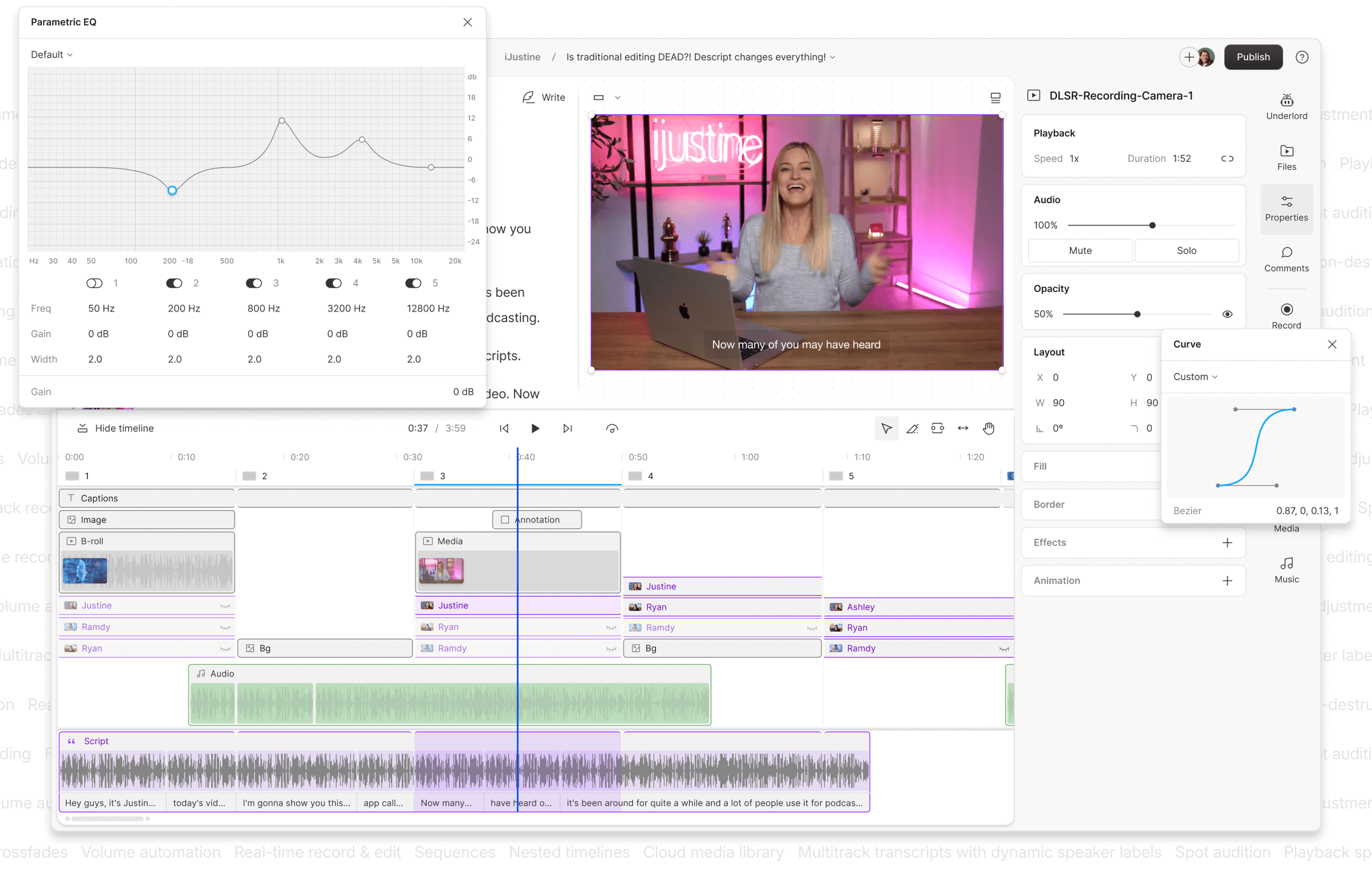
Best For: Professional Creators & Businesses Needing Compliance
- Core Strength: Industry-leading transcription, text-based video editing, Studio Sound AI audio cleanup.
- Pricing: Professional tiers starting at $24/mo.
- Security: ✅ SOC 2 compliant — enterprise-grade.
✅ Strengths
- Industry-best transcription accuracy
- Revolutionary text-based editing
- Studio Sound for audio cleanup
- Enterprise-grade stability
- Full SOC 2 compliance
⚠️ Considerations
- Steeper learning curve for video newcomers
- Not built for high-volume “first draft” mode
- Slower than speed-focused tools
- Higher pricing on advanced tiers
When Should You Consider a Tool Like “Makereels”?
After a thorough analysis, I can only recommend a tool with this profile under a very specific set of circumstances. You should consider this type of tool only if:
- You are a high-volume marketing agency where the primary metric is raw content velocity—the sheer number of “first draft” videos you can generate per hour. This aligns with analysis from industry newsletters which have noted the tool’s ROI is only viable for agencies with dedicated human polish workflows.
- You have a dedicated human editor on staff and have already factored their salary into the TCO.
- The content you are creating is low-stakes and does not involve sensitive client information.
When Should You Choose a Competitor?
For nearly every other use case, a real-world competitor is a better and safer choice. Based on my experience in this Makereels review:
- Consider InVideo AI if your priority is executing a strong content strategy with creative control and high-quality output. Its templates are far superior, and its editor provides the flexibility needed to create brand-aligned videos. It is a strong choice for small businesses and creators.
- Consider Pictory AI if you want a platform that is stable and reliable. When comparing Makereels vs Pictory, choose Pictory if your main concern is platform stability and reliability, as it has a much better reputation for simply working as expected.
- Avoid other tools and choose Descript if you are a professional creator, podcaster, or business that needs a powerful, all-in-one tool. Descript’s text-based video editor, industry-leading transcription, AI-powered audio cleanup (Studio Sound), and SOC 2 compliance make it the undisputed choice for any serious, professional-grade workflow.
Part 7: Final Verdict & Recommendations
Our “Makereels” case study represents a class of AI tools built for a single purpose: speed. They can successfully create a high volume of video drafts faster than many competitors.
However, this speed often comes at a steep price—not just in dollars, but in quality, security, and reliability. The AI output is generic, the business practices can be concerning, and the lack of security compliance is a critical failure for professional use.
This makes any tool fitting this profile a high-risk option suitable only for a very narrow segment of the market. Before you commit, always check whether an exclusive offer for Makereels can soften that risk.
What We Love
- Blazing Fast for Volume Repurposing: For agencies that need to turn one long video into 20 drafts in minutes, the processing speed is genuinely impressive.
- Simple, Intuitive UI for Starting Projects: The initial user experience is clean. Uploading a video and starting the AI generation process is incredibly easy.
- Brand Kits are Effective and Easy to Use: The feature for managing client logos, fonts, and colors is generally well-designed and a clear benefit for agency workflows.
Things to Consider
- 💡 The TCO is Over Double the Sticker Price: The advertised price is often misleading. The mandatory cost of human editing makes the tool more than twice as expensive as it appears.
- 💡 Generic AI Output Requires Full Manual Review: AI-generated clips are rarely usable “out of the box” and require a full manual review to fix irrelevant B-roll and awkward pacing.
- 💡 Concerning Billing Practices Require User Vigilance: A significant number of users across the SaaS industry report aggressive billing, requiring proactive steps (like using a virtual card) to mitigate risk.
- 💡 Critical Lack of Security Certifications: The absence of SOC 2 or ISO 27001 certification is a major consideration for any business handling client data.
- 💡 High Vendor Lock-In with No Project Exports: Many tools do not allow you to export your project files. If you cancel your subscription, you lose all your work.
- 💡 Ineffective Customer Support: Widespread reports of slow and unhelpful support mean you should assume you are on your own if you encounter any problems.
The Bottom Line: Who Should (and Shouldn’t) Buy These Tools?
My recommendations in this Makereels review are clear and segmented based on my professional evaluation of the risks and rewards.
- Recommendation for Agencies: A tool like “Makereels” is a potential high-risk, high-reward tool. It can be a strategic asset IF you are purely focused on volume, you calculate the true TCO, and you have a bulletproof human-in-the-loop workflow. Proceed with caution.
- Recommendation for Solopreneurs & SMBs: AVOID. The risks and costs are likely to harm your brand and budget. The generic output can damage your brand’s reputation, and the unexpected costs can be devastating for a small budget. Your time and money are far better invested in a reputable tool like InVideo AI or Descript.
- Recommendation for Security-Conscious Organizations: AVOID. The lack of SOC 2 compliance is a non-negotiable issue. Do not use any uncertified tool for corporate or enterprise workflows.
Frequently Asked Questions
Q1: How can you tell if an AI tool has scam-like practices?
A: While a tool providing a functional service isn’t an outright scam, certain business practices should be considered red flags. These include making it extremely difficult to cancel a subscription, auto-billing for an expensive annual plan after a short trial with no reminder, and using marketing claims that are fundamentally disconnected from the product’s actual capabilities FTC Guidelines on Deceptive Marketing. The most common user complaint that signals this is feeling “trapped” in a subscription. A key part of my Makereels review process is to check for these patterns. For the best experience, purchase through trusted channels and use a virtual credit card for trials.
Q2: How much do AI video tools really cost in 2026?
A: A pro-tier plan is often advertised around $99/month, but the true Total Cost of Ownership (TCO) can be over $180/month. This is due to the mandatory hidden cost of human labor. My TCO model estimates a conservative $100/month in freelance editor time is needed to fix a typical AI’s generic output and make it suitable for a professional brand. This labor cost is rarely mentioned on pricing pages but is a critical part of a realistic budget Calculating SaaS TCO. Therefore, you should budget for roughly double the advertised subscription fee.
Q3: Should I use a fast AI tool or a better competitor like InVideo?
A: It depends entirely on your priorities. For this conceptual Makereels review, I advise you to use a speed-focused tool only if raw, unpolished volume is your one and only need. For a much better balance of quality, creative control, and value, InVideo AI is a superior choice, as its advanced editor and templates allow for higher-quality output directly from the platform Comparing AI Video Generators. For a platform known for stability, Pictory is a safer alternative.
Q4: Who are AI video repurposing tools best for?
A: Based on my experience, tools that prioritize speed over quality are best for a very specific user: a social media manager within a high-volume marketing agency who has access to a human editor. These agencies must view the tool’s output as raw material and have the budget and workflow to polish every single video before it goes live. For solo creators or small businesses where quality is paramount, these tools often create more work than they save The Agency Stack Report.
Q5: What are the main problems with low-quality AI video tools?
A: The main problems, based on my analysis and widespread user reports, are: the true cost being double the advertised price due to mandatory human editing; the generic and repetitive AI output that requires manual fixing; the lack of standard security certifications like SOC 2; and a pattern of aggressive billing practices and poor customer support Common SaaS User Complaints. These factors combined can make the tool a net negative for a business’s productivity and budget.
Q6: Can I trust a new AI tool with my business content?
A: You should not trust a new or uncertified AI tool with sensitive, confidential, or pre-release content. The platform’s lack of any public-facing security certifications like SOC 2 or ISO 27001 represents a significant risk to data security and client confidentiality Importance of SOC 2 for SaaS. For any professional or corporate workflow, using a tool that has completed a third-party security audit, like Descript, is the standard best practice.
Q7: How do I get started with any AI tool trial safely?
A: To get started safely with any SaaS trial, my strong recommendation is to use a virtual or single-use credit card. This is a standard best practice I recommend for any trial that requires a credit card, as it prevents unwanted charges if you forget to cancel Guide to Virtual Credit Cards. You must also set a calendar reminder to cancel at least 48 hours before the trial ends. This simple two-step process mitigates almost all of the financial risk associated with testing new software.
Q8: Does a tool like “Makereels” allow you to export project files?
A: Many tools in this category do not allow you to export your project files, which is a major form of vendor lock-in. This means that if you decide to cancel your subscription, you lose access to all the work and projects you’ve created, as you cannot take them with you to another platform Understanding Vendor Lock-In. This is a critical factor to consider before building your workflow around any single cloud-based tool, and it’s a key part of my Makereels review process to check for this. If you’re hunting for savings on any of these tools, check the best price for Makereels via coupon before checkout.