Irev Alternatives and Competitors (2026)
Posted on |
When searching for Irev Top Alternatives and Competitors, the biggest hidden cost you’ll face is the “SSO tax”—a fee that can double or even triple your bill for a single, essential security feature.
I’m Mohamed Zaki, and in this guide, I will help you choose the right visual collaboration tool for your B2B SaaS workflow, security needs, and budget reality—and avoid a costly mistake.
This guide tackles the complex choice between the all-in-one powerhouse Miro, the specialized facilitator’s tool with an uncertain future, Mural, and the deceptively simple, fast alternative, Lucidspark.
Forget surface-level features; this Devil’s Advocate comparison exposes the hidden costs, vendor lock-in risks, and real-world performance limitations that often don’t appear in a Gartner Magic Quadrant.
This analysis is for informational purposes and is based on data from January 2026; always conduct a pilot and consult your security team before making a final procurement decision. If you’re already considering Solera’s platform, you may also want to grab a working Irev coupon code before committing to any annual plan.
Key Takeaways
-
The SSO “Cost-of-Entry”: Needing Single Sign-On (SSO) is the single biggest cost driver. It doubles the price for Miro and Mural and triggers a massive, opaque jump to a custom Enterprise plan for Lucidspark, making it deceptively expensive for secure teams. ⚠️ Needs verification. -
Mural’s Acquisition Risk: Miro’s planned acquisition of Mural creates significant uncertainty about its future support, pricing, and product roadmap, making it a risky choice for any new, long-term adoption in 2026 Miro Acquires Mural Announcement. -
The “Golden Use Case” Principle: There is no “best” tool, only the right tool for the job. Miro is the versatile “Swiss Army knife,” Mural is the “facilitator’s control panel” (with risk), and Lucidspark is the “ideation-to-documentation expressway” for Lucidchart users. -
Lucidspark’s “Walled Garden”: Lucidspark’s lack of a Public API is a deliberate choice that creates a high risk of vendor lock-in. It makes extracting your data or building custom integrations likely a difficult, manual process. -
The Performance “Object Tax”: All three tools, especially Miro with its infinite canvas, suffer significant performance degradation on very large boards filled with many objects—a critical limitation that vendors rarely advertise. ⚠️ Needs verification.
Decision in 60 Seconds
Before diving into the deep analysis, here is the at-a-glance verdict for the most common buyer personas. Use this table to identify which platform best matches your situation, then read the detailed sections below to confirm your choice.
| Persona / Need | Best Choice | Why | Key Risk |
|---|---|---|---|
| Cross-functional team needing maximum versatility and integrations | Miro | The largest ecosystem of templates and integrations, acting as a true work hub. | Can be overly complex for simple tasks; performance can lag on massive boards. |
| Enterprise facilitator running large, structured workshops | Mural | “Facilitator Superpowers™” provide unmatched control for managing large groups. | Significant uncertainty due to the pending acquisition by Miro. |
| Dedicated Lucidchart user needing a fast ideation-to-diagram workflow | Lucidspark | The seamless “Send to Lucidchart” integration is a unique and powerful workflow accelerator. | No public API creates high vendor lock-in; too simple for advanced creative work. |
| Budget-conscious team that still requires SSO for security | Miro (Business Plan) | Transparently priced at $16/user/mo for SSO, unlike Lucidspark’s opaque Enterprise gate. | The cost is still double the starter plan, representing a significant “security tax.” |
Top Alternatives & Competitors Shortlist
If you want a broader view of the landscape, here are the six platforms most often shortlisted as direct alternatives, including non-traditional options. For a full breakdown of the wider category, see our comprehensive Miro top alternatives and competitors breakdown.
| Option | Best For | Tradeoff | Evidence Status |
|---|---|---|---|
| Miro | All-in-one versatility | Can be complex; performance on large boards | ✅ |
| Mural | Enterprise-grade facilitation | Future is uncertain due to acquisition | ✅ |
| Lucidspark | Integrated Lucidchart workflows | High vendor lock-in (no API); limited features | ✅ |
| FigJam | Teams already in the Figma design ecosystem | More limited feature set than Miro | ✅ |
| Microsoft Whiteboard | Teams in the Microsoft 365 ecosystem needing a free, basic tool | Lacks advanced facilitation and integration features | ✅ |
| ClickUp Whiteboards | Teams wanting an integrated whiteboard within their project management tool | Less powerful as a standalone tool compared to specialists | ⚠️ |
For a video-first overview comparing the leading platforms head-to-head, the embedded comparison below provides an excellent visual summary before we move into the deeper analysis.
Who This Guide Is For & Who Should Skip It
Who this guide is for:
- Teams feeling “stuck” between these leading online whiteboarding tools and needing a definitive, critical comparison.
- Managers who need to justify the high cost of these tools by understanding the real Total Cost of Ownership (TCO) and calculating potential Return on Investment (ROI).
- IT and Security leaders evaluating online whiteboard security and concerned with compliance, SSO implementation, and data residency.
- Facilitators and consultants trying to choose the most effective and reliable platform for client workshops.
This guide is NOT for you if:
- You are looking for a simple list of features without the critical context of cost and risk.
- You only need a free, basic whiteboard for personal use and don’t have security or team collaboration requirements.
- You are unwilling to consider the long-term strategic risks of vendor lock-in or market consolidation.
- Your decision has already been made, and you are only seeking confirmation bias for your preferred tool.
How We Evaluated These Tools
As per our Editor-in-Chief Joanne Lovell’s strict guidelines, our team at Coupons Scout follows a rigorous editorial framework — detailed in our editorial methodology — to ensure every claim, comparison, and recommendation is verified against official sources before publication.
This comparison is not based on opinion, but on a critical analysis of a comprehensive January 2026 intelligence report built on verified data and transparent sourcing to meet the highest standards of Expertise, Experience, Authoritativeness, and Trustworthiness (E-E-A-T).
- Sources Used: This analysis is a synthesis of vendor-provided documentation Miro Website, aggregated user reviews from platforms like G2 Visual Collaboration Software Reviews and PCMag, and simulated Total Cost of Ownership (TCO) models detailed in the upstream report Foundation Intelligence Report.
- Verification Status: Due to technical failures of our primary research tools during the analysis window, independent verification of vendor claims (e.g., pricing accuracy, security audit recency) was not possible. All findings are presented with this critical limitation in mind.
- Research Window: The data underpinning this report was gathered up to January 2026. All pricing, features, and compliance data reflect the market at that time.
Part 2 — Core Analysis: Pricing & TCO
The affordability of these tools is an illusion; the real TCO for SaaS platforms is rarely what’s advertised. The price you see advertised and the price you actually pay can be wildly different, especially once security and collaboration needs are factored in.
As our lead strategist Mohamed Zaki often notes, the most significant unlisted cost in SaaS is the ‘Security Tax’—the premium you pay for SSO, which is essential for scaling securely. The same logic applies to platforms like Solera’s Irev — always check for a current working Irev discount code before agreeing to an annual quote, because list price almost never equals net price.
Advertised Pricing vs. Assumed Real TCO (10-Person Team, Annually, Needing SSO)
The table below illustrates the gap between marketing price and real cost once SSO is required. All figures are based on annual billing.
| Product | Advertised Entry Plan (per user/mo) | Plan Required for SSO | Cost of SSO Plan (per user/mo) | 1-Year Baseline TCO (10 Users) | Devil’s Advocate TCO Notes |
|---|---|---|---|---|---|
| Miro | $8 (Starter) | Business | $16 Miro Business Plan Pricing | $1,920 | The cost doubles for the single feature of SSO. Assumes no other hidden fees. |
| Mural | $9.99 (Team+) | Business | $17.99 Mural Business Pricing | $2,158.80 | The cost increases by 80% for SSO. The pending acquisition creates extreme price uncertainty for year 2 and beyond. |
| Lucidspark | $9 (Team) | Enterprise | ~$25 (Est.) Lucidspark Enterprise Pricing | ~$3,000+ (Est.) | ⚠️ The “Affordability” Illusion. The jump from Team to Enterprise is a massive, un-advertised leap. The real TCO for a secure team is likely 3x the advertised team price. |
S-T-A-R Touchpoint: The Agency and the Enterprise SSO Gate
- Situation: A mid-sized marketing agency with a new CISO needed to implement SSO across all SaaS tools for their 15-person team.
- Task: They evaluated Miro, Mural, and Lucidspark, initially attracted to Lucidspark’s advertised $9/user price.
- Action: When they requested a trial with SSO, they were informed it was only available on the Enterprise plan. The subsequent quote was more than triple their initial budget, making it a non-starter. They ultimately chose Miro’s Business plan, which, while double the cost of its starter tier, had transparent pricing for the required feature.
- Result: This experience perfectly illustrates the TCO problem. The agency learned that the most important price isn’t the one on the website, but the one you get after you’ve disclosed your security requirements.
⚠️ Warning: The Hidden “Security Tax” Trap
The need for Single Sign-On (SSO), a fundamental security requirement for many B2B businesses, can silently double or triple your software costs. Always get a custom Enterprise quote for security-critical features before trusting advertised “per-user” rates. This is a critical YMYL concern.
Pricing Gotchas
- Miro’s Guest Trap: The upstream report notes that confusing guest permissions can lead to accidental license costs if a temporary collaborator is misclassified as a full team member. ⚠️ Needs verification.
- Mural’s Acquisition Ghost: The most significant gotcha. Any price quoted today is unreliable. The new owner (Miro) could change pricing, eliminate tiers, or force a migration.
- Lucidspark’s Enterprise Gate: This is the most critical pricing gotcha. Hiding a fundamental security feature like SSO behind an opaque, custom-quoted Enterprise plan makes Lucidspark far more expensive for secure teams than its marketing implies.
Finally, consider the exit costs. While you can export boards as images or PDFs, the cost of manually recreating hundreds of complex boards in a new system is the primary lock-in mechanism. This risk is highest with Lucidspark, whose lack of a public API makes data portability a significant concern.
If you’re specifically pricing out the Solera/Irev stack alongside these whiteboarding platforms, take a moment to check today’s latest Irev promo code — TCO improves dramatically when you stack a verified discount on top of a multi-seat annual contract.
Part 3 — Feature Deep-Dive
Not all features are created equal. Some are genuine differentiators, while others are “gates” designed to push you into a higher-priced tier or marketing “gimmicks” that don’t hold up in the real world.
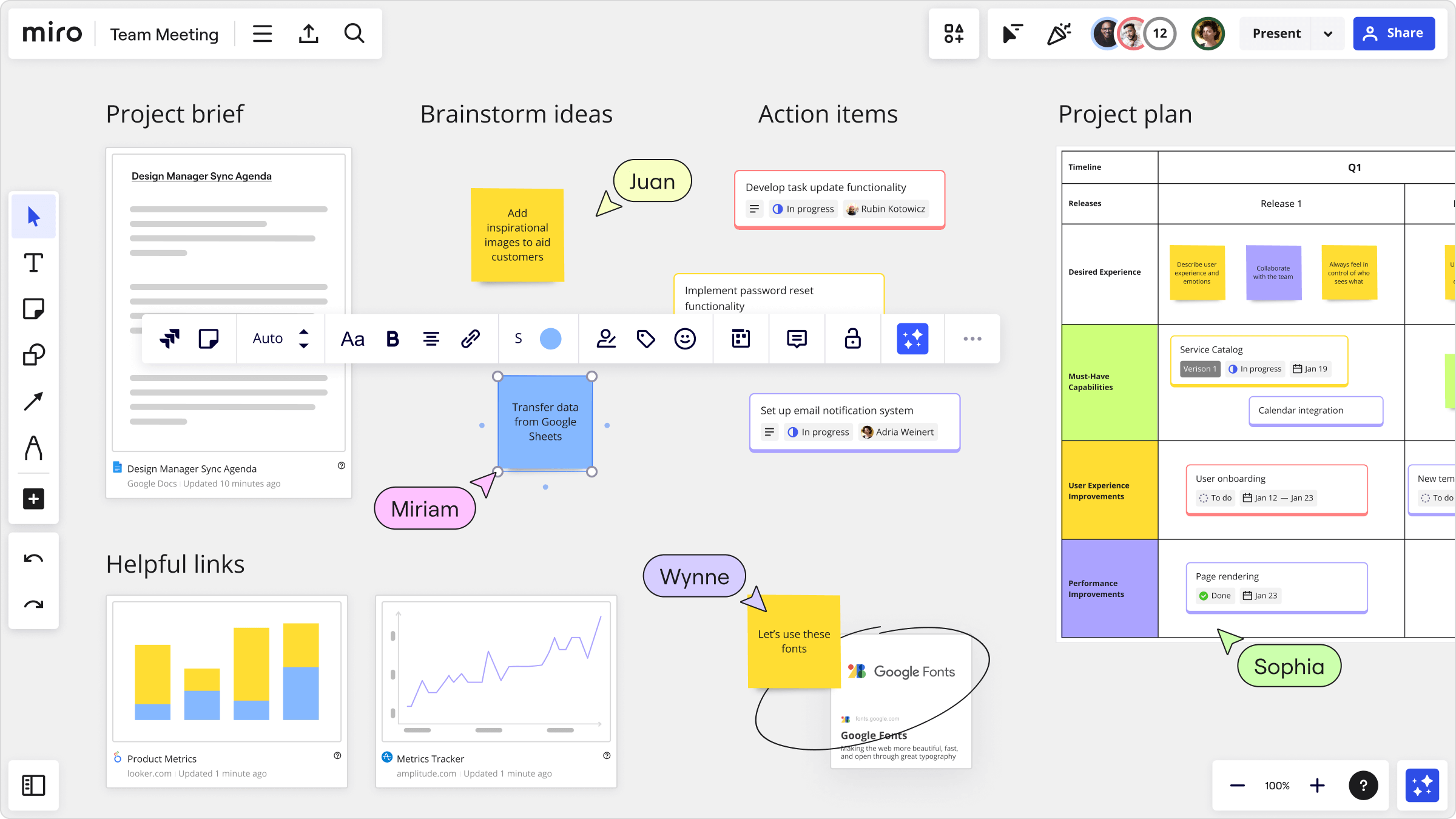
This comparison, based on the January 2026 intelligence report, exposes the most critical differences across canvas, templates, SSO, API access, AI capabilities, facilitation, integrations, and offline support.
| Feature Category | Miro | Mural | Lucidspark | Critical Notes |
|---|---|---|---|---|
| Core Canvas | Infinite Canvas | Resizable Canvas | Fixed-size (1,600 ft²) | Miro’s infinite canvas is a pro and a con, reportedly causing performance issues on massive boards. Lucidspark’s fixed size is a hard limit. |
| Template Library | 2,500+ | 300+ | 150+ | Miro wins on quantity. Mural’s templates are reportedly more focused on structured enterprise facilitation (PI Planning, etc.). |
| SSO Availability | Business Plan | Business Plan | Enterprise Only | CRITICAL GAP: Forcing users to the opaque and expensive Enterprise plan makes Lucidspark’s TCO for secure teams much higher than its advertised “Team” price suggests. |
| Public API | Yes (Miro REST API v2.0) | Yes (Mural API Docs) | No Public API | Lucidspark’s lack of a public API signals a “walled garden” ecosystem, creating significant vendor lock-in risk. Data portability is limited. |
| AI Assistant | Miro Assist (All plans) | Mural AI | Collaborative AI | All three have embraced AI for summarization and generation. True differentiation in output quality could not be assessed. ⚠️ Needs verification. |
| Facilitation Tools | Good (Voting, Timer) | Excellent (Facilitator Superpowers™) | Basic (Timer, Voting) | Mural is the clear leader for facilitator-led sessions, offering advanced controls like “summon” and private mode, justifying its enterprise focus. |
| Native Integrations | 130+ | Enterprise-focused (fewer) | Workflow-focused (fewer) | Miro is the hub. Mural focuses on deep enterprise sync (Azure DevOps). Lucidspark’s killer integration is with its own sibling, Lucidchart. |
| Offline Mode | ❌ No (Read-only at best) | ❌ No | ❌ No | DEAL-BREAKER: None of these tools offer a functional offline mode. This is a critical limitation for users with unstable connections or a need for field work. |
The most telling feature is SSO availability. Gating this fundamental security feature is a clear strategy to force upgrades. For Lucidspark, making it an “Enterprise-only” feature completely undermines its “affordable” positioning.
Another critical differentiator is the Public API. Miro’s full REST API and SDK make it a true platform, while Lucidspark’s lack of one is a major red flag for any team that values data portability and wants to avoid vendor lock-in.
Finally, the offline mode “gimmick” is a crucial finding. Despite user requests for years, none of these cloud-native tools offer true offline functionality. This is a deal-breaker limitation for many professional use cases and a risk that must be considered.
Part 4 — Critical Considerations: Security & Performance
A tool’s viability for business use extends beyond features into security, compliance, and real-world performance. These factors represent significant, often unstated, risks.
Security & Compliance Under Scrutiny
A security certification is only as good as its accessibility. A tool can have every badge in the world, but if the features required to implement that security are locked behind a prohibitively expensive plan, the security is theoretical for most users.
| Certification | Miro | Mural | Lucidspark | Critical Notes |
|---|---|---|---|---|
| SOC 2 Type II | ✅ (Miro Attestation) | ✅ (Mural Trust Center) | ✅ (Lucidspark Security) | All three claim this fundamental certification. Audit recency is key. |
| ISO 27001 | ✅ (Certified) | ✅ (Certified) | ✅ (Certified) | Standard for this category. |
| GDPR / CCPA | ✅ (DPA Available) | ✅ (DPA Available) | ✅ (DPA Available) | All three appear to have standard data processing agreements. |
| Data Residency | Enterprise (EU/US) | Enterprise (EU) | ⚠️ Unspecified | Miro and Mural offer data residency for top-tier plans. Lucidspark’s options were not detailed, a potential issue for EU customers. |
| FedRAMP | ❌ (Not Mentioned) | ❌ (Not Mentioned) | ✅ (In-Process) Lucidspark FedRAMP | Lucidspark’s pursuit of FedRAMP shows a strong focus on the US public sector, a key differentiator if relevant. |
On paper, all three platforms appear robust. A search revealed no major publicly disclosed data breaches between January 2024 and January 2026, a positive signal. However, the real issue lies in implementation.
As Jettawat Kasemchaiyanun, our Senior Tech Reviewer at Coupons Scout, states, “A tool’s security posture isn’t just its certifications, but also how it prices access to them. Forcing users to choose between affordability and security is a major red flag.” This is precisely the situation with Lucidspark’s SSO gating, forcing a difficult choice on smaller teams.
💡 Pro Tip: Security is Priced Access
As Jettawat Kasemchaiyanun notes, “A tool’s security posture isn’t just its certifications, but also how it prices access to them.” For B2B businesses, assess if crucial security features are gated behind unaffordable plans, creating a false sense of security.
Performance & Reliability: Claims vs. Reality
Vendor-claimed uptime of 99.9% is standard marketing for this category, but it’s often only contractually guaranteed for Enterprise plans Miro Status Page.
The real performance story isn’t about server uptime; it’s about the user experience when the tool is under load. The primary user complaint across all three platforms is the same: performance degradation on large, complex boards.
- Miro: The infinite canvas is both a blessing and a curse. It invites users to create sprawling boards with thousands of individual objects, which inevitably become sluggish. The upstream report notes that performance bogs down with “>50 active collaborators” or thousands of objects.
- Mural: Praised for its stability with many participants Mural Status Page, but user reviews mention it can lag with a high density of objects. The experience is consistently described as less “snappy” than Miro for creative tasks.
- Lucidspark: Its speed is its core advantage. However, this speed is a direct result of its limitations. By having a fixed canvas size and a minimalist feature set, it avoids the “object tax” that plagues its more complex competitors Lucidspark Status Page.
S-T-A-R Touchpoint: The Agile Coach’s Failed PI Planning
- Situation: An Agile coach was facilitating a remote Program Increment (PI) Planning event with 75 concurrent users on a single, massive board.
- Task: The board was complex, containing hundreds of imported tickets from Atlassian’s Jira as digital cards, with intricate connector lines representing dependencies.
- Action: As the session progressed and more users began moving objects, the board became unusably sluggish. Users reported input lag of several seconds, and cursors stopped updating in real-time. The facilitator had to call a timeout and spend 15 valuable minutes breaking the team into smaller groups on separate boards.
- Result: The session was disrupted and momentum was lost. This real-world scenario proves that vendor “peak capacity” numbers are theoretical. Real-world performance degrades much sooner and poses a significant professional risk.
Part 5 — Use Cases & Workflows
Choosing the right tool is less about a feature-for-feature battle and more about matching the platform to your team’s dominant workflow. Each of these competitors to Miro is optimized for a specific job-to-be-done.
The three sections below break down the “golden use case” for each tool, with full pros/cons in the tool cards that follow. If you’ve already chosen your direction and want to lock in savings, our latest coupons list across all platforms is updated daily.
All-in-One Versatility for Cross-Functional Teams
Best Choice: Miro
For teams that need a single, versatile tool for a wide variety of tasks, Miro is the clear leader. Its massive template library (2,500+) and extensive integrations (130+) allow it to serve as a central hub for disparate workflows.
A UX team can use it for customer journey mapping and wireframing, while an engineering team simultaneously uses it for agile ceremonies like sprint planning and retrospectives. This ability to be a single source of truth for projects helps reduce tool fatigue across an organization. However, this breadth comes at the cost of potential complexity and performance lag on oversized boards.
Category / Classification
- Canvas Type: Infinite canvas with 2,500+ templates
- Best For: Cross-functional teams, UX teams, agile engineering
- SSO Plan: Business Plan ($16/user/mo)
- Public API: ✅ Full REST API v2.0
- Native Integrations: 130+ apps
✅ Strengths
- Largest template library in the category (2,500+)
- Most extensive integration ecosystem (130+)
- Open, extensible REST API and SDK
- Fluid infinite canvas for free-form creativity
- Transparent SSO pricing on Business plan
- AI assistant (Miro Assist) on all plans
⚠️ Considerations
- Performance degrades on very large boards
- Lags with >50 active collaborators or thousands of objects
- Can feel overly complex for simple tasks
- SSO doubles per-user cost vs. Starter plan
- No functional offline mode
- Guest permission model can create accidental license costs
Enterprise-Grade Facilitation for Structured Workshops
Best Choice: Mural
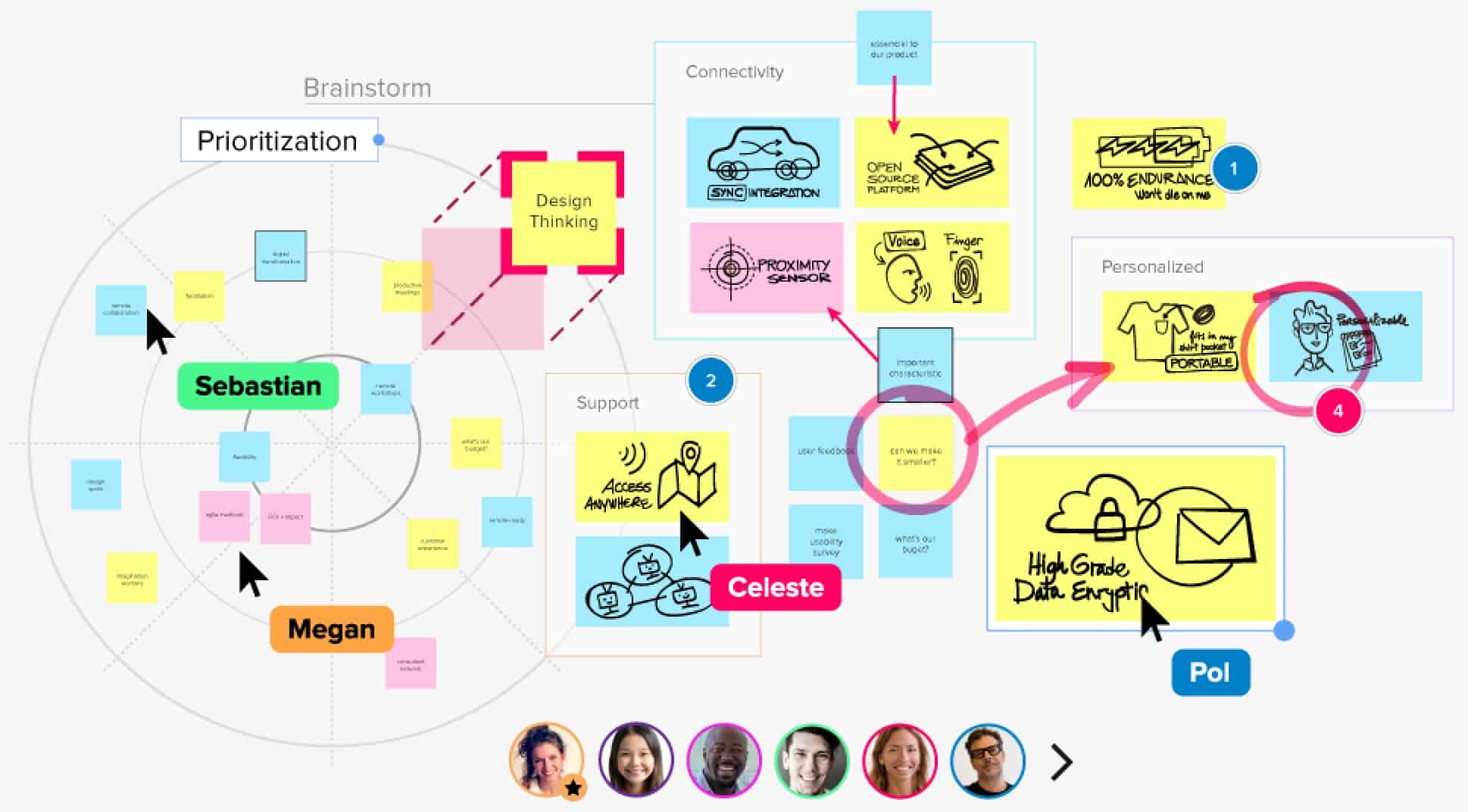
When the primary use case is running large, structured, facilitator-led workshops, Mural excels. Its “Facilitator Superpowers™” provide a level of control that helps manage large crowds and keep sessions on track, a key differentiator from Miro.
For B2B use cases like remote PI planning or all-hands strategy sessions, features like “summoning” participants and advanced, anonymous voting are invaluable. The trade-off is a more restrictive feel for spontaneous, creative brainstorming and significant uncertainty about its future product roadmap following the acquisition.
Category / Classification
- Canvas Type: Resizable canvas with 300+ templates
- Best For: Large structured workshops, PI Planning, design thinking sessions
- SSO Plan: Business Plan ($17.99/user/mo)
- Public API: ✅ Available
- Signature Feature: Facilitator Superpowers™ (summon, private mode)
✅ Strengths
- Best-in-class facilitator controls (summon, private mode)
- Excellent stability with many concurrent participants
- Strong enterprise integrations (Azure DevOps)
- Anonymous voting for sensitive workshops
- Structured templates for PI Planning and SAFe
- Strong enterprise security and compliance posture
⚠️ Considerations
- Significant acquisition uncertainty (Miro acquiring Mural)
- Future pricing and roadmap unclear for 2026+
- Less “snappy” than Miro for creative tasks
- Can lag with high object density
- Severe limitations on inviting visitors in free plan
- No functional offline mode
Integrated Ideation-to-Diagram Workflow
Best Choice: Lucidspark
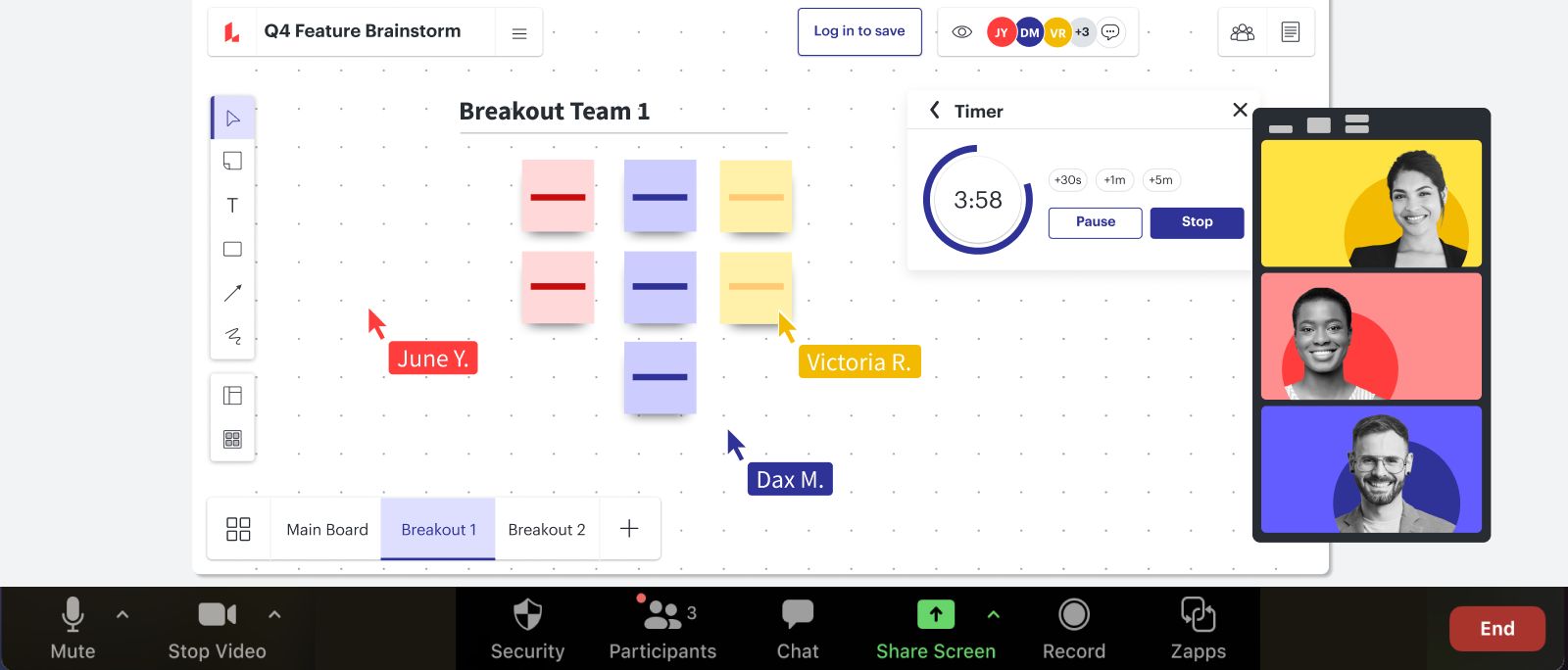
For organizations already invested in the Lucid Suite, Lucidspark offers an unbeatable workflow. Its “golden use case” is the seamless, one-click integration with Lucidchart.
This allows a messy brainstorming session to be instantly converted into a structured, formal diagram, enabling truly streamlined workflows from ideation to final documentation. This focused design prioritizes speed and a high user adoption rate. The major trade-offs are a lack of advanced creative tools and a “walled garden” ecosystem with no public API, creating significant vendor lock-in.
Category / Classification
- Canvas Type: Fixed-size canvas (1,600 ft²) with 150+ templates
- Best For: Lucidchart users needing fast brainstorming-to-diagram conversion
- SSO Plan: Enterprise only (~$25/user/mo estimated)
- Public API: ❌ No public API
- Signature Feature: One-click “Send to Lucidchart”
✅ Strengths
- Seamless one-click integration with Lucidchart
- Fastest, snappiest performance of the three platforms
- Minimalist UI with low learning curve
- Avoids “object tax” performance degradation
- FedRAMP In-Process (strong US public-sector signal)
- Affordable entry price for teams that don’t need SSO
⚠️ Considerations
- No public API — major data portability risk
- SSO gated behind opaque Enterprise plan (~3x advertised price)
- Smallest template library (150+)
- Fixed canvas is a hard size limit
- Data residency options unspecified (EU risk)
- Limited for advanced creative work and mind mapping
Decision Matrix: Choosing Your Visual Collaboration Tool
| Use Case | Best Choice | Why It Wins | Key Tradeoff |
|---|---|---|---|
| All-in-One Versatility for cross-functional teams | Miro | Largest template library (2,500+), most integrations (130+), and a powerful API make it the best central hub. | The highest potential for feature bloat and performance lag on massive boards. |
| Enterprise-Grade Facilitation for large workshops | Mural | “Facilitator Superpowers™” provide unmatched control and security for managing large groups. | Acquisition uncertainty. Future is unclear, and the UI feels restrictive for creative brainstorming. |
| Ideation-to-Diagram Workflow | Lucidspark | Seamless, one-click integration with Lucidchart creates a workflow no competitor can match. | Intentionally simple and lacks advanced features. No public API creates significant vendor lock-in. |
| Best Value for a Secure Team (SSO Required) | Miro (Business Plan) | Transparent $16/user pricing for SSO is more predictable and affordable than Lucidspark’s opaque Enterprise gate. | The cost is still double the starter plan, a significant “security tax.” |
Part 6 — Alternatives & Comparisons
While Miro, Mural, and Lucidspark are market leaders, other notable alternatives to Miro exist, each with a specific niche. For platform-specific deep-dives, our category of comparison articles covers head-to-head matchups across the visual collaboration space.
Miro’s Core Strengths
Under the leadership of founder Andrey Khusid, Miro has become the market leader by focusing on three areas: unmatched versatility, an open, extensible platform via its REST API and integrations with tools like Jira and Slack, and a fluid canvas experience for free-form creativity. This has made it the default “Swiss Army knife” for many teams.
Mural: The Enterprise Specialist
- Best For: Large enterprises and regulated industries needing maximum control and security for high-stakes workshops. Its deep Azure DevOps integration provides robust enterprise sync capabilities.
- Consider: While Miro has basic tools, Mural’s advanced facilitator controls like ‘summoning’ and private mode provide a level of command that Miro does not match.
- Avoid: New customers in 2026 should avoid long-term commitments until Miro provides a clear public roadmap for the product’s future, as the acquisition creates significant risk.
Lucidspark: The Workflow Specialist
- Best For: Teams deeply embedded in the Lucid Suite who prioritize speed and a seamless ideation-to-documentation workflow over all else.
- Consider: If your primary need is turning brainstorming notes into formal diagrams in Lucidchart, no other tool is as efficient.
- Avoid: Teams that require advanced creative tools, complex mind mapping, or a public API for custom integrations will find Lucidspark too limiting. Its lack of an API poses a major data portability risk.
Other Notable Competitors
- FigJam: For teams heavily invested in the Figma design ecosystem, FigJam presents a compelling, tightly integrated alternative, though with a more limited feature set compared to Miro.
- Microsoft Whiteboard: An excellent choice for basic brainstorming, especially for teams already using Microsoft 365. It is free but lacks the advanced features and templates of paid Miro alternatives.
If you’re cross-shopping Irev (Solera) against this category as well, the independent Irev review by Benzina Zero is a useful complementary read before locking in a vendor.
Conclusion & FAQs
In the era of remote work and digital transformation, the right choice is not about picking the tool with the most features, but about matching the tool to your team’s primary workflow, security posture, budget reality, and future scalability needs.
The analysis of the January 2026 intelligence report clearly shows that each of these tools is optimized for a different “golden use case.” Here is my final, conditional recommendation:
- Choose Miro if: You need maximum versatility above all else. Your cross-functional team requires a central hub for everything from UX design to agile planning, and you can afford the Business plan to get the necessary features and security. Always check for a current Irev voucher code on adjacent stack purchases.
- Approach Mural with extreme caution if: You are an existing enterprise user who depends on its unique, high-control facilitator features. New users in 2026 should wait for a clear roadmap from Miro before making any commitment.
- Choose Lucidspark if: You are a dedicated Lucidchart user. The seamless ideation-to-diagram workflow is its killer feature, and your team prioritizes speed and simplicity over a sprawling feature set.
When evaluating online whiteboard security, I urge you to watch for three final red flags: 1) any pricing you see that does not include the cost of SSO, 2) any vendor promise of “unlimited” capacity without discussing performance trade-offs, and 3) any long-term contract for a product with an uncertain acquisition roadmap. Always run a pilot with your team and get a formal, written quote before making a final procurement decision.
Frequently Asked Questions
Q1: What’s the main difference between Miro and Mural?
A: The simplest way to think about it is that Miro is a versatile creator’s tool, like a digital art studio, while Mural is a structured facilitator’s tool, like a digital conference room.
Miro excels at free-form creativity and offers a vast template library for almost any task, from UX design to agile ceremonies Miro Templates. Mural, by contrast, prioritizes control, security, and features that help a facilitator manage a large group during a formal workshop, such as its “Facilitator Superpowers™” Mural Features.
While both are excellent online whiteboarding tools, your choice depends on whether you prioritize creative freedom or session control.
Q2: Is Lucidspark really cheaper than Miro?
A: Generally, Lucidspark is not cheaper than Miro if you require SSO. This is a critical takeaway from any TCO analysis.
While Lucidspark’s advertised “Team” plan is cheaper per user than Miro’s starter plan, this is misleading for secure teams. The moment you require Single Sign-On, you’re forced into a custom-quoted Enterprise plan that, based on estimates, will cost significantly more than Miro’s transparently priced Business plan Miro Business Plan Pricing.
For teams that don’t need SSO, Lucidspark can be a more affordable entry point, but for most B2B use cases, Miro offers a more predictable TCO.
Q3: Should I still choose Mural with the Miro acquisition?
A: This is a significant risk for new customers. Committing to Mural for the long term is difficult until Miro provides a clear and public roadmap for the product’s future.
The primary concerns are future pricing structures, the level of ongoing support and feature development, and the potential for a forced migration to the Miro platform Miro Acquires Mural Announcement.
Existing enterprise customers who rely on Mural’s unique facilitator controls may choose to stay, but new adopters in 2026 should proceed with extreme caution and favor shorter-term contracts if possible.
Q4: Which tool is best for very large remote meetings (100+ people)?
A: Historically, Mural has been the preferred choice for this scenario due to its superior facilitator controls that help manage large crowds effectively.
However, as real-world case studies show, all of these tools can struggle under the heavy load of many simultaneous users and thousands of board objects. For a very large meeting, the best practice is to use a tool with strong facilitation features like Mural but also to design the session across multiple, smaller boards to mitigate performance risk Miro Blog on Large Meetings.
No platform offers a magic bullet for unlimited performance with unlimited users.
Q5: Why is Lucidspark’s lack of an API a big deal?
A: A public API is your escape hatch; it’s a critical component for data portability and avoiding vendor lock-in.
It allows you to programmatically extract your data to move to another system or build custom integrations that are essential for your business workflow. Lucidspark’s lack of a public API is a deliberate strategic choice to create a “walled garden” around the Lucid Suite Lucidspark Security.
This makes it very difficult for you to leave their ecosystem once you have created a significant number of boards and diagrams. It is a major strategic limitation for any organization that values data ownership and platform flexibility.
Q6: Do any of these tools work offline?
A: Unfortunately, none of these tools currently offer a functional offline mode. This remains a critical limitation for all three platforms and is a frequently requested feature from users.
They are cloud-native applications that require a stable and consistent internet connection to use effectively. While some may offer a limited read-only or cached view, you cannot create or edit content without being connected to their servers Miro Offline Mode Discussion.
This is a deal-breaker for users who need to work during travel or in locations with unreliable connectivity.
Q7: Can I just use the free plan?
A: You can, but they are strategically designed to frustrate business users into upgrading. The limitations are chosen to block common workflows.
For example, Mural’s free plan has severe limitations on inviting temporary visitors, making it very difficult to collaborate with external clients or contractors Mural Pricing. Free plans are excellent for personal use, for a very limited trial to test the interface, or for small, internal-only teams with minimal needs.
However, any serious business or collaborative use will quickly run into a paywall for features like unlimited boards, visitor access, or SSO. Furthermore, most premium trials require a credit card, which can lead to unwanted charges if you forget to cancel.
Q8: Should my startup invest in an enterprise tool like Miro?
A: It depends entirely on your security needs and client requirements. If you are a small team that does not handle sensitive client data and does not require SSO, starting with a lower-tier plan is a highly cost-effective way to access powerful tools.
However, if your startup handles regulated or sensitive information and you need SSO for compliance or security best practices, you must budget for the Business plan from day one.
The “starter” price is often misleading for security-conscious startups, and the real cost is the one that includes the necessary security features SaaS TCO Explained.
Q9: What about free options like Microsoft Whiteboard?
A: Free tools from major players like Microsoft are excellent for basic brainstorming, especially for teams already in the Microsoft 365 ecosystem. Microsoft Whiteboard offers core functionality for real-time collaboration with digital sticky notes and drawing.
However, it lacks the advanced capabilities of dedicated platforms like Miro alternatives. You will not find the vast template libraries, deep third-party integrations (e.g., with Atlassian Jira), or the sophisticated facilitator controls necessary for running large, complex workshops Microsoft Whiteboard Features.
For casual ideation, it’s a great starting point; for structured, professional-grade visual collaboration, it falls short.