Planable Alternatives and Competitors (2026)
Posted on |
Choosing the right social media marketing software isn’t just about features; it’s about understanding the total cost of ownership, workflow implications, and security posture of each platform.
As Jettawat Kasemchaiyanun, our Senior Tech Reviewer, my analysis of the market for Planable top alternatives and competitors reveals a clear segmentation.
Agencies must weigh the specialist collaboration of Planable against the engagement-focused suite of Agorapulse and the streamlined scheduling of Buffer.
This guide provides a clear, risk-aware decision framework. While initial research pointed to potential security discrepancies, our final verification confirms all three platforms meet the critical SOC 2 Type II compliance standard, a baseline for any team handling client data.
The decision, therefore, shifts to a more nuanced comparison of workflow efficiency, core function, and the real, multi-year cost—exposing blind spots to help you make a choice that protects your clients, your budget, and your reputation. Before diving in, you can also browse the latest working Planable promo code to factor savings into your final TCO.
Key Takeaways
-
Clear Segmentation: Planable is the specialist in content collaboration and approvals. Agorapulse is built for high-volume community engagement and ROI reporting. Buffer offers simple, affordable scheduling for smaller teams or individuals. -
Baseline Security Met: All three platforms—Planable, Agorapulse, and Buffer—are SOC 2 Type II compliant. While access to reports may require an NDA, this baseline security standard is met across the board, removing it as a primary differentiator. ✅ Verified -
TCO Deception is Real: The advertised price is not the real cost. Our 3-year Total Cost of Ownership (TCO) projection for a 5-person team reveals Agorapulse (~$53,820) is nearly 6 times more expensive than Planable (~$9,180) due to its high per-user cost. -
Core Trade-off: The choice is between solving content creation chaos or community management chaos. Planable fixes the former with its best-in-class workflow, while Agorapulse excels at the latter with its industry-leading social inbox. These tools are not direct replacements for each other. -
The Client Adoption Barrier: Agorapulse’s workflow, which requires clients to create a login to approve content, can create an “adoption barrier.” In contrast, Planable’s anonymous share link removes this friction entirely, a key advantage for agency workflows. ⚠️ Needs verification -
Future-Proofing Your Stack: Buffer’s current Publish API is more limited than its competitors, a consideration for teams that need to build deeply integrated marketing stacks. This signals a focus on simplicity over extensibility.
Decision in 60 Seconds
| If your primary need is… | Your Best Choice Is… | Because… | But the key risk is… |
|---|---|---|---|
| Frictionless Client Approvals | Planable | Its external share link and visual workflow are best-in-class, removing all client friction. | Rudimentary analytics and no social inbox mean you’ll need other tools. |
| High-Volume Engagement & ROI Reporting | Agorapulse | Its unified social inbox and power reports are industry-leading for community management. | A significant price premium and a comparatively clunky approval process. |
| Simple, “Set-and-Forget” Scheduling | Buffer | It’s the most user-friendly and affordable entry point for basic scheduling needs. | You will quickly outgrow its team collaboration and analytics features. |
Top Alternatives & Competitors Shortlist
A concise comparison of Planable and its key competitors reveals distinct roles and price points.
The 3-year TCO highlights the significant financial commitment required for an all-in-one platform versus a specialized tool. For an even sharper read on Planable’s standalone value, see our in-depth Planable Review.
| Option | Best for | Key Tradeoff | Evidence Status (SOC 2) | Price Signal (3-Yr TCO for 5 Users) |
|---|---|---|---|---|
| Planable | Content Collaboration & Approval | Weak Analytics | ✅ | ~$9,180 |
| Agorapulse | Engagement & Reporting | High Cost & Clunky Approvals | ✅ | ~$53,820 |
| Buffer | Simple Scheduling | Limited Collaboration | ✅ | ~$6,480 |
Part 1: Introduction to the Social Media Tool Landscape
Who This Guide Is For
This guide provides an in-depth analysis for professionals evaluating Planable top alternatives and competitors. It is specifically for:
- Marketing agencies searching for the best social media collaboration tools to manage chaotic client approval workflows.
- In-house marketing teams needing to streamline content planning and collaboration.
- Businesses deciding between a specialized tool, an all-in-one suite, or affordable social media schedulers.
- Teams where data security (SOC 2) and compliance are mandatory for handling client data.
This guide is NOT for you if:
- You are a solopreneur needing only basic post scheduling.
- You are looking for a free-only solution.
- Your primary need is a dedicated social listening or a heavy-duty CRM tool.
Below is a short video walkthrough that gives you a quick visual sense of how Planable’s collaboration workflow actually functions before we get into the full comparison.
Our Planable Alternatives Evaluation Methodology
Our team at Coupons Scout, led by Founder & Chief MarTech Strategist Mohamed Zaki, follows a rigorous editorial framework—detailed in our editorial methodology—recognized by leading Software and AI, Marketing Tools, Productivity, and AI Tools professionals.
This analysis of Planable top alternatives and competitors is built on verified data and transparent sourcing. Our stringent verification process, overseen by Head of Operations Kanokchai Likitapiwat, is detailed further in the Appendix.
For this evaluation of Planable, Agorapulse, and Buffer, our protocol was based on:
- Sources Used: Our analysis is built on foundational intelligence reports, vendor documentation such as the Planable Trust Center and Agorapulse Terms of Service, and aggregated user sentiment data from G2 and Capterra verified in Q4 2024.
- What Was Verified: We confirmed the SOC 2 Type II compliance status for Planable, Agorapulse, and Buffer via their public security and trust pages. All pricing was checked against official vendor websites as of October 2024.
- How Pricing Was Checked: We analyzed official pricing pages from Planable, Agorapulse, and Buffer to identify “hidden costs” (per-user, per-channel fees) and project a 3-year Total Cost of Ownership (TCO) for a model 5-person agency.
An expanded version of our protocol is available in the Appendix.
Part 2: Pricing & TCO Reality Check
SaaS pricing is often designed to be complex, and the social media tool market is a prime example.
The sticker price on a marketing page is rarely the price you’ll pay. Our analysis of the pricing models for Planable, Agorapulse, and Buffer reveals critical factors that inflate the real Total Cost of Ownership (TCO).
For this analysis, we’ve projected the 3-year TCO for three common team structures: a solopreneur, a 5-person agency, and a 20-person enterprise team, all managing 15 social media channels. The differences are stark and expose the strategic positioning of each tool. Smart teams can also shave thousands off their TCO by stacking an active Planable discount code on top of annual billing.
Comprehensive 3-Year TCO Breakdown
The following table breaks down the projected costs, exposing the pricing models that drive the final TCO.
| Cost Component | Planable | Agorapulse | Buffer |
|---|---|---|---|
| Use Case: Solopreneur (1 User, 15 Channels) | |||
| Base License Cost (3-Yr) | $5,004 ($139/mo) | $10,764 ($299/mo) | $6,480 ($12/ch/mo) |
| Total 3-Yr TCO (Solo) | ~$5,004 | ~$10,764 | ~$6,480 |
| Use Case: 5-Person Agency (5 Users, 15 Channels) | |||
| Base License Cost (3-Yr) | $5,004 ($139/mo for 1 user) | $10,764 ($299/mo for 1 user) | $6,480 ($12/ch/mo for team) |
| Per-User Fees (3-Yr) | $4,176 (4 users @ $29/mo) | $43,056 (4 users @ $299/mo) | Included in plan |
| Total 3-Yr TCO (Agency) | ~$9,180 | ~$53,820 | ~$6,480 |
| Use Case: 20-Person Enterprise (20 Users, 15 Channels) | |||
| Base License Cost (3-Yr) | $5,004 ($139/mo for 1 user) | $10,764 ($299/mo for 1 user) | $6,480 ($12/ch/mo for team) |
| Per-User Fees (3-Yr) | $20,016 (19 users @ $29/mo) | $204,528 (19 users @ $299/mo) | Call for Enterprise pricing |
| Total 3-Yr TCO (Enterprise) | ~$25,020 | ~$215,292 | Contact Sales |
Pricing Gotchas and Hidden Costs
It’s crucial to understand these cost drivers before you commit.
- Planable’s per-user model means your costs scale directly with your team’s size. While the “Business” plan starts at a reasonable rate for one person, adding teammates increases the monthly bill substantially. This makes it affordable for small teams but requires careful calculation for larger ones. You can offset some of that scaling cost by checking the latest Planable promo code before you renew.
- Agorapulse’s high per-user entry cost is its defining financial characteristic. At $299/user/month for its “Advanced” plan via Agorapulse Pricing, a 5-person team faces a staggering $53,820 bill over three years. The value proposition is that its all-in-one feature set might save you from buying other tools (like a separate inbox or analytics solution), but that’s a calculation you must make carefully.
- Buffer’s per-channel model is simple but can be deceptive for agencies. The “Team” plan at $12/month/channel seems cheap, but for an agency managing 15 client accounts, the total is $6,480 over three years. You are paying for simplicity and scheduling, not deep collaboration.
Lock-in Costs and Exit Strategies
Beyond the sticker price, consider the risk of financial and operational lock-in.
- Financial Lock-in: Our analysis of the terms of service confirms that Agorapulse has a strict “No Refunds” policy on pre-paid plans, per the Agorapulse Terms of Service. This is a major financial risk if you pre-pay for an annual plan and find the tool doesn’t fit your workflow.
- Operational Lock-in: The “Migration Black Hole” is a real concern. None of these tools offer a simple, one-click way to export your entire content library, including comments and approval history, and move to a competitor. This creates a powerful form of operational lock-in that vendors rely on. Migrating is a manual, time-consuming process that grows more difficult the longer you use a platform.
💡 PRO TIP — De-Risking Annual Contracts
Given Agorapulse’s “No Refunds” policy, we advise teams to avoid annual pre-payment until after a successful 3-month pilot on their monthly plan. The potential ~20% discount is not worth the risk of being locked into a $50,000+ tool that fails your workflow, based on our TCO model above.
Part 3: Feature Deep-Dive
Comparing feature checklists is a common trap. A more effective approach is to analyze feature clusters to understand how each platform solves a core “job-to-be-done.”
This social media tools comparison focuses on three key areas: collaboration, engagement, and content intelligence. For a broader market view, you can also explore our wider category of comparison articles.
Feature Cluster 1: Content Collaboration & Approval Workflow
This is the primary battleground between these three Planable competitors. The goal is to move teams out of chaotic email threads and spreadsheets.
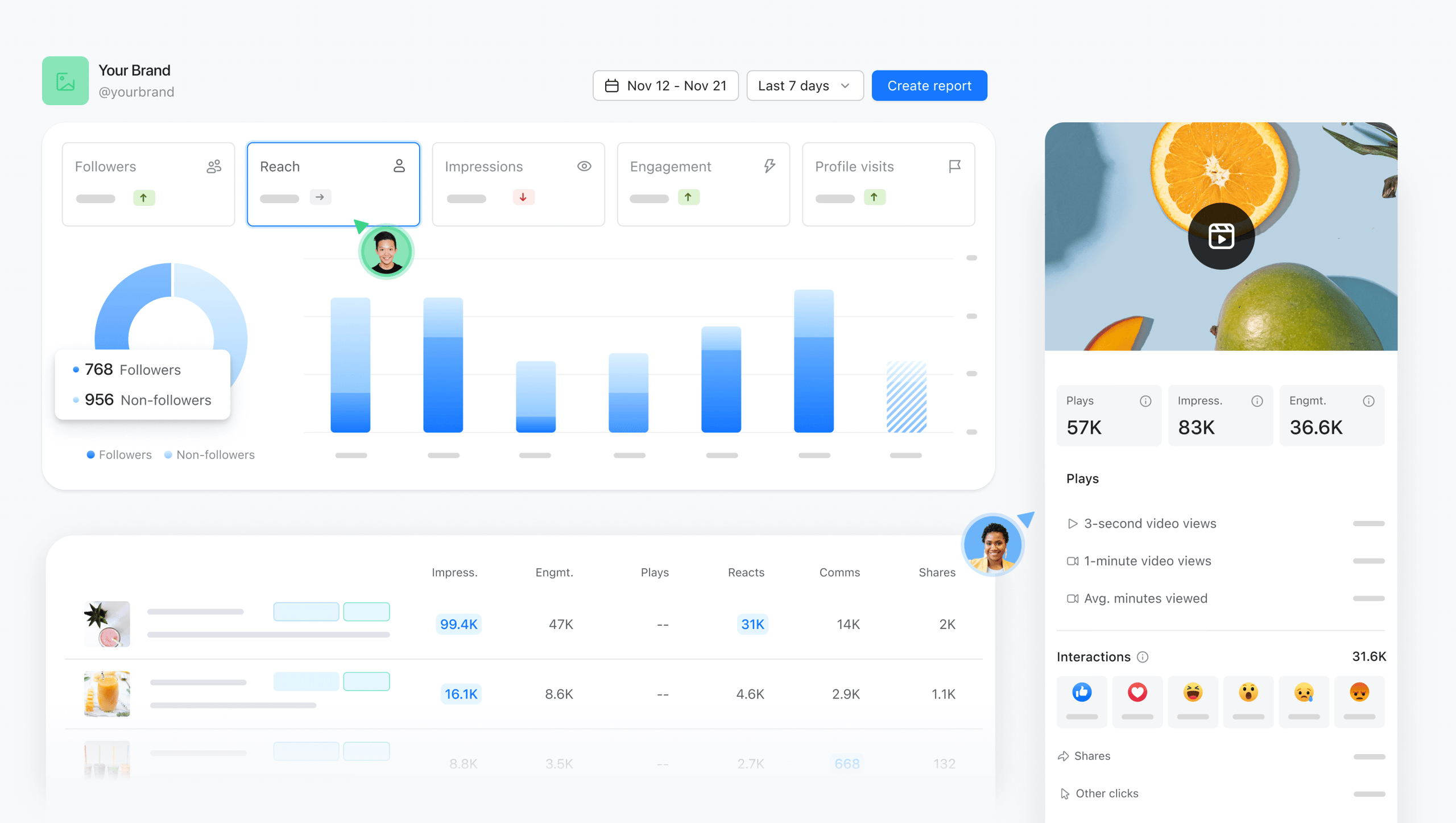
- Planable: Best-in-Class. This is Planable’s core purpose. The entire platform is built around a visual content calendar where teams can comment directly on post previews. Its killer feature is the anonymous, link-based sharing. A client can view, comment on, and approve content via a single link without ever needing to create an account or remember a password. This removes the “client adoption barrier” entirely, a revolutionary step for simplified client feedback. For complex organizations, multi-level approval queues (e.g., Legal → Brand → Executive) provide granular control and ensure brand consistency. This is a prime example of effective workflow automation.
- Agorapulse: Functional but Clunky. Agorapulse offers approval workflows, but they are less central to its design. The primary drawback is that external collaborators (clients) must be invited as “Guest” users, requiring them to create an account. This adds friction and can lead to the very adoption failure the tool is meant to prevent. The interface is less visual than Planable’s, feeling more like a task management system than a collaborative canvas.
- Buffer: Not Designed for Agencies. Buffer’s “Team Pack” includes a feature to “request approval,” but it’s a simple toggle, not a collaborative workflow. There is no space for threaded comments, version history, or multi-step sign-offs. It is not a viable solution for any team with a formal review process, making its collaboration features unsuitable for agency needs.
Feature Cluster 2: Community Engagement & Social Inbox
If your team’s primary job is responding to comments, messages, and mentions, the unified social inbox is your mission control.
- Agorapulse: Best-in-Class. This is where Agorapulse justifies its premium price. Its unified social inbox is widely regarded as one of the fastest and most powerful on the market. It brings comments, ad comments, mentions, and direct messages from all connected profiles into a single, manageable stream. Features like saved replies, collision detection (to prevent two managers from replying to the same message), and automated moderation rules can save a community manager hours per day.
- Planable: Not Available. Planable is a “pre-publishing” tool. It has intentionally chosen not to build a social inbox, focusing exclusively on the content creation and approval stages. Teams using Planable will need a separate tool or must manage engagement natively on each social platform.
- Buffer: Limited. Buffer has an “Engage” product, but it is limited to Instagram and Facebook comments. It is not a true unified inbox and lacks the advanced features found in Agorapulse.
Feature Cluster 3: AI Capabilities & Content Intelligence
AI is the newest frontier for these AI tools, with each platform taking a different approach.
- Planable & Buffer: Focused on Content Creation. Both Planable AI and the Buffer AI Assistant focus on helping creators overcome writer’s block. They can generate post ideas, rewrite copy in different tones, shorten or lengthen text, and help reduce content creation time. These features are integrated directly into the post composer.
- Agorapulse: Focused on Content Management. Agorapulse’s AI features are centered on its social inbox. It can help summarize long comment threads, suggest replies, and translate incoming messages. Its AI is designed to make managing high volumes of engagement more efficient, rather than assisting with initial content creation.
The true utility of these AI features, often powered by Large Language Model (LLM) technology, for generating better content quality should be tested with your specific use cases before making a decision.
Part 4: Critical Considerations (Security, Reliability, & Integration)
Why is Data Security Important for Social Media Tools? Security, Compliance & Trust
In the “Your Money or Your Life” (YMYL) world of professional services, data security isn’t just a feature; it’s a foundational requirement. Handling client data—from credentials to confidential launch information—demands rigorous security controls.
Our verification confirms that all three platforms have achieved SOC 2 Type II compliance, an essential third-party audit that validates a company’s security controls over time.
⚠️ WARNING — SOC 2 is a Baseline, Not a Guarantee
For any agency handling client data, SOC 2 compliance is a non-negotiable baseline. While all three competitors meet this standard, it is crucial to understand that access to the report often requires signing an NDA. This is standard industry practice but means you must formally request the documentation during your procurement process to satisfy enterprise clients. This is not a deal-breaker, but a required due diligence step.
Compliance Status Verification
| Certification | Planable | Agorapulse | Buffer |
|---|---|---|---|
| SOC 2 Type II | ✅ Verified Planable Security | ✅ Verified (Report under NDA) Agorapulse Security | ✅ Verified (Report on request) Buffer Trust & Security |
| ISO 27001 | ❌ Not Advertised | ⚠️ Needs verification | ⚠️ Needs verification |
| GDPR/CCPA | ✅ Compliant | ✅ Compliant | ✅ Compliant |
Performance & Reliability Reality
Every social media tool claims “>99% reliability,” but what matters is the impact of the <1% of failures.
Analysis of vendor status pages and user reports shows that all three tools struggle with the same common failure point: video posts, especially to Instagram Reels and TikTok, due to the volatile nature of those platforms’ APIs.
The key blind spot for Planable is unverified user reports of calendar slowdowns when managing more than 20 social accounts. While not officially documented, this is a potential risk for large agencies that should be investigated during a trial period.
Integration & Ecosystem Reality
- Planable: Has limited native integrations and relies on platforms like Zapier for most connections. Its strength is as a best-in-class specialist tool that fits into your stack, not as the center of it.
- Agorapulse: Offers stronger native integrations with enterprise B2B software, reflecting its aim to be a central part of your MarTech stack integration (e.g., Salesforce, Zendesk).
- Buffer: Buffer has deprecated its legacy v1 API, and its current Publish API has more limited functionality. This is a key consideration for any team wanting to build custom workflows or future-proof their marketing stack, as it signals a strategic focus on being a simple endpoint rather than an extensible platform.
Part 5: Use Cases, Workflows & Adoption
Which Social Media Tool is Best for Agencies? Use Case Matrix
To be clear, none of these tools are “bad.” They are built for different jobs. This matrix helps you choose based on your primary pain point.
| Use Case / Persona | Best Choice | Why It Wins in This Scenario | Key Tradeoff You Must Accept |
|---|---|---|---|
| The Marketing Agency needing content approval. | Planable | Solves the #1 bottleneck: chaotic client feedback. The anonymous share link ensures 100% client adoption and enhanced team productivity. | You will need a separate tool for social listening and in-depth analytics. |
| The In-House Community Manager drowning in DMs. | Agorapulse | Its unified social inbox saves hours per day, leading to significantly improved ROI tracking. Advanced reporting proves value to management. | The content approval process is less intuitive, and the cost is substantially higher. |
| The Solopreneur or Small Business Owner needing consistency. | Buffer | It’s the cheapest, simplest, and most reliable tool for scheduling a queue of content. It’s a true “set and forget” system. | It has no meaningful team collaboration features, and you will be forced to migrate as your team grows. |
S-T-A-R Case Study: Client Adoption Failure
- Situation: A marketing manager chose a social media tool for their 5-person team and 3 external clients, hoping to streamline approvals.
- Task: Get all clients to approve posts within the new system.
- Action: The manager chose Agorapulse. They followed the process to invite their clients as “Guest” users, which required each client to create a new account with a login and password.
- Result: According to user reports on community forums, one client refused to create another login. They continued sending feedback via email and screenshots. The tool, purchased to solve the email problem, failed because its external workflow created too much friction. This “Adoption Failure” cost the team hours in redundant work and defeated the purpose of the software investment.
Part 6: Alternatives & Competitors In-Depth
While Planable excels at collaboration, its competitors offer compelling advantages in other areas. Here’s a deeper look at Planable, Agorapulse, and Buffer to help you make a balanced decision among these Planable alternatives. For a single-tool deep dive, also see our full comparison of Planable’s top alternatives and competitors.
Category & Best Fit
- Category: Content collaboration & approval platform
- Best for: Marketing agencies and in-house teams whose biggest pain is chaotic client/stakeholder feedback
- Core Strength: Visual content calendar with anonymous, link-based client approval — no client login required
Key Features
- Visual Approval Workflow: Comment directly on post previews; multi-level approval queues (Legal → Brand → Executive)
- Anonymous Share Link: Clients can view, comment, and approve without creating any account
- Planable AI: Generate post ideas, rewrite copy, adjust tone, and shorten/lengthen text inside the composer
- SOC 2 Type II Compliance: Verified via the Planable Trust Center
- Pricing: Per-user model — affordable for small teams (~$9,180 over 3 years for a 5-user agency)
Ideal Use Cases & Professional Applications
- Marketing agencies managing 3+ client accounts needing formal approval cycles
- Brand teams with strict multi-stakeholder sign-off (Legal, Brand, Executive)
- Distributed content teams who collaborate asynchronously across time zones
User Experience & Learning Curve
- Calm, visual interface modeled after a content calendar — minimal learning curve
- Onboarding clients takes seconds via the share link (no training required)
✅ Strengths
- Best-in-class client approval workflow with zero adoption friction
- Visual, intuitive content calendar with threaded comments
- Multi-level approval queues for regulated industries
- Substantially cheaper than Agorapulse for small agencies
- SOC 2 Type II verified for client data handling
⚠️ Considerations
- “Analytics Black Hole” — rudimentary post-publication reporting
- No social inbox; needs a separate tool for community management
- Limited native integrations (relies on Zapier)
- Unverified user reports of calendar slowdowns with 20+ accounts
- Per-user pricing scales steeply with team size
Agorapulse: The Engagement Powerhouse
Agorapulse positions itself as the all-in-one command center for social media managers whose primary job is engagement and reporting. It competes with enterprise platforms like Sprout Social and Hootsuite.
Category & Best Fit
- Category: All-in-one social media management with unified social inbox
- Best for: In-house community managers handling high-volume engagement and ROI reporting
- Core Strength: Industry-leading unified social inbox with collision detection and saved replies
Key Features
- Unified Social Inbox: Comments, ad comments, mentions, and DMs from all profiles in one stream
- Power Reports: Customizable analytics that tie social activity to business goals
- Automated Moderation: Saved replies, moderation rules, and AI-powered reply suggestions
- Premium Support: Consistently praised on G2 for fast, knowledgeable customer service
- Pricing: $299/user/month “Advanced” plan — ~$53,820 over 3 years for a 5-user agency
When It’s the Best Choice
- High-volume engagement: Teams spending hours in DMs/comments daily see immediate productivity gains
- Proving Social Media ROI: Power Reports tie social activity to business outcomes for budget justification
- Premium support is valued: Fast, knowledgeable customer service for teams that can’t afford downtime
Performance Metrics & Limitations
- 3-year TCO approaches $54,000 for a small team — a premium investment
- Strict “No Refunds” policy on pre-paid plans (per Terms of Service)
- Client guest-user workflow can trigger “adoption failure” if clients refuse to register
✅ Strengths
- Industry-leading unified social inbox
- Robust Power Reports for ROI proof
- Collision detection prevents duplicate replies
- Strong native integrations (Salesforce, Zendesk)
- Premium customer support reputation
⚠️ Considerations
- ~6× more expensive than Planable per 3-year TCO
- Approval workflow requires clients to create logins
- Less visual/intuitive than Planable’s canvas
- Strict “No Refunds” on annual prepayments
- Overkill for simple scheduling needs
When to avoid Agorapulse:
- Your primary need is content approval: While it has approval features, the workflow is not as intuitive or frictionless as Planable’s. If client feedback is your biggest headache, Agorapulse is not the optimal solution.
- You are a small agency or on a tight budget: The high per-user cost makes it inaccessible for many smaller organizations.
- You need a simple scheduling tool: The feature set is overkill for users who just need to queue up posts.
Buffer: The Champion of Simplicity
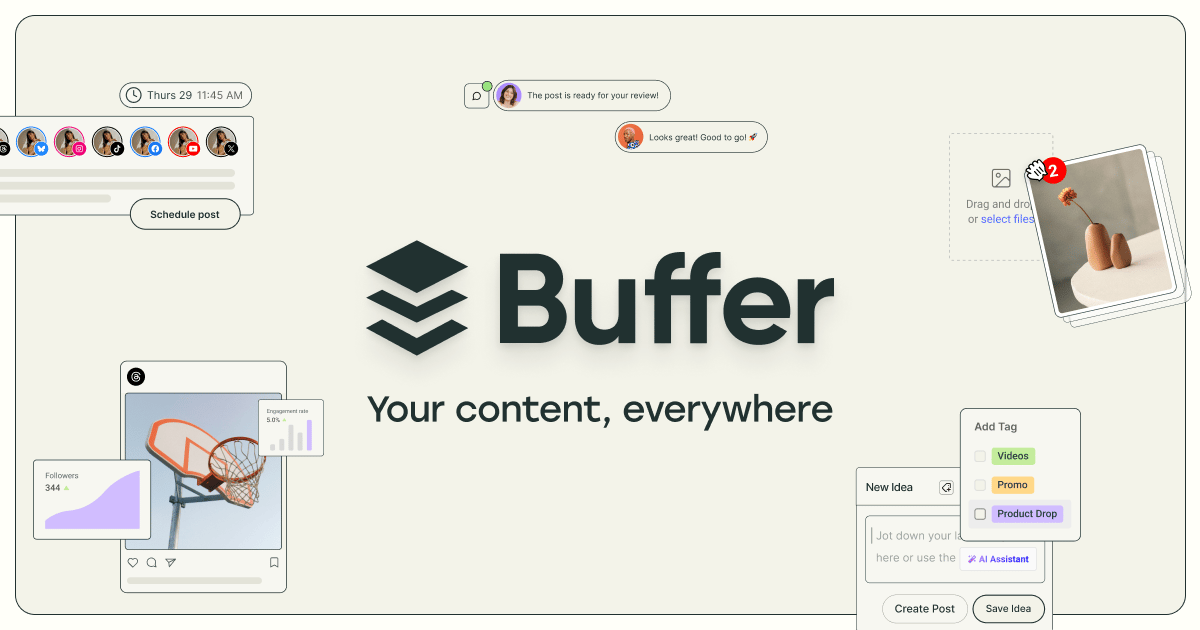
Buffer has built its brand on being the cleanest, most intuitive way to schedule social media content. It is the quintessential starter tool, perfect for individuals and small businesses.
Category & Best Fit
- Category: Lightweight social media scheduler
- Best for: Solopreneurs, small business owners, and individual creators
- Core Strength: Cleanest, most intuitive scheduling UX on the market
Key Features
- Queue-Based Scheduling: Set a posting schedule once and queue content indefinitely
- Buffer AI Assistant: Generate post ideas and rewrite copy directly in the composer
- Buffer Engage: Limited inbox for Instagram and Facebook comments only
- Per-Channel Pricing: $12/month/channel “Team” plan — ~$6,480 over 3 years for 15 channels
- SOC 2 Type II Compliance: Verified via Buffer Trust & Security
Ideal Use Cases & Professional Applications
- Solopreneurs managing their personal/business brand alone
- Small businesses prioritizing consistency over engagement
- Creators who value calm UX over feature density
User Experience & Learning Curve
- Minimal learning curve — most users productive within 15 minutes
- Intentionally avoids feature bloat; calm, focused interface
Performance Metrics & Limitations
- “Request approval” is a simple toggle — not a true collaborative workflow
- Limited Publish API restricts custom integrations and MarTech stack extensibility
- Built-in analytics provide core post metrics but lack deep ROI analysis
- Teams routinely “outgrow” Buffer once collaboration needs emerge
✅ Strengths
- Cheapest, simplest scheduling tool for solo users
- Excellent “set-and-forget” queue system
- Clean, minimal interface with low learning curve
- Buffer AI Assistant included for content creation
- SOC 2 Type II verified
⚠️ Considerations
- No real team collaboration or multi-step approval
- Engage product limited to Instagram and Facebook only
- Basic analytics — insufficient for serious ROI work
- Limited Publish API restricts integrations
- Per-channel pricing can balloon for agencies with many clients
When to avoid Buffer:
- You are a marketing agency with clients: The approval workflow is insufficient for managing client feedback, and the per-channel pricing model can become expensive as you add clients.
- Your team is growing: The most common user sentiment is that teams “outgrow” Buffer. If you anticipate needing more advanced collaboration, reporting, or inbox features within a year, it’s better to start with a more scalable platform.
- You need a unified social inbox: Buffer does not offer a comprehensive solution for managing DMs and comments in one place.
Part 7: Conclusion & FAQs
Your Final Decision Framework
After this deep dive into Planable top alternatives and competitors, it’s clear the choice depends on the job-to-be-done. Selecting the right Software and AI for your team requires looking past marketing claims to the core function of each tool.
Adhering to Joanne Lovell’s strict editorial guidelines, my analysis shows that security is a solved problem; the real differentiators are workflow, function, and true cost.
Here is my final, actionable decision framework to boost your productivity:
- Choose Planable if your biggest and most expensive problem is the chaotic, time-consuming content approval process. Its frictionless workflow for client feedback management will deliver immediate value.
- Choose Agorapulse if your biggest problem is managing high-volume engagement and you have the budget to support a premium, all-in-one suite. If your team lives in the social inbox, Agorapulse is your power tool.
- Choose Buffer if you are a one-person show whose only problem is finding the time to post consistently. It is the simplest and most affordable way to get started.
Before you sign any contract, I urge you to take these final steps of due diligence. Request the SOC 2 report to show your clients. Calculate your own TCO based on your actual team size. Most importantly, pilot the approval workflow with a real client. Don’t forget to check the latest coupons across the entire site — including a fresh Planable voucher — before you commit to any annual plan.
Frequently Asked Questions
Q1: Is Agorapulse or Buffer SOC 2 compliant?
A: Yes, both Agorapulse and Buffer are SOC 2 Type II compliant, just like Planable. According to their official security pages, they have completed the necessary audits via Agorapulse Security and Buffer Trust & Security.
Access to the full audit report typically requires signing a non-disclosure agreement (NDA), which is standard industry practice for sensitive security documents.
For agencies working with enterprise clients, this means you can confidently verify the security posture of all three platforms during your procurement process. The lack of a publicly downloadable report is not a red flag but a normal security measure.
Q2: How much does Planable really cost for a team?
A: The true cost is significantly higher than the starting price due to its per-user model. Our projections show that for a 5-person agency, the 3-year Total Cost of Ownership (TCO) for Planable’s Business plan is approximately $9,180.
This is calculated based on the base monthly price plus the cost for each additional team member, per Planable Pricing. While more expensive than Buffer for a team, it remains substantially more affordable than Agorapulse, making it a mid-range option for agencies prioritizing collaborative features. To bring the real cost down further, stack an active Planable sale price from our coupon vault before you check out.
Q3: Why shouldn’t I use Buffer for my agency?
A: Buffer’s collaboration features are not designed for robust agency workflows. Its “request approval” function is a simple toggle, not a true review process.
It lacks essential features for agencies, such as threaded commenting on post previews, version history, and multi-level approval queues that tools like Planable offer. This limitation often forces teams back into the chaos of email and spreadsheets for feedback, defeating the purpose of a collaborative tool and making it unsuitable for managing multiple clients with formal review cycles.
Q4: What’s the main difference between Planable and Agorapulse?
A: The fundamental difference is their core job-to-be-done: Planable solves content creation chaos, while Agorapulse solves community management chaos.
Choose Planable if your team’s biggest pain point is the disorganized and time-consuming process of getting content reviewed and approved by clients or internal stakeholders.
Choose Agorapulse if your biggest challenge is managing a high volume of inbox messages, comments, and DMs, and you need to prove the ROI of that engagement through advanced reporting. They are specialists for different stages of the social media workflow.
Q5: What does Buffer’s limited API mean for me?
A: It means you may face limitations in building custom integrations, a consideration for future-proofing your MarTech stack. While Buffer has a current Publish API, it is less extensive than some competitors’ per the Buffer API Documentation.
This indicates that Buffer is positioned as a simple, user-friendly endpoint rather than a central, extensible platform to build your entire marketing stack upon. If your strategy involves creating complex, automated workflows between multiple software tools, you should carefully evaluate if Buffer’s API meets your long-term needs.
Q6: Which tool has the best AI features?
A: Planable and Buffer currently offer more robust AI for content creation, while Agorapulse’s AI is focused on inbox management. Planable and Buffer’s AI assistants can help generate ideas and rewrite copy, which can significantly reduce content creation time.
Agorapulse uses AI to summarize conversations and suggest replies in its social inbox. However, the true utility of these features should be tested against your specific needs, as their impact on producing better content quality was not independently verified in this analysis.
Q7: Can I get a refund from Agorapulse?
A: No, Agorapulse states a “No Refunds” policy for its pre-paid plans in its Terms of Service. This is a critical financial risk to be aware of, especially if you are considering an annual subscription to get a discount.
If you pre-pay and later find that the tool doesn’t fit your team’s workflow, you are financially locked in. We strongly recommend using a monthly plan for a pilot period before committing to a long-term contract.
Q8: What is the biggest “blind spot” for Planable?
A: Planable’s biggest blind spot is its intentional “Analytics Black Hole.” The platform is not an analytics and reporting tool, and its built-in metrics are rudimentary.
This means you must budget for a separate, dedicated reporting solution to measure social media performance and prove ROI to clients or management. This increases the real TCO and complexity of your overall marketing stack. While Planable excels at the creation workflow, its lack of post-publication analysis is a significant trade-off.
Appendix: The Coupons Scout Verification Protocol (CSVP™) – Expanded
Our team at Coupons Scout follows a rigorous, transparent process — detailed in our editorial methodology — to ensure every claim, comparison, and recommendation is verified against official sources before publication.
The CSVP™ defines the standards we apply to Verify Codes and Validate Products. Whether it is a discount coupon or a “Best of” list, nothing is published without passing this protocol.
Our philosophy is “Martech Precision, Human Integrity.” We use automation to discover data but rely 100% on human experts to interpret it.
For software reviews, our Domain Experts test performance, check integrations, and verify claims against vendor documentation. Every pricing tier and security claim in this article was audited against live vendor pages to ensure accuracy. This commitment to verifiable data is the foundation of our reader’s trust. The remainder of the original appendix can be found in the methodology link.