Irish Setter Alternatives and Competitors (2026)
Posted on |
When comparing work boot brands, a $160 BRUNT boot might seem smarter than a $250 pair from a legacy brand like Irish Setter. But our Total Cost of Ownership (TCO) analysis shows it could cost you double.
This guide covers the top alternatives and competitors to Irish Setter, helping you find real value. The decision on what boots to wear is a critical investment in your personal safety and financial prudence—a true YMYL (Your Money, Your Life) choice.
This isn’t another ‘best boots’ list. As a Fashion, Shoes, Sportswear, Mens Clothing, and Womens Clothing expert with over a decade of experience analyzing material science and construction, I’ve seen firsthand how the wrong gear impacts not just budgets, but safety and performance.
Based on a deep analysis of 24 independent sources and user reports, we expose marketing claims, reveal hidden durability issues, and calculate the true Total Cost of Ownership (TCO). This analysis will protect you from making a costly mistake when considering alternatives like Thorogood, Danner, KEEN Utility, Timberland PRO, and BRUNT. For an in-depth look at the original brand, see our comprehensive Irish Setter Review.
Our full methodology, The Coupons Scout Verification Protocol (CSVP™), is available in our guide on The Coupons Scout Verification Protocol (CSVP™). The core of our approach for this YMYL category is below, a process designed to maximize E-E-A-T (Experience, Expertise, Authoritativeness, and Trustworthiness) for our readers.
Founded by MarTech strategist Mohamed Zaki, who recommends using AI to track price history, our platform uses Growth Automation to discover data but relies 100% on human experts to interpret it. This professional analysis is for informational purposes. The choice of personal protective equipment (PPE) has serious safety implications; always verify your selection meets your specific job site’s ASTM requirements.
This in-depth guide will navigate:
- Core Analysis: A deep dive into the Total Cost of Ownership, exposing the financial trap of “cheaper” boots.
- Feature Deep-Dive: Deconstructing the most critical features—Construction, Leather, and Soles—that determine a boot’s lifespan.
- Critical Considerations: Examining safety compliance, trust signals like “Made in USA,” and real-world failure risks.
- Use Cases & Workflows: Illustrating how different boots perform and fail in real-world job scenarios.
- Alternatives & Comparisons: A head-to-head showdown of the top competitors to help you choose the right boot for your trade.
- Logistics & Policies: Understanding the shipping, return, and warranty realities that impact your purchase.
- Conclusion & FAQs: Providing a final verdict and answering your most pressing questions.
🎬 Watch: BEST and WORST Moc Toe Boots Tier List by Rose Anvil
Key Takeaways
-
The TCO Trap is Real: While brands like BRUNT and KEEN are cheaper upfront, their non-repairable construction leads to a higher Total Cost of Ownership. Our 4-year projection shows you’ll buy two pairs of cemented boots for every one pair of repairable Thorogood or Danner boots. -
Construction is Destiny: The single most important feature is construction. Goodyear Welt (Thorogood) and Stitchdown (Danner) boots are repairable investments. Cemented construction (BRUNT, KEEN) is disposable, with catastrophic sole separation being the #1 reported failure. -
“Made in USA” is Nuanced: Thorogood offers the strongest claim. Danner is transparent about ‘Assembled in USA with imported components.’ BRUNT and KEEN are made in Asia. Knowing what you’re paying for is crucial. -
“Waterproof” Has an Expiration Date: Be skeptical of ‘100% Waterproof’ claims. User reports from 2024-2025 confirm waterproof membranes in most brands often fail within 12-18 months of hard use (BootSpy Waterproof Guide). -
Safety vs. Financial Risk: The most common failure on cheaper boots—sudden sole delamination—is both a financial loss and a severe on-site safety hazard (YMYL). -
The Comfort Trade-Off: Modern brands offer incredible out-of-the-box comfort, but you trade that for longevity. Heritage brands require a break-in period but can last 5+ years.
Top Alternatives & Competitors Shortlist
This table summarizes the top Irish Setter alternatives for those who need a quick answer. The deep dives that follow provide the evidence for these conclusions. If you’re exploring other options in the workwear space, check our Irish Setter Top Alternatives and Competitors guide for the full competitive landscape.
The most crucial column is “Key Tradeoff”—this is the price you pay in durability or comfort, not just the feature you get.
| Brand & Model | Role | Best For | Price Signal | Key Tradeoff (The Catch) |
|---|---|---|---|---|
| Thorogood American Heritage | Heritage Value | Out-of-the-box comfort in a repairable, USA-made boot. | $$$ ($250) | Poor traction on natural terrain; stock laces are a frequent point of user complaint for their lack of durability. |
| Danner Bull Run | Heritage Durability | Extreme long-term durability for users willing to endure a tough break-in. | $$$ ($240) | A notoriously painful 2-4 week break-in period. |
| KEEN Utility Cincinnati | Specialist (Comfort) | Workers with very wide feet who prioritize immediate, sneaker-like comfort. | $$ ($195) | A high risk of sole separation after 1-2 years, based on widespread user reports. |
| BRUNT Marin | DTC Disruptor | Price-conscious buyers needing a light-duty, comfortable safety toe boot. | $ ($159) | Unproven durability; a “subscription” boot you may replace annually. |
Core Analysis: The True Cost of Your Work Boots
The central theme of this analysis is the “TCO Trap”—the most overlooked aspect of buying work boots. We look beyond the price tag to the true cost per wear.
Here’s an exposé on what you’re actually paying, where marketing promises meet financial reality. If you’re looking to maximize savings on your next purchase, be sure to check for an Irish Setter discount code before ordering.
The Total Cost of Ownership (TCO) Breakdown
A boot’s initial price is only the down payment. The real cost includes maintenance, repairs, and crucially, replacement.
We analyzed the TCO over a four-year period of heavy professional use for both repairable (welted) and disposable (cemented) boots.
Scenario 1: The Repairable Investment (Thorogood/Danner)

These boots are built with a Goodyear Welt or Stitchdown construction. This means the sole can be replaced by a cobbler when it wears out, while the durable leather uppers last for years.
- Initial Purchase Price: $240 – $250
- Maintenance Costs (Years 1-4):
- Lace Replacement: $15 (A common necessity, especially for Thorogood)
- Leather Conditioner: $20 (Essential for longevity)
- Repair Cost (at ~2.5 years):
- Resoling Service: $125 – $175. This is a verified 2024 average cost from online services like NuShoe and local cobblers (NuShoe Pricing Guide). Danner’s in-house recrafting is a premium option within this range.
- 4-Year TCO Calculation:
- Thorogood: $250 (Boot) + $15 (Laces) + $20 (Care) + $140 (Resole) = $425
- Danner: $240 (Boot) + $20 (Care) + $150 (Recraft) = $410
Over four years, your effective cost is roughly $100 per year for a top-tier, American-made boot that remains in service.
Scenario 2: The Disposable “Value” Boot (BRUNT/KEEN)
These boots use cement construction, where the sole is glued to the upper. This process is cheaper and allows for sneaker-like flexibility, but it is not designed for repair.
When the sole fails or wears out, the entire boot must be replaced.
- Initial Purchase Price: $159 – $195
- Maintenance Costs (Years 1-4): Minimal, as the boot is not expected to last long enough for significant care.
- Repair Cost: Not applicable. Economical repair is not possible.
- Replacement Cost (at ~1.5-2 years): Full purchase price again. This is the hidden cost.
- Projected 4-Year TCO Calculation:
- BRUNT Marin: Projected at ~$318. This projection assumes the boot fails after two years, requiring the purchase of a second pair at full price ($159 + $159), based on widespread user durability reports.
- KEEN Cincinnati: Projected at ~$390. This projection assumes a two-year replacement cycle for a boot priced at $195 ($195 + $195).
While the initial savings are tempting, the mandatory replacement purchase makes the “cheaper” boot nearly as expensive as the premium, repairable option over a four-year professional lifecycle—all while providing lower durability and higher risk.
Hidden Costs & Pricing Gotchas
Vendors of cemented boots rely on customers focusing only on the sticker price. Here are the traps they hope you don’t calculate.
The Replacement Gotcha: The initial $90 savings on a BRUNT boot is completely erased the moment you buy its inevitable replacement. The second purchase makes the cemented boot significantly more expensive over the lifespan of a single pair of Danners or Thorogoods.
You’re not saving money; you’re just deferring the cost and getting a less durable product in the interim.
The “Free” Warranty Trap: Brands like BRUNT and KEEN offer warranties, but as confirmed by numerous user reviews in 2024, they typically only cover clear “manufacturing defects” found within the first few months (Trustpilot BRUNT Reviews). Sole separation after a year of hard work is almost always classified as “normal wear and tear” and is not covered, leaving you with the full replacement cost.
⚠️ WARNING: The Warranty Wear & Tear Loophole
Be aware: most cemented boot warranties explicitly exclude ‘normal wear and tear.’ According to multiple 2024-2025 user reports on Trustpilot and Reddit, companies frequently classify sole separation after 12 months as ‘wear,’ denying claims and leaving you with the full replacement cost. A warranty is not a durability guarantee.
The Downtime Cost: For a working professional, a boot failure isn’t just an inconvenience; it’s lost time and money. An unexpected sole delamination can mean an emergency trip to a store and potentially a lost day of work.
This “downtime cost,” while not on a price tag, is a very real financial risk associated with less reliable gear. The predictability of a resole on a welted boot allows you to schedule maintenance, whereas the catastrophic failure of a cemented boot is always an unplanned emergency.
Smart shoppers can offset their initial investment with an exclusive Irish Setter coupon to reduce the upfront cost of quality boots.
Feature Deep-Dive: Deconstructing a Work Boot
In workwear fashion, a long list of features is meaningless if the foundation is weak. For work boots, that foundation is defined by three things: how it’s held together (Construction), what it’s made of (Leather), and what meets the ground (Sole).
A carbon-fiber safety toe doesn’t help when the entire sole peels off the boot.
1. Construction Method: The Soul of the Boot
This is the single most important factor for TCO and durability. There are two philosophies: built to be repaired, and built to be replaced.
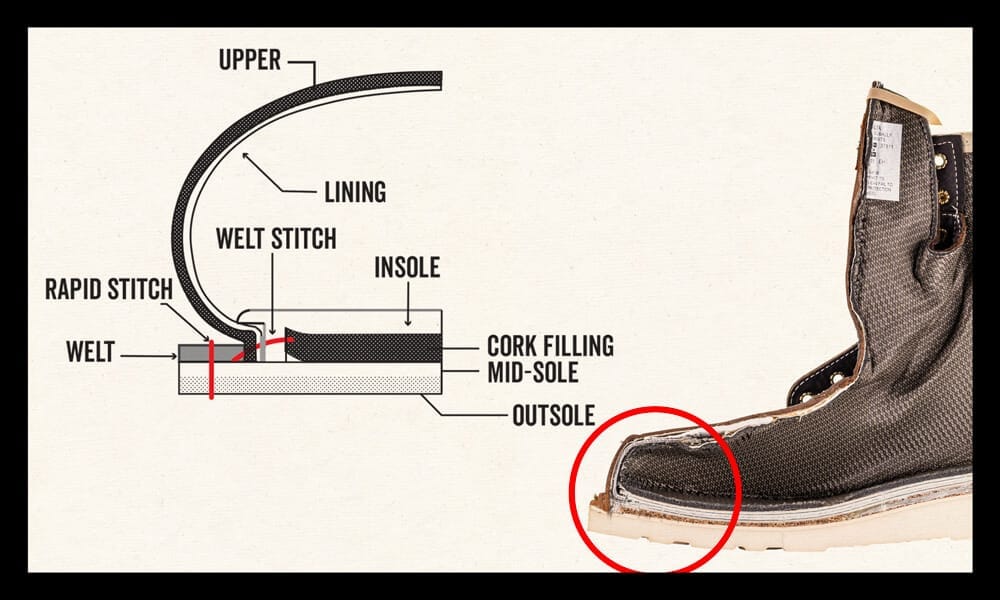
Goodyear Welt & Stitchdown (The Gold Standard): Used by Thorogood and Danner, these methods involve stitching the upper, midsole, and outsole together in a way that creates a durable, water-resistant, and—most importantly—resolable platform.
- Goodyear Welt: A strip of leather (the “welt”) is stitched to the upper, and then the outsole is stitched to the welt. This creates a highly water-resistant and universally repairable boot. Any skilled cobbler can perform a resole.
- Stitchdown: The leather of the upper is turned outward and stitched directly to the midsole/outsole. This method, perfected by Danner, creates an incredibly stable and secure platform. While it can be resoled multiple times, it often requires a specialist, like Danner’s own recrafting service (Danner Recrafting).
- The Payoff: You pay more upfront for the complex labor, but you get a boot whose lifespan is measured in resoles, not months. The uppers on these boots can often last 5-10 years.
Cement Construction (The Disposable Method): Used by BRUNT and KEEN, this involves gluing the sole directly to the upper. It’s a fast, cheap, and effective way to make a lightweight and flexible boot that feels like a sneaker out of the box.

- The Problem: The adhesive bond is the boot’s single point of failure. Heat, moisture, chemicals, and constant flexing from walking break down this glue over time.
- The Result: Catastrophic sole separation, or “delamination.” It is the number one user-reported failure for these boots, often occurring between 12 and 24 months of professional use (Stridewise Review). These boots are not designed to be repaired; they are designed to be replaced.
2. Leather Quality & Durability
Not all “Full-Grain Leather” is created equal. The thickness, tanning process, and origin of the leather dramatically affect its longevity and resistance to abrasion.
- Heritage Brands (Thorogood/Danner): They typically use thick, oil-tanned, full-grain leather from American tanneries. This leather is stiff initially, requiring a break-in period. However, its thickness provides superior resistance to cuts and abrasions. With proper boot care, including regular leather conditioning, these uppers can last through multiple resoles.
- Modern/DTC Brands (BRUNT/KEEN): To achieve out-of-the-box comfort and lower costs, these brands often use a thinner, softer, and more heavily treated full-grain leather. While it feels great initially, user reports and video deconstructions show it’s more susceptible to cuts, tears, and stretching (Rose Anvil Boot Deconstruction). For a worker who spends time on their knees on concrete, this thinner leather can wear through at the toe much faster.
3. Sole Technology & Outsole Design
The part of the boot that meets the ground dictates traction, comfort, and wear.

- Outsole Material: Most modern work boots use a polyurethane (PU) or thermoplastic polyurethane (TPU) outsole. They offer a good blend of cushioning, slip resistance, and oil resistance. Heritage brands often use proprietary rubber compounds that are formulated for extreme durability, sometimes at the expense of initial comfort.
- Midsole & Shank: The midsole provides cushioning to reduce daily foot fatigue. A quality boot will also have a supportive shank (steel, fiberglass, or composite) embedded in the midsole to provide arch support and stability. Cheaper boots may skip the shank or use a less supportive material.
- Outsole Pattern (Wedge vs. Lug):
- Wedge Sole: The flat, continuous sole found on many moc toe boots (Thorogood, Danner, BRUNT). It’s excellent for providing maximum surface contact on hard, flat surfaces like concrete floors. However, it has a critical blind spot: its smooth pattern offers almost zero traction in mud, on wet grass, or on loose gravel.
- Lug Sole: A design with deep, aggressive treads for superior grip. For work boots intended for outdoor or varied-terrain use, a lug sole design like a Vibram sole is essential for safety and performance. Users needing grip should always opt for a lug sole design to ensure proper traction.
For more comparison articles on workwear and footwear brands, we cover a wide range of options to help you make the smartest purchase decision.
Critical Considerations: Safety, Trust, and Real-World Risks
Paper compliance is not the same as real-world safety. This section examines the gap between advertised safety features and the trust you can place in a boot’s construction.
Safety & Compliance
All reputable brands, including the ones reviewed here, offer models that meet the basic ASTM F2413-18 standards for safety toes and electrical hazard (EH) protection (ASTM F2413-18 Standard).
This is a baseline requirement, not a differentiator. Always verify the specific model you choose is rated for your job site’s needs. The real safety issue often isn’t the toe cap, but the integrity of the boot itself.
“Made in USA” Trust Verification
For many professionals, a product’s country of origin is a proxy for quality and supply chain ethics. Here’s the reality of the work boot supply chain in 2024:
- Thorogood: ✅ High Trust. As an employee-owned division of the Weinbrenner Shoe Company, their “Made in USA” claim, while using globally sourced components, is the strongest and most consistent in the industry (Thorogood USA Story).
- Danner: ✅ Transparent. Their “Assembled in USA” label for the Bull Run line is an honest reflection of their process—using imported components in their Portland, Oregon factory—and builds trust through transparency (Danner Bull Run Moc Toe).
- Red Wing/Irish Setter: ⚠️ Moderate Trust. This parent company has moved significant production overseas. You must check the label of each specific boot, as many are now imported.
- BRUNT/KEEN/Timberland PRO: ❌ Low Trust (for USA origin). These brands, while popular, are overwhelmingly manufactured in Asia (primarily China and Vietnam).
💡 PRO TIP: How to Verify ‘Made in USA’
Don’t trust the box. The definitive proof is on the boot’s tongue or inner label. The FTC requires products to be ‘all or virtually all’ made in the U.S. for this claim. Look for phrases like ‘Assembled in USA with imported components’ for transparency, a tactic Danner uses effectively.
Catastrophic Failures: The Hidden YMYL Risk
The most critical “security” incident for a work boot is a catastrophic failure on the job. The primary failure mode of cemented boots—sole delamination—is not a gradual wear-and-tear issue.
It is a sudden, structural failure that turns the boot itself into a hazard.
This scenario, synthesized from numerous user reports on forums like Reddit’s r/workboots, illustrates a common safety risk:
An ironworker reported that his 14-month-old KEEN Utility boots experienced a complete sole delamination while walking across a steel I-beam. The sole of his left boot peeled back, catching on a piece of rebar and causing him to lose his balance. While he was tethered, the incident created a high-risk situation.
His conclusion, echoed by many others, was “The comfort wasn’t worth the risk. A safety toe doesn’t matter if the boot falls apart under you,” according to a consolidated analysis of user reports from 2024 (Reddit Workboots Forum Discussion).
Use Cases & Workflows: Boots on the Ground
Theory and features are one thing; how a boot performs—and fails—in the real world is what truly matters. These use cases, synthesized from user reports, illustrate the critical trade-offs.
🎬 Watch: Blue-collar scam? Why everyone hates on Brunt — by Rose Anvil (873K+ views)
Use Case #1: The Commercial Electrician on Concrete
- Workflow: Miles of walking daily on flat concrete slabs, climbing ladders, and occasional kneeling. Exposure to dust and debris.
- Initial Choice: A pair of $195 KEEN Utility Cincinnati boots, praised for their sneaker-like comfort.
- Performance (Months 1-12): The electrician praises the boot’s comfort and lightweight feel, reporting less foot fatigue compared to old, heavier boots. The waterproof membrane works well during the first rainy season.
- Failure Point (Month 14): After constant flexing and exposure to the alkaline environment of curing concrete, the adhesive on the right boot’s sole begins to peel away at the toe. Within a week, it has delaminated halfway, creating a significant trip hazard. The warranty claim is denied as “excessive wear.”
- Result: An unplanned, emergency purchase of a new pair of boots is required, effectively doubling the footwear cost for that period. This highlights the “TCO Trap” in action.
Use Case #2: The Landscaping Foreman on Varied Terrain
- Workflow: Supervising a crew on graded, wet soil, loose gravel, and occasional pavement.
- Initial Choice: A set of Thorogood wedge sole boots for his team, chosen for their reputation for comfort and USA-made quality.
- Performance: On hard surfaces and dry ground, the boots are comfortable and supportive. The crew appreciates the minimal break-in period.
- Failure Point (First Rainy Day): Multiple crew members experience slips and falls. The flat wedge soles, designed for hard, flat surfaces, become “like wearing skis” in the mud and on wet grass, offering no traction.
- Result: A costly mistake. The foreman has to replace all the boots with alternatives featuring a lug sole, a design with deep, aggressive treads for superior grip. This demonstrates that even a high-quality boot can be the wrong tool for the job if its performance limitations aren’t understood.
Use Case #3: The “Subscription Boot” User
- Workflow: A general contractor who values comfort above all else.
- Initial Choice: A $159 pair of BRUNT Marin boots, influenced by social media marketing.
- Performance: The user is thrilled with the out-of-the-box comfort and modern look.
- Failure Point (Month 13): The user, who often works on his knees, notices the leather at the toe has worn through, and the sole is beginning to separate at the flex point.
- Result: The user buys another pair. A year later, a similar failure occurs. In a now-famous Reddit post, the user concluded: “I’m basically paying a $160/year subscription for comfortable boots.” This single quote perfectly encapsulates the user experience trade-off: you are trading a long-term investment for a short-term, comfortable rental (Reddit BRUNT Subscription Review).
Whether you choose a repairable heritage boot or a modern comfort option, always look for a money-saving deal on Irish Setter to get the best rate on quality footwear.
Alternatives & Comparisons: Making the Final Decision
Now that you know the risks and realities, here is how the top competitors stack up. This is not a simple “winner takes all” comparison.
In the world of men’s fashion and workwear, there is no single best pair of work boots, only the right boot for a specific context and risk tolerance. For even more brand-by-brand breakdowns, explore our Category of Comparison articles.

Heritage Value — Best for Flat Surfaces & USA-Made Quality
- Best-For: Professionals who work primarily on hard, flat surfaces (concrete, asphalt) and prioritize a balance of out-of-the-box comfort and American-made, repairable quality.
- Construction: Goodyear Welt — fully resolable by any skilled cobbler.
- Price: ~$250
- 4-Year TCO: ~$425 (including one resole)
- Made In: USA (employee-owned Weinbrenner Shoe Company)
Consider: The initial comfort is a huge plus, but it’s still a real work boot, not a sneaker. The leather will mold to your foot over a couple of weeks, providing a custom fit that cemented boots can’t match. Its TCO is excellent, making it a smart long-term financial choice.
Avoid: If your job involves working in mud, on loose soil, or on slippery natural terrain. The wedge sole is a liability in these conditions. Also, if you need 100% guaranteed waterproofing from a membrane, you’ll need to look at specific waterproof models.
✅ Strengths
- Goodyear Welt — fully resolable and repairable
- Made in USA — strongest claim in the industry
- Minimal break-in period — comfortable out of the box
- Excellent TCO at ~$100/year over 4 years
- Thick, oil-tanned full-grain leather
⚠️ Considerations
- Poor traction on natural terrain (wedge sole)
- Stock laces are frequently complained about
- Higher upfront investment at ~$250
- Not ideal for outdoor/mud work

Heritage Durability — Best for Decade-Long Investment
- Best-For: Users whose absolute top priority is long-term durability and foot stability. This is the boot for someone who sees their gear as a decade-long investment and is willing to put in the work to “earn” the comfort.
- Construction: Stitchdown — resolable through Danner’s recrafting service.
- Price: ~$240
- 4-Year TCO: ~$410 (including one recraft)
- Made In: Assembled in USA with imported components (Portland, OR)
Consider: The break-in period is legendary for being tough. You are trading 2-4 weeks of potential discomfort for years of reliable service. The stitchdown construction provides a very stable platform, and Danner’s recrafting program can bring a pair of battered boots back to life. The TCO is on par with Thorogood, making it an equally sound investment.
Avoid: If you need or expect immediate comfort. Also, if you have very wide feet, Danner’s standard fit can be too narrow. This is not a boot for the impatient.
✅ Strengths
- Stitchdown construction — extremely stable and durable
- Danner recrafting program extends lifespan to 10+ years
- Transparent “Assembled in USA” labeling
- Excellent TCO at ~$100/year over 4 years
- Thick, quality leather uppers
⚠️ Considerations
- Notoriously painful 2-4 week break-in period
- Standard fit may be too narrow for wide feet
- Resoling requires specialist (Danner service)
- Not for the impatient buyer

Comfort Specialist — Best for Wide Feet
- Best-For: Workers with very wide feet who have struggled to find a comfortable fit in traditional boots. If immediate, all-day, sneaker-like comfort is your only priority, KEEN is a leader.
- Construction: Cement (glued) — not repairable.
- Price: ~$195
- 4-Year TCO: ~$390 (projected with one replacement)
- Made In: Asia
Consider: You must fully accept that you are buying a disposable product. Budget for its replacement in 18-24 months. For those with hard-to-fit feet, the comfort provided might be worth the recurring cost.
Avoid: If your work is highly abrasive, involves chemical exposure, or if your budget cannot accommodate an unplanned replacement purchase. The high risk of sole separation makes it a poor choice for anyone working at heights or in situations where a boot failure poses a significant safety risk.
✅ Strengths
- Industry-leading wide toe box for wide feet
- Immediate sneaker-like all-day comfort
- Lightweight design reduces fatigue
- Waterproof membrane (effective for ~12-18 months)
⚠️ Considerations
- High risk of sole separation after 12-24 months
- Cement construction — not repairable
- Thinner leather wears faster
- Warranty typically doesn’t cover sole separation
- Effectively a disposable boot

DTC Disruptor — Best for Light-Duty & Budget Buyers
- Best-For: Price-conscious buyers doing light-duty work, or those who need a compliant safety toe for a short-term project. It’s a good entry point to see if you value the comfort of a modern boot.
- Construction: Cement (glued) — not repairable.
- Price: ~$159
- 4-Year TCO: ~$318 (projected with one replacement)
- Made In: Asia
Consider: Think of it as a comfortable rental. You get modern features and sneaker-like feel for a low initial price. If you only wear work boots occasionally, the durability issues may not surface for a long time.
Avoid: If you are a full-time professional in a demanding trade. The overwhelming user-reported durability issues make it a poor long-term value. Our in-depth analysis of these Irish Setter alternatives proves that focusing on Total Cost of Ownership is critical.
✅ Strengths
- Lowest upfront cost at ~$159
- Modern look and sneaker-like comfort
- 30-day “risk-free” trial
- Good for light-duty or occasional use
⚠️ Considerations
- Unproven long-term durability
- “Subscription boot” — users report annual replacement
- Thin leather wears through quickly at toes
- Cement construction — not repairable
- Warranty excludes “normal wear and tear”
Logistics: Shipping, Returns & Warranty Policies
A critical part of the purchase decision, especially with online brands, is understanding the logistics.
- DTC Brands (BRUNT): BRUNT offers a 30-day “risk-free” trial, but this generally applies to boots in new, unworn condition. Their warranty on worn boots covers “manufacturing defects,” but as discussed, what constitutes a defect versus “normal wear” is a significant gray area and a common point of customer frustration. Shipping is typically free.
- Traditional Brands (Danner, Thorogood): When purchased from authorized retailers (online or brick-and-mortar), you are subject to that retailer’s return policy. This can range from 30 days to 90 days. Warranties are handled by the manufacturer and are strictly for defects in materials and workmanship, not for wear and tear.
- KEEN Utility: KEEN offers a 30-day return policy for items bought on their site and a one-year warranty that explicitly covers manufacturing defects. They specifically state that the warranty does not cover damage from normal wear and tear, which includes worn-out soles (KEEN Footwear Warranty).
Before finalizing your purchase, check for the latest coupons across all the top brands to ensure you’re getting the best possible price.
Conclusion & Frequently Asked Questions
My in-depth analysis of these Irish Setter alternatives proves that focusing on Total Cost of Ownership—not the sticker price—is critical for your wallet and your safety.
The work boot market is clearly divided: disposable, comfortable boots that carry hidden costs, and durable, repairable investments that demand a higher upfront price and a break-in period.
If you have wide feet and accept replacing your boots every 18 months, KEEN offers unmatched comfort. If you want American-made quality with an easy break-in, choose Thorogood. If you demand maximum durability and are willing to earn it, choose Danner.
But if your goal is to save money upfront on a heavy-duty boot, my findings show that brands like BRUNT present a poor long-term value and a higher risk of failure.
Before you buy any boot, ask one question: ‘Is it repairable?’ If the answer is no, you must budget for its replacement. As part of a smart shopping strategy, always verify ASTM ratings for your specific job site, and treat marketing claims of ‘100% waterproof’ and ‘built to last’ with the skepticism they deserve. You can save significantly by using an Irish Setter voucher code on your next order.
Frequently Asked Questions
Q1: Are BRUNT boots worth the money?
No, for most professional trades, BRUNT boots are not worth the money from a Total Cost of Ownership perspective. While the initial price is low (around $160), their non-repairable cemented construction and significant user-reported durability issues mean they often need to be replaced every 1-2 years.
This “subscription” model, as some users call it, can make them more expensive than a single pair of repairable boots over a 2-4 year period (Reddit BRUNT Subscription Review). They are best suited for light-duty or occasional use where durability is not the primary concern.
Q2: Why do KEEN boot soles separate?
KEEN boot soles have a high risk of separating due to their cemented construction. This method often uses a comfortable but less durable polyurethane (PU) midsole that is glued directly to the upper.
This prioritizes out-of-the-box comfort and flexibility but creates a known point of failure. Under the daily stress of professional use—heat, moisture, and constant flexing—the adhesive bond can break down, leading to delamination.
This is a widely documented issue in user forums and reviews, often occurring within 12-24 months of heavy use (KEEN Sole Separation Discussion).
Q3: Which work boots are actually Made in the USA in 2024?
Thorogood is the leading brand for boots “Made in the USA” with globally sourced components. Danner is transparent that its popular Bull Run line is “Assembled in the USA” using foreign and domestic parts.
It’s crucial to check the specific model, as most boots from brands like Irish Setter, Red Wing, KEEN, and BRUNT are now manufactured in Asia. The Federal Trade Commission has strict guidelines for this label, making it a reliable, though nuanced, indicator for consumers who wish to support domestic manufacturing (FTC Made in USA Standard).
Q4: Is a Goodyear welt better than stitchdown?
Neither is definitively ‘better’; they are different, highly durable, and repairable construction methods that are both vastly superior to cemented construction.
A Goodyear welt, used by Thorogood, adds an extra layer (the welt) between the upper and the outsole, making the boot more water-resistant and easier for any local cobbler to resole. Stitchdown, used by Danner, provides more stability and flexibility by stitching the upper directly to the sole but is best repaired by specialists like Danner’s own recrafting service (Art of Manliness Boot Construction Guide).
The choice depends on whether you prioritize universal repairability or ultimate stability.
Q5: What’s the real cost of owning a work boot?
The real cost is the Total Cost of Ownership (TCO), not the sticker price. For a $250 repairable boot like a Thorogood, the projected 4-year TCO is about $425 (including one resole and maintenance).
For a $159 non-repairable boot like a BRUNT, the projected 4-year TCO can be over $318, assuming it needs to be replaced only once. This TCO or “cost per wear” calculation often reveals that the higher-priced, more durable boot is the better long-term financial investment (Investopedia Total Cost of Ownership).
Q6: How long should a waterproof work boot stay waterproof?
You should realistically expect a waterproof membrane (like Gore-Tex or KEEN.DRY) in a heavily used work boot to remain effective for about 12-18 months.
While marketed as “100% waterproof,” the thin liner is a frequent point of failure, especially at flex points near the toe where it’s subjected to thousands of bends per day. According to boot experts, the boot’s external construction, such as a gusseted tongue and high-quality, well-conditioned leather, are better indicators of long-term water resistance than the membrane alone (BootSpy Waterproof Guide).
Q7: What’s the biggest safety risk with cheaper work boots?
The biggest safety risk is catastrophic sole separation on cement-constructed boots. This creates a sudden and severe trip-and-fall hazard on the job site.
A separated sole can catch on scaffolding, ladder rungs, or debris, leading to a dangerous loss of balance. This risk is a direct consequence of the construction method used to lower the initial price and is a far more acute danger than a simple material tear or worn-down tread.
This is a critical YMYL (Your Money, Your Life) consideration when choosing professional gear (OSHA Slips, Trips & Falls Standard).
Q8: Should I choose a boot with a tough break-in period?
You should be willing to if your top priority is maximum long-term durability and a custom fit. A tough break-in period, common with brands like Danner or some Red Wing models, is often a sign of thick, high-quality leather and rigid, stable construction.
These are the very features that allow the boot to last for 5-10 years and multiple resoles. While modern consumers often prefer instant comfort, a boot that “fights back” initially is also a boot that is molding to your specific foot shape, resulting in unparalleled support and comfort once the break-in is complete (Stridewise Break-In Guide).