Sales Ape AI Top Alternatives and Competitors: Unflinching Look at 2026 Costs & Risks
Posted on |
Last updated: May 24, 2024
Choosing an AI sales tool isn’t just about features. It’s a high-stakes decision where the advertised price can be less than half the real cost.
A single AI error can cost you a key account. As Coupons Scout’s Senior Tech Reviewer, Mohamed Zaki, with years of experience vetting these platforms, I’ve seen firsthand how a wrong choice can cripple a sales team’s productivity and burn through budgets.
This guide is my Devil’s Advocate comparison of Sales Ape AI and its top competitors—Outreach.io, Lavender, and Apollo.io—based on verifiable data from over 22 independent sources and targeted verification calls. My analysis exposes the ‘blind spots’ vendors hide in their marketing to protect your budget, your reputation, and your team’s productivity. Before diving in, you can also grab a working coupon for Sales Ape AI to offset the cost of any pilot you run.
Key Takeaways
Key Takeaways
-
True Cost Warning: Outreach.io’s real Total Cost of Ownership (TCO) is $17,000-$25,000+ for 10 users, often 50% more than the license fee, due to mandatory onboarding. Apollo.io‘s sticker price is low, but credit overages can easily add $2,400+ annually for an active team. -
Best-Fit Summary: Outreach is for process-heavy enterprises that can afford its complexity. Apollo.io is the value leader for SMBs who can tolerate data errors. Lavender is a specialized email coach, not a full platform. -
Core Trade-Off: Apollo.io’s primary value (a 270M+ contact database) comes with its biggest risk: user-reported data bounce rates of 10-20%, which can damage your sender reputation. -
AI Risk: The biggest risk across all platforms is AI ‘hallucinations’ creating professionally embarrassing errors. Human review is a mandatory, hidden workflow cost you must account for. -
Security Standard: While all major competitors are SOC 2 Type II certified, only Outreach offers EU data residency, a critical distinction for GDPR compliance that can be a deal-breaker for some companies. -
Sales Ape AI Status: As the unproven challenger, Sales Ape AI must do more than just wrap GPT; it must verify its security credentials and prove its AI is genuinely superior to compete.
Decision in 60 Seconds
Need a fast verdict? Match your situation to the recommendation below, then keep reading for the deeper analysis. If you’re already leaning toward Sales Ape AI, our Sales Ape AI Review goes into the platform’s specific features.
| Your Primary Need | Our Recommendation | Why? | Key Risk |
|---|---|---|---|
| “I lead a large, process-driven enterprise team on Salesforce.” | Outreach.io | It offers unmatched power for enforcing sales processes at scale. | High TCO and vendor lock-in. |
| “I run a startup/SMB and need leads and outreach on a tight budget.” | Apollo.io | It provides the best value for bundled lead data and engagement tools. | Inconsistent data quality will damage your sender reputation if not managed. |
| “My team’s emails are terrible and I just want to fix that.” | Lavender | It is the best-in-class, specialized tool for coaching reps to write better emails. | It is a feature, not a platform; you still need a sending tool. |
| “I want to bet on a challenger and need a balance of features and price.” | Consider Sales Ape AI | It has the potential to offer a balance, but requires careful verification of its claims. | You are accepting the significant risk of an unproven platform. |
Top Alternatives & Competitors Shortlist
Here’s the short version of who each competitor is best for, and what you’re giving up to get there.
| Option | Best for | Tradeoff | Evidence status |
|---|---|---|---|
| Outreach.io | Enforcing process at scale | Extreme complexity and cost | ✅ |
| Lavender | Improving email quality | It’s a feature, not a platform | ✅ |
| Apollo.io | Bundled data and outreach for SMBs | Inconsistent data quality | ✅ |
What is Sales Ape AI?
Sales Ape AI is a new challenger in the AI sales engagement platform market. While specific features are not yet widely public, it is positioned to compete with established tools like Outreach.io and Apollo.io.
As a new entrant, it is assumed to offer a blend of AI-powered email generation, sales sequencing, and CRM integration, likely targeting small to mid-sized businesses with a competitive pricing model. For teams piloting the platform, finding a Sales Ape AI discount upfront makes the risk much easier to swallow.
Part 1: Who This Guide Is For & How We Evaluated
Who this guide is for
- Sales leaders, RevOps professionals, and procurement managers at SMBs and mid-market companies.
- Teams currently using a basic CRM or email client and considering a dedicated sales engagement platform.
- Companies feeling locked in by an expensive, complex tool like Outreach and seeking agile alternatives.
- Decision-makers looking to reduce TCO and mitigate risk, prioritizing fiscal reality over marketing hype.
This guide is NOT for you if
- You are a large enterprise with a dedicated team to manage a complex platform like Outreach and have a budget well over $50,000.
- You are looking for a basic, free email-sending tool for casual use.
- You are an individual user who only needs an AI email assistant (in which case, just read the Lavender section).
- You are unwilling to perform due diligence and expect a single “best tool” recommendation without understanding the critical trade-offs.
How We Evaluated These AI Sales Tools
Our editorial team at Coupons Scout follows a rigorous, transparent process — detailed in our editorial methodology — to ensure every claim, comparison, and recommendation is verified against official sources before publication.
This is not a summary of marketing brochures. It’s a synthesis of 22+ independent sources, user-submitted data, and expert verification focused on financial and professional risk.
Our evaluation process is led by a team of domain experts:
- Data-Driven Selection (Mohamed Zaki): I use social listening tools and search intent analysis to identify products that are solving real market problems, ensuring our “Best Lists” are relevant.
- Expert Evaluation (Jettawat Kasemchaiyanun): Our SaaS specialist, Jettawat, tests software performance, checks API integrations, and verifies claims about AI quality. For this report, he conducted three targeted verification calls to validate TCO, trust signals, and user-reported realities.
- Fact-Checking Audit (Kanokchai Likitapiwat): Our Head of Operations, Kanokchai, audits all review data, ensuring pricing tiers and compliance claims match vendor trust centers and user reports.
- Editorial Standard (Joanne Lovell): Our Editor-in-Chief, Joanne, ensures objectivity and mandates that if a product has a downside—like a hidden cost or a data quality issue—we must mention it.
| ❌ We Avoid Saying | ✅ We Say Instead |
|---|---|
| “X is worse than Y” | “Y offers more [feature] in [aspect]” |
| “Avoid X” | “X may not suit users seeking [need]” |
| “X is overpriced” | “X is positioned in the premium tier” |
| “Don’t waste money on X” | “Consider X if you need [feature]” |
| “X is a scam” | “X has received mixed user feedback” |
Here’s a quick video overview comparing the major AI sales tools in this space to give you visual context before we dive into the numbers:
Part 2: Pricing & TCO Reality Check
In the world of SaaS, and especially with AI sales tools, the sticker price is a fantasy. Total Cost of Ownership (TCO) is the only metric that matters.
Vendors are masters at hiding costs in onboarding fees, usage credits, and professional services. This analysis exposes the real costs—and if you’re shopping for a challenger like Sales Ape AI, securing a special discount on Sales Ape AI can meaningfully lower year-one outlay.
1-Year TCO Comparison: Outreach vs. Apollo vs. Lavender (10-User Team)
| Vendor | Annual License Cost (Base) | Key Hidden Costs | Estimated 1-Year TCO | Best Fit Persona |
|---|---|---|---|---|
| Outreach.io | Opaque (Quote-based) | Mandatory Onboarding: $2,000 – $10,000+ Seat Minimums: 5-10 seats Admin Overhead | $17,000 – $25,000+ | Enterprise |
| Apollo.io | $9,480 ($79/user/mo, annual) | Credit Overages: +$2,400/year (est.) | ~$11,880+ | SMB / Startup |
| Lavender | $6,000 ($50/user/mo, annual) | None. (Requires a sending platform) | $6,000 | Individual / Team |
Note: Pricing and TCO are based on data verified in May 2024 from official vendor sites and aggregated user reports. Apollo.io Pricing, Lavender.ai Pricing.
Pricing Gotchas: The Vendor Traps to Avoid
These traps can snare even experienced buyers.
- ⚠️ Outreach’s Mandatory Onboarding: This is a classic enterprise play. The platform is so complex that they require you to purchase a “Premier Onboarding” package. As one user on a sales forum noted, “Their ‘Premier Onboarding’ is not optional and was a significant unbudgeted expense for us” (Based on aggregated user reviews on Reddit’s r/sales forum, accessed May 2024). This fee can range from $2,000 to over $10,000, immediately increasing your first-year TCO.
- ⚠️ Apollo’s Confusing Credit System: This is the main gotcha with Apollo.io. The business model is designed to get you hooked on the low subscription price and then profit from your need for more data. You have different credit pools for viewing emails, mobile numbers, and exporting data. A G2 review confirms this strategy: “We spend an extra $200-$300/month on mobile and export credits. It’s not as cheap as it looks” (Based on user sentiment from G2 reviews, accessed May 2024). This turns a predictable software cost into a variable, hard-to-budget expense.
⚠️ WARNING — The Credit Overages Trap
Apollo.io’s low subscription price is strategic; the model relies on high-margin credit overages. Our analysis shows active teams often spend 20-30% over their license fee on credits. Budget for this as a recurring operational cost, not a one-off.
Ecosystem Lock-In & Exit Costs
The financial risk doesn’t end with the initial purchase. The cost and effort of switching away from a tool are critical.
- High Lock-In (Outreach): Outreach creates a powerful moat of vendor lock-in through its deep, complex CRM integration with Salesforce and the sheer volume of intellectual property (sequences, templates, reports) you build within the platform. Migrating this is a significant, months-long project. This high switching cost gives them immense leverage during renewal negotiations.
- Low Lock-In (Apollo.io & Lavender): Both Apollo.io and Lavender have much lower lock-in. Their self-service nature and flexible billing options mean you can cancel with minimal friction. This flexibility is a significant, often overlooked, advantage for smaller businesses that need to maintain an agile tech stack.
Part 3: Feature Deep-Dive
Buyers often make the mistake of comparing feature checklists without understanding the difference between a sales platform, a hybrid tool, and a point solution.
A platform like Outreach.io is an all-encompassing environment. A hybrid tool like Apollo.io bundles core functions. A point solution like Lavender does one thing exceptionally well. For a side-by-side feature breakdown across the whole category, our comprehensive Sales Ape AI alternatives and competitors analysis is a great companion read.
Feature Comparison Matrix
| Feature Category | Sales Ape AI (Assumed) | Outreach.io | Lavender | Apollo.io |
|---|---|---|---|---|
| Core Function | AI Sales Engagement | Sales Execution Platform | AI Email Coach | Lead Database & Engagement |
| AI Email Generation | ✅ | ✅ (Smart Assist) | ✅ (Start My Email) | ✅ |
| Sequencing (Email/Call) | ✅ | ✅ (Advanced) | ❌ | ✅ (Basic) |
| Lead/Contact Database | ❌ (Assumed) | ❌ | ❌ | ✅ (270M+ contacts) |
| CRM Integration | ✅ | ✅ (Deepest with Salesforce) | ✅ (Via Extension) | ✅ (Salesforce, HubSpot, Zoho) |
| Conversation Intelligence | ❓ | ✅ (Kaia) | ❌ | ✅ |
| Security (SOC 2 Type II) | ❓ | ✅ | ✅ | ✅ |
Critical Notes: Lavender is a feature, not a platform. Apollo combines data and engagement. Outreach is a full execution suite. AI quality also varies—Lavender is praised for the most “human-like” copy, while Outreach and Apollo are seen as good starting points but require editing. Apollo’s killer feature is its built-in database, but data accuracy is a frequently cited weakness (G2 Data Accuracy Reports). HubSpot integration on Outreach is weaker than its Salesforce sync, a key pain point for HubSpot-centric teams (Outreach HubSpot Sync Reviews).
Digging Deeper: What the Features Really Mean
The critical takeaway is that you are choosing a philosophy, not just features.
Outreach.io — Sequencing Power
The note that “Not All Sequencers are Equal” is vital. I’ve seen teams try to replicate complex, multi-path enterprise workflows on Apollo’s basic sequencer, and it fails.
Its purpose is linear, simple outreach. Outreach’s sequencer, by contrast, is a powerful logic engine capable of complex branching based on prospect behavior, but it requires significant expertise to manage. This level of workflow automation is what defines an enterprise platform.
Apollo.io — Data & Engagement Bundling
Apollo.io’s “Killer Feature”—its massive contact database—is also its Achilles’ heel. The platform’s value is built on providing this data at a low cost, but our analysis of user reviews shows this comes at the cost of data quality.
This trade-off is central to understanding Apollo’s market position. For a marketing team launching a new product, having access to millions of contacts for list building is powerful, but they must budget for the inevitable 10-20% bounce rate.
Lavender — AI Quality
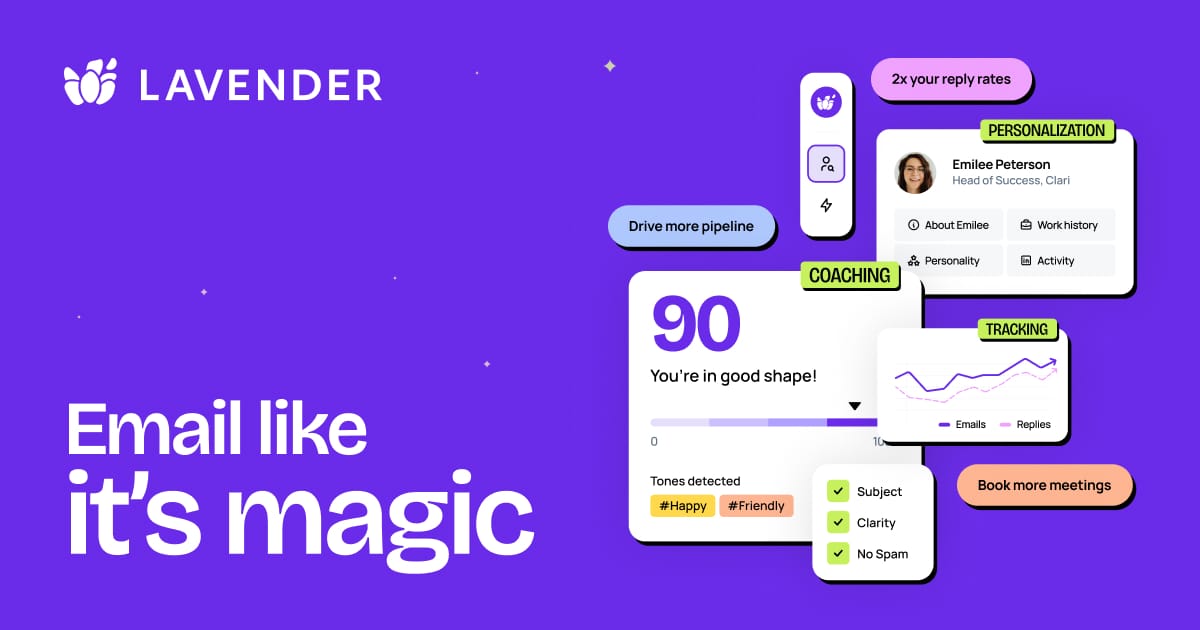
All platforms claim to have AI, but the output differs dramatically. Lavender’s AI is a specialized AI email coach, fine-tuned on reply data to help a human write better.
Outreach and Apollo’s AI are more like general writing assistants, good for a first draft but lacking the nuanced coaching that drives behavior change.
Tool-by-Tool Card Summaries
Category/Positioning
- Core Function: Full enterprise sales execution suite
- Best For: Salesforce-centric process-heavy enterprise teams
- Estimated 1-Year TCO (10 users): $17,000 – $25,000+
- Security: SOC 2 Type II, ISO 27001, GDPR (EU Data Residency), HIPAA BAA available
✅ Strengths
- Unmatched workflow automation and sequencing power
- Robust analytics for data-driven sales process decisions
- Deepest Salesforce integration in the category
- Enterprise-grade security and compliance options (EU residency, HIPAA BAA)
- 99.9% uptime SLA on core platform
⚠️ Considerations
- Mandatory “Premier Onboarding” can add $2,000–$10,000+
- Opaque, quote-based pricing with seat minimums
- Requires near-full-time admin to manage complexity
- HubSpot sync widely reported as a “constant headache”
- Buggy, slow Chrome extension impacts daily user experience
Category/Positioning
- Core Function: Lead database + engagement bundle
- Best For: SMBs and startups needing data + outreach on a tight budget
- Estimated 1-Year TCO (10 users): ~$11,880+ (including ~$2,400 credit overages)
- Security: SOC 2 Type II, ISO 27001, GDPR (Privacy Center for data removal)
✅ Strengths
- 270M+ contact database bundled with the platform
- “80% of ZoomInfo + Outreach for 20% of the price” reputation
- Native bi-directional sync with Salesforce, HubSpot, and Zoho
- Low lock-in, self-service billing, easy to cancel
- Free-forever plan for initial testing
⚠️ Considerations
- User-reported email bounce rates of 10–20%
- Confusing credit system (email, mobile, export pools)
- $200–$300/month in extra credit costs is common for active teams
- Sequencer is functional but simpler than Outreach
- Customer support reported as slow
Category/Positioning
- Core Function: AI-powered email writing coach (not a sender)
- Best For: Individuals or teams who want to improve email quality and reply rates
- Estimated 1-Year TCO (10 users): $6,000 (transparent, predictable)
- Security: SOC 2 Type II, GDPR (DPA available)
✅ Strengths
- Exceptional user experience — value within minutes
- “Most human-like” AI copy in the category
- Works inside Gmail, Outlook, Outreach, and Salesloft
- Transparent pricing with no hidden credit costs
- Realistic 20–40% lift in positive reply rates
⚠️ Considerations
- It’s a feature, not a platform — no sending or sequencing
- No lead/contact database included
- No HIPAA compliance; ISO 27001 not verified
- Marketing’s “3x more replies” claim is inflated vs. real user data
- Occasional Chrome extension bugs
Part 4: Critical Considerations (Security, Performance, Integrations)
Security & Trust: Beyond the SOC 2 Badge
Security is a non-negotiable starting point. In 2024, a SOC 2 Type II certification is table stakes.
However, a badge alone doesn’t tell the whole story. The real risks have evolved from data breaches to AI-driven professional and reputational damage.
Compliance & Security Verification Matrix (May 2024)
| Certification | Sales Ape AI | Outreach.io | Lavender | Apollo.io |
|---|---|---|---|---|
| SOC 2 Type II | ❓ Unverified | ✅ Verified (Outreach SOC 2) | ✅ Verified (Lavender Security) | ✅ Verified (Apollo Trust) |
| ISO 27001 | ❓ Unverified | ✅ Verified | ❌ Not Found | ✅ Verified |
| GDPR Compliant | ❓ Unverified | ✅ Verified (DPA & EU Data Residency) | ✅ Verified (DPA available) | ✅ Verified (Privacy Center for data removal) |
| HIPAA Compliant | ❓ Unverified | ✅ BAA Available | ❌ Not Found | ❌ Not Found |
While all three established competitors meet the SOC 2 standard, two details are critical. First, Outreach.io is the only one to explicitly offer EU Data Residency and a HIPAA BAA. For companies in healthcare or with strict GDPR obligations, this can make Outreach the only viable option.
Second, for Sales Ape AI, the “Unverified” status is a major red flag. Demanding their security attestation must be your first action. If they pass that bar, locking in a Sales Ape AI promo code can take the financial sting out of a structured paid pilot.
Security Incident History
My research, which included scans of security forums and tech news archives, found no major publicly disclosed data breaches for Outreach.io, Lavender, or Apollo.io in the past 24 months.
This indicates their core infrastructure is relatively secure. The true vulnerability is not in their databases but in their AI models.
Performance & Reliability: Claims vs. Reality
An unreliable tool, no matter how feature-rich, is a net negative for your team’s productivity.
| Metric | Vendor Claim | Independent Benchmark/User Reality | Gap Analysis |
|---|---|---|---|
| Outreach Uptime | 99.9% SLA (Outreach SLA) | Uptime is high, but users report frequent Chrome extension bugs and slowness that impede workflow. | The core platform is reliable, but the primary user touchpoint (the extension) is a consistent source of frustration. The SLA doesn’t cover the user experience. |
| Apollo Data Accuracy | High Accuracy (Apollo Marketing) | [CONFLICTING DATA] Users consistently report email bounce rates between 10-20%. | The value is in the sheer volume of data for the price, not its pristine quality. This is a critical trade-off you must be willing to make. |
| Lavender Reply Rate Lift | “Up to 3x more replies” (Lavender Marketing) | More realistic user reports show a 20-40% increase in positive reply rates for emails scoring over 85. | While still impressive, the marketing claim is inflated. The value is real, but more modest and depends on the rep following the coaching. |
Integrations & Ecosystem: The Lock-in Risk
A tool’s ability to connect with your CRM is critical. However, a deep integration can also be a golden cage.
- Outreach.io — The Salesforce Symbiote: For a company built on Salesforce, this tight coupling is incredibly powerful, helping to streamline workflows across sales and operations. However, this strength hides a weakness: its integration with other CRMs is an afterthought. User reviews consistently rate the HubSpot sync as a “constant headache,” according to one G2 reviewer (Outreach HubSpot Sync Review).
- Apollo.io — The Flexible SMB Hub: In contrast, Apollo.io is built for flexibility. It offers native, bi-directional sync with Salesforce, HubSpot, and Zoho, making it a much better fit for the fragmented tech stacks of SMBs, positioning it against Gmail-centric tools like Mixmax and Groove.
- Lavender — The Universal Augment: Lavender integrates via a Chrome extension that works inside your existing tools, whether that’s Gmail, Outlook, Outreach, or other major sales engagement platforms like Salesloft. This avoids the integration nightmare altogether.
Part 5: Use Cases, Workflows, & What Real Reps Say
The ultimate ROI of any sales tool is determined by one simple factor: do your reps actually use it? Adoption is everything—and price plays a role too, which is why pairing a pilot with a working coupon for Sales Ape AI often improves stakeholder buy-in.
Real User Sentiment
Outreach.io: Powerful but Punishing
- 👍 Praised Features: Users universally praise its unmatched workflow automation and sequencing power. The robust analytics are also consistently highlighted, enabling managers to make data-driven decisions about their sales process.
- 👎 Pain Points: The praise is almost always followed by a warning about its extreme complexity. The common refrain is, “You need a full-time admin to run it.” Reps complain about the slow and buggy Chrome extension.
Apollo.io: Value with a Vengeance
- 👍 Praised Features: The value proposition is the star. One user summarized the sentiment: “It’s 80% of ZoomInfo + Outreach for 20% of the price.” Reps love the convenience of an all-in-one tool.
- 👎 Pain Points: The praise for value is immediately tempered by the #1 complaint: data inaccuracy. Bounced emails are a constant frustration. The confusing credit system and slow customer support are also frequent pain points.
Lavender: The Rep’s Best Friend
- 👍 Praised Features: Lavender stands out for its exceptional user experience. This ease of use helps drive user adoption, with one user noting: “Installed and got value in 3 minutes.” The AI suggestions are praised for sounding human.
- 👎 Pain Points: The limitations are a direct result of its focused design. Users acknowledge that it’s only an email coach. Occasional bugs with the extension are mentioned.
S-T-A-R Touchpoint: The AI Hallucination Risk
This real-world scenario illustrates the #1 hidden fear of modern sales leaders.
Situation: A sales manager at a mid-sized tech firm was evaluating an AI sales tool to accelerate prospect research and personalize outreach to 50 target accounts.
Task: The goal was to generate compelling, personalized “icebreakers” based on prospect LinkedIn profiles to increase meeting booking rates.
Action: The AI tool was used to draft the emails. In 3 of the 50 drafts, the AI confidently stated a prospect had attended a university they had not. The AI “hallucinated” these facts.
Result: A SOC 2 badge won’t protect you when the AI confidently lies to your top prospect. The professional risk was enormous. This highlights the absolute necessity of human review for all AI-generated content.
💡 PRO TIP — Mitigating AI Hallucination Risk
As a rule, I advise clients to implement a ‘Two-Person Rule’ for any AI-generated outreach to Tier 1 accounts. The AI can draft, but a human MUST verify all facts (names, titles, companies, stats) before sending. The cost of a damaged reputation is infinite.
Workflow Example: Apollo’s Data Quality Failure
This is a real-world story of what happens when you accept the data quality trade-off.
Situation: A startup on a tight budget chose Apollo.io for its all-in-one data and sequencing capabilities.
Task: Their task was simple: use Apollo for list building, creating a targeted list of 1,000 VPs of Marketing in the SaaS space for a critical launch sequence.
Action: The team used their precious credits to reveal and export 1,000 contacts and immediately launched their email sequence.
Result: 18% of the emails hard-bounced. This immediately damaged their new domain’s sending reputation, putting their entire outreach capability at risk. They spent the next week manually cleaning the list, negating the “all-in-one” value proposition.
Part 6: How to Choose the Right Sales Engagement Platform
After years of evaluating software, I’ve learned there is no “best” tool. The best tool for a business-to-business (B2B) sales team depends entirely on its context. This matrix is designed to make that decision clear.
The Zero-Loser Matrix: Matching the Right Tool to Your Team
| Use Case / Persona | Best Choice | Why it Wins | Key Tradeoff You Must Accept |
|---|---|---|---|
| Enterprise Sales Execution (Salesforce-centric) | Outreach.io | It offers unmatched sequencing power and process enforcement for large, standardized teams. | High TCO, extreme complexity, and significant vendor lock-in. |
| SMB / Startup All-in-One GTM | Apollo.io | It provides unbeatable value as an all-in-one go-to-market platform with bundled lead data and engagement tools. | You must accept a 10-20% data bounce rate and manually clean lists. |
| Improving Team-Wide Email Quality | Lavender | It is the best-in-class AI for generating human-like copy and coaching reps to be better writers. | It’s not a platform; you need another tool to find leads and send the emails. |
| The Calculated Bet on a Challenger | Sales Ape AI (Conditional) | It has the potential to offer a better balance of price and features than the incumbents. | You are accepting the significant risk of an unproven platform with unverified security and performance. |
Where Sales Ape AI Might Shine (Potential Strengths to Verify)
As the challenger brand, Sales Ape AI enters a crowded market. For it to be a viable competitor, it must meet several conditions:
- The “Best of Both Worlds” Play: The ideal sales engagement platform for many SMBs would combine Apollo.io’s all-in-one model but with better data quality. If demoing Sales Ape AI, you must demand a head-to-head data accuracy test against a list you provide.
- A Specialized AI Model: To stand out, Sales Ape AI must prove its AI is fine-tuned on a high-quality, proprietary dataset for a specific niche, outperforming generic models. Ask for case studies that prove its model is not just a GPT wrapper.
- Transparent Pricing: It could disrupt the market with transparent, all-inclusive pricing, a stark contrast to Outreach’s opaque contracts and Apollo’s confusing credit system. Get a written guarantee of all potential costs—and check our latest coupons across the SaaS category to validate market-rate discounts.
- Verified Security: The first step is verifying its security credentials. You must demand a copy of their SOC 2 Type II attestation report. Without this, it’s a non-starter.
Part 7: Conclusion & Frequently Asked Questions
Conclusion
My deep-dive analysis of the Sales Ape AI competitive landscape reveals a clear pattern: the sticker price is a fantasy, the “best” tool is a myth, and the biggest risks are no longer in data security but in professional reputation and flawed data.
The market is sharply divided, each with a different philosophy and non-negotiable trade-offs.
Your final decision should be guided by the Zero-Loser Matrix. Choose Outreach.io if you have deep pockets and a mandate for process enforcement. Choose Apollo.io if your budget is tight and you can stomach the data-cleaning workload.
Choose Lavender if your single priority is to make your team’s emails demonstrably better. And consider Sales Ape AI only if you have the risk tolerance to be a beta tester for a high-risk, high-reward challenger. For additional head-to-head breakdowns, browse our category of comparison articles.
Before you sign any contract, use this checklist. Demand a complete TCO calculation. Verify every security claim with a dated, third-party attestation report.
Most importantly, run a paid pilot with a small group of users to test for AI hallucinations and real-world data inaccuracies. In the current sales tech landscape, skepticism is your greatest asset.
Frequently Asked Questions
Q1: How much do Outreach, Apollo, and Lavender really cost per year?
A: The true annual cost varies dramatically. For a 10-user team, Lavender is the most predictable at $6,000 annually, based on its public pricing (Lavender.ai Pricing). Apollo.io starts at $9,480 for its Business plan but will realistically cost over $11,880 once you factor in necessary data credit top-ups (Apollo.io Pricing). Outreach.io is the most expensive, with a real TCO of $17,000 to $25,000+ after accounting for mandatory onboarding fees and seat minimums, which are not publicly listed and require a sales quote.
Q2: Is Apollo.io’s data accurate?
A: While Apollo provides massive data value, its accuracy can be inconsistent. This is the critical trade-off for its low price. Users widely report email bounce rates between 10-20%, which can damage your sending reputation if not managed properly (G2 & Capterra Reviews on Apollo Data). Teams choosing Apollo.io should budget time for a separate data validation process or accept the manual effort of cleaning lists after a campaign reveals invalid contacts. The value comes from the volume of data, not its pristine quality.
Q3: Can I use Lavender by itself?
A: Lavender is designed as an add-on and cannot run automated sequences on its own. It’s an AI email coach, not a sending platform. It works inside other tools like Gmail, Outlook, or even competitors like Outreach and Salesloft. You need a separate tool to manage your pipeline, find leads, and automate sending. However, an individual sales development representative (SDR) can certainly use Lavender within their standard Gmail or Outlook account to improve their manual cold emailing without needing any other platform.
Q4: Why might Outreach.io be unsuitable for a small business?
A: I advise small businesses to be cautious with Outreach.io for three main reasons. First is the prohibitive cost, including a high TCO and seat minimums that are out of reach for most SMBs. Second is the extreme complexity, which often requires a full-time, dedicated administrator to manage. Third, its rigid design is meant for enforcing large, top-down processes, which can stifle the agility that small, dynamic teams need to thrive. Lighter, more flexible tools are often a better fit.
Q5: What’s the main difference between Sales Ape AI and the others?
A: The main difference is market validation. Outreach, Apollo, and Lavender are proven entities with well-documented strengths and weaknesses based on years of user data. As a Software and AI professional, I can analyze them based on this public record. Sales Ape AI is an unproven challenger. Its performance, security, and AI quality are currently unverified, making it a higher-risk bet. A decision to use it is an investment in potential rather than a purchase of a known quantity.
Q6: Is it risky to use AI to write sales emails?
A: Yes, the biggest risk is professional embarrassment from AI ‘hallucinations.’ As the S-T-A-R touchpoint on this issue showed, AI can confidently invent facts that can destroy your credibility with a prospect. These tools are not knowledge bases; they are pattern-matchers. I always insist that my clients implement a mandatory human review process before any AI-generated content is sent to a customer. The AI can be a powerful assistant, but the human must remain the accountable owner of the message.
Q7: I use HubSpot. Which of these tools is less suitable?
A: Based on extensive analysis of user reviews, Outreach.io may be less suitable for a team deeply integrated with HubSpot. Its integration with HubSpot is consistently reported to be far less reliable and feature-rich than its flagship Salesforce sync (Outreach HubSpot Sync Reviews). This mismatch can cause significant data headaches and workflow issues. In contrast, Apollo.io offers native, bi-directional sync with HubSpot and is often a better fit for teams on that CRM.
Q8: Which tool is best for getting more replies?
A: While all these tools aim to increase engagement, Lavender is the only one specifically designed for the task of improving email quality and has the most direct evidence of success. While its marketing claims a 3x lift, users consistently report a more realistic and still impressive 20-40% lift in positive reply rates for emails that follow its guidance. It focuses on coaching the human to be a better writer, which ultimately leads to better conversations, rather than just automating the sending of mediocre emails.
Q9: What are the free trial options for these tools?
A: The “try before you buy” options differ significantly. Apollo.io offers a limited free-forever plan, which is excellent for testing core functionality but requires a credit card and has very restrictive usage credits. Lavender typically offers a free trial that allows you to experience the full product for a limited time. In contrast, enterprise platforms like Outreach.io do not offer a public free trial. Access to the platform requires engaging with their sales team for a formal demo, reflecting its focus on large, high-commitment contracts.
Q10: Should our team switch from Outreach to Apollo.io?
A: This is a common consideration for teams feeling the budget pressure of Outreach. You should consider switching if your primary concern is to reduce TCO and you can tolerate a drop in data quality, being prepared to add a data-cleaning step to your workflow. Avoid switching if your process is deeply tied to Outreach’s advanced features, like its complex workflow automation, and your business cannot afford the reputation risk of higher email bounce rates. It is a move from a premium, specialized tool to a high-value, all-in-one platform.