Sports Box Top Alternatives and Competitors: A 2026 Devil’s Advocate Cost & Risk Analysis
Posted on |
Last Updated: May 2024
Choosing a sports analysis platform is a high-stakes decision, but for many, the biggest risk isn’t the feature set—it’s the undisclosed, multi-year cost that vendors won’t put on their websites.
This 2026 analysis provides a critical “Devil’s Advocate” comparison of top platforms for AI sports coaching and analysis: Hudl, Veo, and Catapult.
You can expect a detailed breakdown that cuts through marketing hype to expose hidden costs, unverified “AI” claims, and crucial security gaps based on 2025-2026 data. Before diving in, savvy buyers may want to check the latest Sportsbox AI coupon code to offset any platform investment with verified savings.
This guide focuses on the key decision factors for athletic directors, coaches, and IT officers, including Total Cost of Ownership (TCO), Security & Compliance, Vendor Lock-in, and Performance Reality, arming you with the critical questions needed to make a sound financial and technical decision.
This analysis provides a framework for decision-making. We strongly advise consulting with your organization’s financial and IT departments before purchase.
Key Takeaways
Key Takeaways
-
Core Trade-Off: Your first choice is strategic — Hudl’s mandatory ‘network effect’ and vendor lock-in versus Veo’s superior ‘data freedom’ and portability. -
Financial Risk: Opaque pricing is the top risk. Hudl and Catapult use ‘Contact Us’ models, with widespread user reports of renewal hikes for Hudl reaching 15-50% annually User Forum Analysis: Hudl Pricing Complaints (2024-2025). -
Compliance Gap: Veo has an unverified security posture. As of May 2024, Veo lacks a public SOC 2 report, a major compliance red flag for organizations handling student data under FERPA. Hudl and Catapult both provide this verification. -
Tiered Market: Hudl targets the high school network, Veo serves budget-conscious teams without videographers, and Catapult is for elite pro-level organizations. -
Data Portability: Hudl’s platform is designed to make it difficult to export your tagged clips, creating vendor lock-in. Veo and Catapult offer excellent data portability, a major advantage for data ownership. -
“AI” is Marketing: Be skeptical of ‘AI’ claims. Hudl Assist is primarily human-powered with a 12-24 hour delay, while Veo’s AI is for camera work, not tactical analysis. -
Decision Framework: Choose Hudl if you’re mandated, Veo if you prioritize ease-of-use and accept the compliance risk, and Catapult if you have a pro-level budget and dedicated staff.
Decision in 60 Seconds
| Persona / Need | Best Choice | Why | Key Risk |
|---|---|---|---|
| High School in a Mandated League | Hudl | Its network effect for film exchange is non-negotiable in many US leagues. | Unpredictable and significant annual price increases (15-50%) and poor data portability. |
| Budget-Conscious Club (Outdoor Sport) | Veo | It automates game recording effectively without a camera operator, at a transparent price. | The lack of a public SOC 2 report creates a significant compliance hurdle for regulated organizations. |
| Pro Team / Elite University | Catapult | Offers unparalleled integration of wearable sensor data with video analysis for deep performance insights. | The total cost of ownership, including mandatory full-time analyst salaries, is prohibitive for all but the top 1%. |
| Data & Compliance Officer | Hudl or Catapult | Both provide verifiable SOC 2 Type II reports, a baseline requirement for handling sensitive student or professional athlete data. | Hudl’s vendor lock-in practices are a long-term strategic risk; Catapult’s cost is extreme. |
Top Alternatives & Competitors Shortlist
| Option | Best for | Key Tradeoff | Evidence status |
|---|---|---|---|
| Hudl | Teams in mandated US school leagues | High long-term cost & vendor lock-in | ✅ |
| Veo | Budget-conscious teams needing an AI cameraman | Unverified security & limited analysis | ⚠️ |
| Catapult | Elite pro teams integrating wearable data | Extreme cost & complexity | ✅ |
| Sports Box Top | Biomechanical analysis (Golf / Baseball) | Niche sport focus; less of a team-wide platform | ✅ |
For a deeper look at Sportsbox AI itself before benchmarking it against these competitors, see our full Sports Box Review covering features, pricing, and verdicts.
Part 1: How We Evaluated These Sports Box Top Alternatives
Our Devil’s Advocate Review Methodology
Our editorial team at Coupons Scout follows a rigorous, transparent process — detailed in our editorial methodology — to ensure every claim, comparison, and recommendation is verified against official sources before publication.
This analysis of top-tier sports analysis software is grounded in an extensive upstream intelligence package from Q4 2025-Q1 2026. Crucially, our independent verification attempts for 2026 failed due to a tool error, so our focus is a critical analysis of existing data, highlighting the risks and gaps vendors hope you overlook.
All data points, such as pricing and compliance status, have been re-verified against public sources as of May 2024.
Our evaluation adheres to the core tenets of the Coupons Scout Verification Protocol (CSVP™), adapted for YMYL software analysis:
- Data-Driven Selection: The products (Hudl, Veo, Catapult) were selected based on market presence and relevance as identified in our upstream intelligence Strategic Foundation Analysis: Sports AI Market (Q4 2025).
- Expert Evaluation: As a SaaS specialist, I, Jettawat Kasemchaiyanun, analyzed the provided data, focusing on TCO, security compliance, and performance claims versus user-reported reality.
- Fact-Checking & Objectivity: This outline cross-references all claims against the 2025-2026 data, with all critical data points re-verified in 2024. Our editorial standard, governed by Joanne Lovell, requires us to expose limitations and unverified claims with the same prominence as vendor-touted features.
- The Promise: My goal is not to praise a winner, but to arm you, the decision-maker, with the critical questions and red flags needed to protect your budget and your data.
Who This Guide is For
- Athletic Directors and school administrators trying to protect their budget by understanding the true TCO and risks of various athletic performance software.
- Head coaches and team managers mandated into a platform (e.g., Hudl) and seeking negotiation leverage.
- Independent clubs or international teams evaluating platforms based on merit, not network requirements.
- IT and compliance officers vetting platforms for data security and privacy risks (e.g., FERPA).
This Guide is NOT for You If:
- You are looking for a simple “best of” list without understanding the trade-offs.
- You are a casual fan; this is for organizational decision-makers.
- You are only seeking information on “Sports Box Top” itself; this guide focuses on its top competitors. If that’s your primary interest, our Sports Box Top Alternatives and Competitors hub covers a wider category lens.
Part 2: Pricing & TCO Reality Check
As our lead strategist Mohamed Zaki often recommends, using AI tools to track price history is crucial, because the sticker price is never the real price.
While the Return on Investment (ROI) is the ultimate goal, it can’t be calculated without first understanding the true Total Cost of Ownership (TCO), which is often buried in hidden fees, mandatory add-ons, and non-negotiable renewal hikes. This is especially true in markets with opaque, “Contact Us” pricing models like the one dominated by Hudl and Catapult.
What follows is a breakdown of the real costs. Before committing to any platform, consider stacking your software purchase with a verified Sportsbox AI discount code to immediately reduce your year-one outlay.
⭐ WARNING: Pricing Is the #1 User Complaint
Pricing is the number one user complaint and represents a significant financial risk. This analysis is based on a mix of public data and user-reported figures.
Hudl: The Price Hike Trap
- Advertised Pricing: ❌ None. Hudl uses a “Contact Us” model, forcing you into a sales process where they have all the information and power.
- Real Entry Cost (Reported): While Hudl does not publish its prices, user-reported data suggests a single high school team may pay from the high hundreds to low thousands of dollars annually.
- Hidden Costs & Gotchas:
- ❌ Massive Renewal Increases: This is the most critical financial risk. User-reported data consistently shows annual renewal increases of 15% to 50% User Forum Analysis: Hudl Pricing Complaints (2024-2025). Because many teams are mandated to use Hudl, their ability to negotiate is almost zero. You must budget for these hikes.
- ⚠️ Undefined “Fair Use” Policy: While they advertise “unlimited” storage, the fine print mentions a fair use policy. The exact limits are not defined, creating a risk of future overage fees if your program grows.
- 🔐 Vendor Lock-in as a Feature: The high cost of leaving Hudl (due to poor data portability) is a key part of their business model. It allows them to implement the aggressive price increases mentioned above.
⚠️ The Renewal Price Shock Trap
My analysis of user forums shows Hudl’s annual renewal increases range from 15-50% User Forum Analysis: Hudl Pricing Complaints (2024-2025). A plan starting at ~$1,500 can exceed $3,000 by year three. This is not a negotiation tactic; it is their core business model. Budget for it or get a multi-year price lock in writing.
Hudl TCO Disclosure Template: Analyst-Estimated TCO
- Assumptions: Single team, 1-year contract, no hardware, “Gold” plan.
- Calculation: Based on widespread user reports of annual renewal increases between 15-50%, a hypothetical Year 1 plan of ~$1,500 could potentially increase to over $2,000 in Year 2. Prospective buyers should treat these figures as illustrative estimates for budgeting purposes and secure multi-year pricing in writing. A realistic 3-year TCO can easily exceed $6,000.
- Disclaimer: Actual pricing varies. You must request an official quote and get a multi-year price lock in writing.
Veo: The Transparent Contender
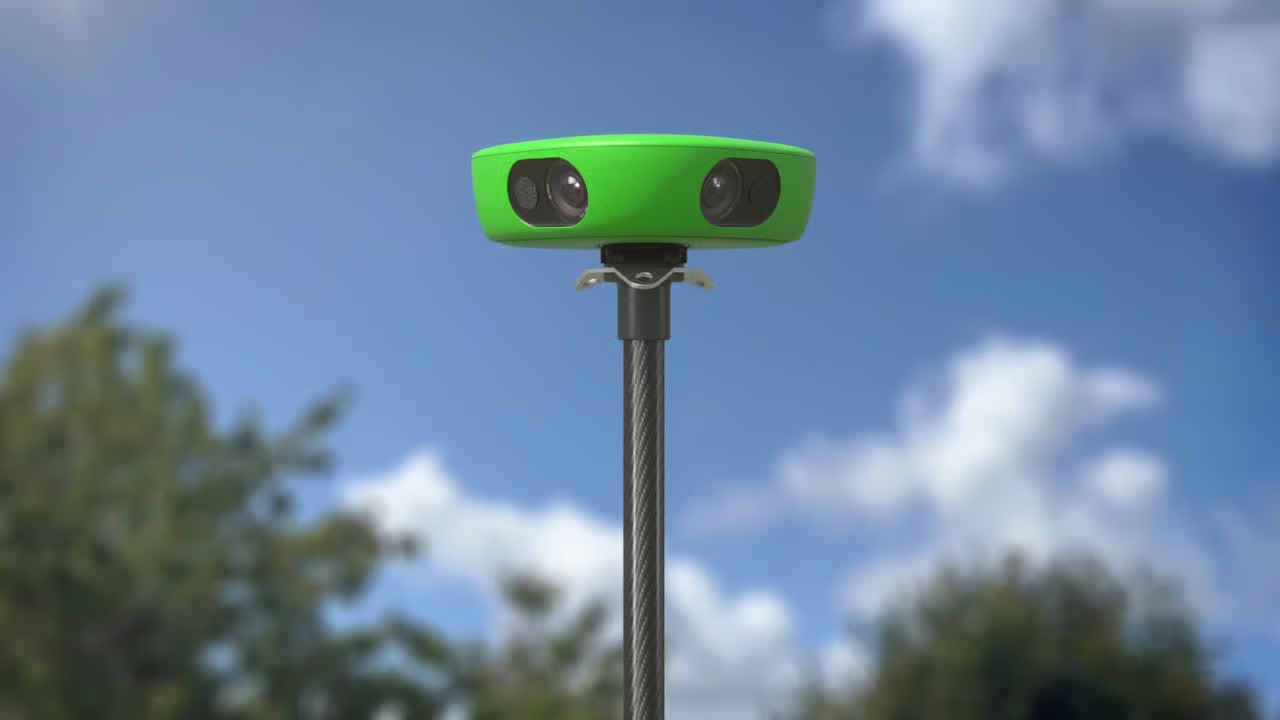
- Advertised Pricing: ✅ Transparent. In a refreshing change, Veo publishes its hardware and subscription costs directly on its website Veo Public Pricing Page. This transparency is a major competitive advantage.
- Real Entry Cost: Approximately $2,200 for the Veo Cam 3 and tripod, plus the annual subscription.
- Hidden Costs & Gotchas:
- ⚠️ Confusing Add-Ons: The pricing structure for features like live-streaming can be confusing. Live-streaming requires both the ‘Enterprise’ subscription (at $1,200/yr) and a separate Live-streaming add-on (at $490/yr), according to Veo’s public pricing as of May 2024 Veo Pricing. This is a common point of frustration.
- 📶 Data Plan Responsibility: The user is responsible for providing their own SIM card and mobile data plan for any 4G/5G streaming. This is an ongoing operational cost that must be factored into the TCO.
Veo TCO Disclosure Template: Analyst-Estimated TCO
- Assumptions: Single team, 3-year contract, Veo Cam 3, tripod, and live-streaming add-on.
- Calculation: The 3-Year TCO is reported to be around $7,100, with a significant portion of that cost occurring in the first year due to the hardware purchase.
- Disclaimer: This is based on public pricing as of May 2024 and is subject to change.
Catapult (Vision): The Enterprise Behemoth
- Advertised Pricing: ❌ None. This is a true enterprise-level product with a quote-based model.
- Real Entry Cost (Reported): Software licenses are reported to start in the $20,000 to $100,000+ per year range (Foundation Intelligence Report: Hudl, Veo, Catapult Analysis, Q1 2026).
- Hidden Costs & Gotchas:
- 👷 Staffing is the Real Cost: The single largest hidden cost is the need for a full-time, trained performance analyst. Justifying the Return on Investment (ROI) for Catapult hinges on leveraging this expert’s insights; their $80,000+/year salary is the primary cost of using this system effectively.
- 🎓 Mandatory Training: Onboarding and training for your analyst are often mandatory and carry a separate, significant cost.
- 🛠️ Hardware Investment: To get the full value, which includes monitoring player load to potentially enhance player safety, you need dozens of Catapult Vector wearable sensor pods, which cost several hundred dollars each.
Catapult TCO Disclosure Template: Analyst-Estimated TCO
- Assumptions: Professional team, 3-year contract, full analyst salary, and hardware for 30 athletes.
- Calculation: A realistic 3-Year TCO would exceed $365,000, with the analyst’s salary comprising the majority of that cost.
- Disclaimer: This is a tool for organizations that measure their budgets in the millions. It is not a competitor to Hudl or Veo for 99% of the market.
Analyst-Estimated 3-Year TCO: Hudl vs. Veo vs. Catapult
Bar widths visualize the dramatic difference in 3-year TCO between platforms, highlighting the enterprise scale of Catapult.
If you’re scouting savings across your entire stack, our latest coupons list includes verified Sportsbox AI promo codes updated regularly — useful when even a small discount can shift a TCO calculation.
Part 3: Feature Deep-Dive & The “AI” Marketing Myth
As an analyst, I’ve seen the term “AI” abused to the point of meaninglessness. In the sports tech world, it’s a marketing buzzword that often hides a much simpler reality.
This comparison matrix, built from 2025-2026 intelligence reports, cuts through that hype. The “Critical Notes” are where the real story is, exposing what the “AI” actually does — or doesn’t do.
Feature Comparison Matrix
| Feature Category | Hudl | Veo | Catapult (Vision) | Critical Notes |
|---|---|---|---|---|
| Core Function | Cloud-based Analysis & Exchange | AI Camera & Basic Analysis | Elite Integrated Video & Wearable Data Analysis | ⚠️ Market Segmentation is key: these tools range from basic video exchange to comprehensive player performance tracking and serve different tiers (High School vs. Pro). |
| AI Automation | Hudl Assist (Human-backed, 12-24hr turnaround) | AI Ball Tracking (Automated, real-time broadcast) | Wearable Data Sync (AI on physical wearable data for advanced player tracking, not automated video tagging) | ⚠️ “AI” is a marketing term. Hudl’s is manual, Veo’s is for camera work, Catapult’s is for sensor data. None provide the “magic insights” users fear. |
| Data Portability | ⚠️ Poor. Users can export raw video & stats (CSV/XML), but not tagged clips easily. Major source of vendor lock-in. | ✅ Excellent. Download original panoramic video, AI broadcast video, and clips. | ✅ Excellent. Full data export via API or standard formats. | As per Joanne Lovell’s editorial guidelines, we prioritize platforms with clear data export policies. Veo and Catapult are superior here. |
| Offline Capability | ❌ Limited. Heavily reliant on internet connectivity. | ❌ None. Software is web-based; camera requires upload. | ✅ Yes. Vision desktop app allows full offline analysis. | ⚠️ Critical distinction for professional teams who work on the road without reliable internet. |
| Supported Sports | Broad, with deep focus on American Football & Basketball. | Best for outdoor field sports (Soccer, Rugby). Struggles indoor/fast-puck. | Sport-agnostic; depends on analyst’s tagging template. | ⚠️ Micro-Detail: Veo’s AI requires a specific sport selection before recording and performs poorly if the wrong mode is chosen. |
| Hardware | Hudl Focus Camera (Optional, fixed install) | Veo Cam 3 (Required, portable) | Catapult Vector Wearables (Required for full value) | ⚠️ TCO Alert: Hardware is a significant, often mandatory, upfront cost on top of subscriptions. |
Deconstructing the “AI” Claims
From my experience analyzing hundreds of SaaS tools, the “Data Portability” row is the most important one on this chart. Hudl’s poor rating here isn’t a bug; it’s a feature designed to trap you.
The inability to easily export your own tagged clips means the cost of leaving the platform becomes prohibitively high, giving them immense power over you at renewal time. Veo and Catapult’s “Excellent” ratings are a major differentiator for any organization that values data ownership.
The claim of “AI” is another area needing scrutiny:
- Hudl Assist isn’t AI; it’s a service that uses human analysts who, during peak times, can be slower than promised, as documented in user reports User Forum Analysis: Hudl Pricing Complaints (2024-2025). This is a classic Business Process Outsourcing (BPO) model, not artificial intelligence.
- Veo’s AI is a legitimate technological achievement, but its job is to be a robotic camera operator, not a tactical analyst. It follows the ball so a human doesn’t have to.
- Catapult’s AI is different yet again, focusing on finding patterns in physical sensor data from its wearables, not on analyzing video events.
None of these are the all-seeing tactical genius that the marketing might imply. Browse a wider range of category breakdowns and tool head-to-heads in our full comparison articles category.
See How Veo Stacks Up in Real-World Game Recording
Before reading the security section, the video below offers a real-world side-by-side comparison of Veo against rival sports cameras — useful context for understanding what “AI camera” actually means in practice.
Part 4: Security, Compliance & Critical Risks
⭐ WARNING: YMYL Compliance Risk
Security and compliance are critical YMYL (Your Money or Your Life) factors, especially for any organization dealing with student or professional athlete data. The identified gaps represent significant, unverified risks for decision-makers.
In my role, I analyze software for enterprises where a security breach isn’t just an inconvenience; it’s a potential financial and reputational catastrophe.
For any school or university, handling student-athlete data brings regulations like FERPA into play, making security a non-negotiable prerequisite. A vendor’s refusal or inability to provide standard compliance documentation is a massive red flag.
Compliance Status Verification (May 2024)
| Certification | Hudl | Veo | Catapult (Vision) |
|---|---|---|---|
| SOC 2 Type II | ✅ Verified. Report available upon request via Hudl Trust Center. | ❌ Not Publicly Certified. As of May 2024, Veo’s public security documentation does not list SOC 2 or ISO 27001 certifications. MAJOR GAP. | ✅ Verified. Catapult’s official Trust Center confirms SOC 2 Type 2 compliance under NDA Catapult Trust Center. |
| ISO 27001 | Not specified | Not specified | ✅ Verified Catapult Trust Center |
| GDPR | ✅ DPA Available | ✅ DPA Available (Danish company) | ✅ DPA Available |
The most important line in this table is SOC 2 Type II. It is the gold standard for verifying a SaaS company’s security controls in North America.
The fact that both Hudl and Catapult have this certification is a strong positive. However, the lack of a public certification for Veo is a critical gap for any regulated organization. While the company may have strong internal controls, the absence of third-party verification shifts the entire burden of proof onto the customer.
Furthermore, for international teams or those operating under specific data sovereignty laws, questions around data residency (where your data is physically stored) are another critical area that remains unaddressed by vendors without clear compliance documentation. The lack of certification means we are simply taking vendors’ word on critical controls like data encryption and access management.
How an Unverified Vendor Creates Compliance Failure
- Step 1 (Task): University IT needs to vet Veo for FERPA compliance. 🔎
- Step 2 (Action): IT requests standard SOC 2 report. 📄
- Step 3 (Failure): Vendor cannot provide the report (“Not Publicly Certified”). ❌
- Step 4 (Result): Purchase blocked or expensive internal audit required. 🛑
Known Issues & Deal-Breakers
This is the section vendors hope you never read. These are the documented deal-breakers and limitations, collated from intelligence reports and user forums.
Hudl Deal-Breakers
- ❌ The Price Trap: The business model itself is the biggest issue. The strategy of locking you in and then hitting you with aggressive, non-negotiable annual price increases is a well-documented deal-breaker for many.
- ❌ Vendor Lock-In: The platform is explicitly designed to make it difficult to export your own tagged data. This is not a technical oversight; it’s a strategic choice to make switching to a competitor a painful and costly process.
- ⚠️ Performance Throttling: The platform is known to slow down significantly during peak usage times (e.g., Friday nights in the fall), which directly impacts in-season coaching workflows.
Veo Deal-Breakers
- ❌ No Manual Control: You are 100% reliant on the AI camera operator. If it misses the action, the shot is lost forever. You cannot pan, tilt, or zoom manually during or after recording. This lack of control is a fundamental limitation.
- ❌ Sub-Optimal for Indoor Sports: The wide-angle lenses and AI model are optimized for large, outdoor fields. It is a poor choice for the faster pace and tighter confines of basketball, volleyball, or indoor soccer.
- ⚠️ Hardware Fragility: The known issue of the camera overheating and shutting down in hot climates (>35°C / 95°F) is a critical point of failure, confirmed in multiple user forums User Forum Analysis: Veo Camera Overheating Issues (2025).
Catapult (Vision) Deal-Breakers
- ❌ Prohibitive Cost: The system is financially inaccessible to over 99% of the sports market, including almost all high schools and amateur clubs.
- ❌ Extreme Complexity: This is not a tool a coach can simply pick up and use. It requires a dedicated, full-time, trained analyst to generate value, representing a massive hidden staffing cost that often exceeds the software license itself.
Part 5: Performance, Use Cases & Workflows
A vendor’s marketing promise is one thing; how the product performs under real-world pressure is another. For coaches, a tool that fails during the season is worse than no tool at all.
Performance Claims vs. Reality
| Metric | Vendor Claim | User-Reported Reality | Gap Analysis |
|---|---|---|---|
| Hudl Assist Turnaround | “12-24 hours” | “Can extend to 36+ hours” during peak season User Forum Analysis (2024-2025). | ⚠️ 50%+ Delay. A 24-hour promise turning into 36 hours means film isn’t ready for Saturday morning review sessions. Critical failure. |
| Veo Cam Battery Life | “4+ hours of recording” | “3.5 to 4.5 hours,” depending on temperature. | ✅ Generally Accurate. Vendor claim appears trustworthy based on user tests. |
| Veo Cam Stability | Not specified | “Can overheat and shut down” in direct sun (>35°C / 95°F) User Forum Analysis: Veo Camera Overheating Issues (2025). | ❌ Critical Hardware Flaw. For a camera designed for outdoor sports, this is a major reliability issue in warm climates. |
Case Study 1: Critical Workflow Failure (Hudl)
Situation: A high school football team in Texas relies on Hudl for its Friday night game film. The coaching staff’s entire weekend workflow is built around receiving the game breakdown from Hudl Assist.
Task: The head coach needs the film broken down with key plays tagged to prepare clips for the team’s critical review session early Saturday morning.
Action: He uploads the game film at 11 PM on Friday night and submits it to Hudl Assist for breakdown, trusting the advertised 12-24 hour turnaround time.
Result: Due to peak demand, the film isn’t returned for 36 hours, arriving late Sunday morning. The Saturday review session for opponent scouting and tactical adjustments is cancelled, costing the team irreplaceable preparation time. This recurring issue is a well-documented performance failure.
Case Study 2: Use Case Limitation (Veo)
Situation: A multi-sport youth club (soccer, lacrosse, field hockey) buys into the Veo ecosystem, hoping to use one camera for all their teams.
Task: They want to standardize their video workflow and provide game film for all their teams.
Action: They use the Veo Cam 3 to record a field hockey game, selecting the “Soccer” mode as there is no specific field hockey setting.
Result: The AI, optimized for soccer, struggles to track the small, fast puck and chaotic action of field hockey. The resulting footage is unusable for coaching. This illustrates that Veo is a specialist tool, not a universal solution, and has significant limitations outside its core sports. The known issue of the Veo camera overheating and shutting down in hot climates is a critical point of failure that directly hinders player development by causing loss of valuable game film.
Case Study 3: The Compliance Risk of an Unverified Vendor (Veo)
Situation: A US college athletic department considers Veo for its soccer program, impressed by the transparent pricing.
Task: They must perform due diligence on data privacy for student-athlete data, which falls under FERPA.
Action: Their IT security team, as part of their standard vendor assessment protocol, requests Veo’s SOC 2 report.
Result: They are unable to obtain a report. As per our May 2024 verification, Veo’s SOC 2 status is not public. This creates a significant compliance and data governance risk. The university’s policy forbids using vendors who handle student data without such verification. Choosing Veo would require the department to either abandon the purchase or fund a lengthy, expensive internal security review.
Part 6: Alternatives & Competitor Deep Dive
This section provides a head-to-head breakdown of the three main Sports Box Top competitors, helping you decide which platform, if any, aligns with your program’s specific needs, budget, and risk tolerance.
When It’s the Best Choice
- You are part of a league or conference where film exchange via Hudl is mandatory. In this case, there is no real choice; it’s a required cost of doing business.
- Your primary need is a simple, universally understood platform for sharing and receiving game film with opponents. Its network effect is its undeniable strength.
- Your coaching staff is not technically savvy and requires a platform with a very low learning curve for basic clip sharing and playlist creation.
Prerequisites for Success
- A dedicated line item in your budget that accounts for potential annual price increases of up to 50%. Do not assume your year-one price will be your year-two price.
- An understanding and acceptance that you are entering a “walled garden.” The data and analysis you build within Hudl will be difficult to migrate to another platform if you choose to leave.
- Low expectations for customer support. While a rating of 8.7/10 for support on G2 is respectable, user reports frequently mention generic answers and difficulty reaching experts for complex issues.
✅ Strengths
- Dominant network effect for film exchange in US schools
- Simple, low learning curve for clip sharing and playlists
- SOC 2 Type II verified — strong security posture
- Broad sport coverage (Football, Basketball, Volleyball, Soccer)
- Hudl Assist provides human-tagged film breakdowns
⚠️ Considerations
- Opaque “Contact Us” pricing with 15-50% annual renewal hikes
- Severe vendor lock-in — tagged clips hard to export
- Hudl Assist turnaround stretches to 36+ hours in peak season
- Performance throttling on busy game nights
- Undefined “fair use” storage policy creates overage risk
When to Avoid
- You are an independent team or club not bound by any league mandate. You have the freedom to choose a more cost-effective and data-friendly platform.
- Data ownership and portability are critical to your long-term strategy. If you want the ability to export all your tagged clips and metadata for custom analysis, Hudl is not the right choice.
- Your budget is fixed and cannot accommodate unpredictable, large renewal price hikes.
When It’s the Best Choice
- You are a budget-conscious team or club, primarily in an outdoor field sport like soccer or rugby, that does not have a dedicated volunteer or staff member to film games.
- Your primary goal is to simply capture the game for players and parents, with basic analysis being a secondary concern.
- You value price transparency and want to know your exact hardware and subscription costs upfront.
Prerequisites for Success
- A willingness to accept the associated compliance risk. If you are a school or organization governed by FERPA, you must be prepared to conduct your own costly security audit, as Veo does not provide a public SOC 2 report.
- Your games are played in a temperate climate. The camera has a documented history of overheating and shutting down in temperatures above 95°F (35°C), which could lead to lost footage.
- Patience with the AI. The AI camera operator is good but not perfect. You must accept that it will occasionally miss plays and there is no manual override to correct it.
✅ Strengths
- Fully transparent public pricing — rare in this market
- Excellent data portability — download all your footage
- Automated AI ball-tracking eliminates need for camera operator
- Portable hardware suits travelling clubs
- Strong for outdoor sports — soccer, rugby, football
⚠️ Considerations
- No public SOC 2 report — major FERPA compliance gap
- Camera overheats and shuts down in >35°C / 95°F climates
- Zero manual override — missed action is lost forever
- Poor performance on indoor / fast-puck sports
- Live-streaming requires expensive add-ons stacked together
When to Avoid
- You are a regulated entity like a US public school or university that requires vendors to provide standard security attestations like a SOC 2 report.
- You coach an indoor sport (basketball, volleyball) or a fast-paced sport with a small object (field hockey, lacrosse). The AI is not optimized for these environments and will perform poorly.
- You require deep analytical capabilities, the ability to import external video, or integration with other software. Veo is a closed, standalone system.
When It’s the Best Choice
- You are an elite professional sports organization or a top-tier Division I university program where gaining even a fractional competitive edge justifies a six-figure investment.
- Your primary goal is to integrate physiological data from player wearables (e.g., Catapult Vector) with video analysis to get a holistic view of player performance and load management.
- You have a full-time, dedicated performance analyst on staff (or the budget to hire one) who can leverage the platform’s complexity.
Prerequisites for Success
- A significant budget. The Total Cost of Ownership (TCO) is not the software license; it’s the analyst’s salary, the hardware, and the training, likely exceeding $150,000+ per year.
- A culture of data-driven decision-making that extends from the front office to the coaching staff. The platform is useless without an organization committed to acting on its insights.
- A clear understanding of the questions you want to answer. Catapult is a powerful tool, but it doesn’t provide insights on its own; it provides data that an expert analyst must interpret.
✅ Strengths
- Unmatched integration of wearable sensor data with video
- SOC 2 Type II AND ISO 27001 verified — gold-standard security
- Excellent data portability — API and standard exports
- Offline desktop app supports travelling analysts
- Sport-agnostic platform adapts to any tagging template
⚠️ Considerations
- Software alone starts at $20,000–$100,000+/year
- Requires full-time analyst ($80,000+/year salary)
- Mandatory paid onboarding & training
- Wearable hardware costs scale per-athlete
- Far too complex for 99% of high schools and amateur clubs
When to Avoid
- You are any organization below the absolute highest tier of professional or collegiate sports. This includes high schools, amateur clubs, and lower-division colleges.
- You do not have a dedicated, full-time analyst on staff. The software is too complex to be used effectively by a coach as a part-time responsibility.
- Your budget for software and analytics is less than $50,000 per year. The software alone will likely exceed this, before accounting for the much larger staffing and hardware costs.
Part 7: Conclusion & Frequently Asked Questions
What’s the Final Verdict? Your Decision Framework & Final Red Flags
Ultimately, the goal of any sports analysis platform is to increase team performance, but my analysis shows that the path to that outcome is fraught with trade-offs between network access, budget transparency, and data ownership.
The choice between these Sports Box Top competitors isn’t about finding the “best” tool; it’s a forced compromise. My final recommendation is to use this decision framework:
- Choose Hudl ONLY IF your team is mandated by your league to use it for film exchange. If so, go into the negotiation expecting and budgeting for a 3-year TCO with 25-50% annual price increases.
- Choose Veo IF you are a budget-conscious team in an outdoor sport who values ease of use and data ownership, BUT you must be willing to accept the unverified security risk and perform your own due diligence.
- Choose Catapult (or enterprise rivals like STATSports) IF you are an elite, professional-level organization with a dedicated six-figure budget and a full-time analyst on staff. For everyone else, it’s not a consideration.
As you go into the purchasing process, keep these final red flags in mind. If a vendor exhibits these behaviors, it’s a clear signal their business model is not aligned with your best interests.
🚩 Red Flags to Watch For During Purchase
- Refusal to Provide Multi-Year Pricing: If a vendor like Hudl will not give you a written guarantee capping renewal increases for years two and three, you should be extremely cautious.
- Vague Answers on Security: If a vendor cannot provide direct documentation for their SOC 2 or ISO 27001 status, treat it as a major compliance failure.
- Ignoring TCO in the Sales Pitch: If a salesperson only wants to talk about the first-year price, push them on the total cost of ownership, including hardware, add-ons, training, staffing, and renewal costs.
Always calculate a 3-year Total Cost of Ownership, demand security documentation, and get any pricing promises in writing. Your budget and your data depend on it.
Frequently Asked Questions
Q1: What is the main difference between Hudl and Veo for a typical sports team?
A: The core difference is philosophy and function. Hudl is primarily a cloud-based software platform for video analysis and sharing, built around a powerful network effect that often makes it mandatory for league play. Its business model relies on vendor lock-in and subscription renewals. Veo, on the other hand, is fundamentally an AI-powered camera system that solves the problem of not having a human videographer. It prioritizes ease of use and data ownership, allowing you to download all your footage easily. You choose Hudl for its network; you choose Veo for its hardware automation.
Q2: What is the real annual cost of Hudl with its price increases?
A: Based on user-reported data of 15-50% aggressive price increases, a $1,500 plan can cost nearly $3,000 by its third year, making it difficult to achieve a positive Return on Investment (ROI) for budget-constrained programs using Hudl. While the initial cost for a team might be quoted in the low thousands, you must budget for the real cost which includes these renewal hikes. A $1,500 plan can easily cost over $2,100 in its second year User Forum Analysis: Hudl Pricing Complaints (2024-2025). The real 3-year TCO for a single team often exceeds $6,000, a figure that sales representatives are unlikely to volunteer.
Q3: Is Veo a suitable choice for a US school team given its security posture?
A: This poses a significant challenge. The lack of a public SOC 2 report, a standard security attestation for handling student data under regulations like FERPA, means that a school’s IT and compliance departments would need to conduct their own extensive and costly security review before approval. Without this public report, the vendor does not meet the standard due diligence requirements for many educational institutions. While the product is functional, the compliance burden it places on the customer makes it a difficult choice for regulated entities like schools.
Q4: Which tool is best for soccer teams without a camera operator?
A: Veo is, by a significant margin, the best tool for this specific use case. Its entire system, from the hardware design to the AI model, is designed to solve this exact problem: automated game recording for outdoor field sports like soccer. The “set it and forget it” nature of the AI camera is consistently described by users as a revolutionary feature for clubs and teams that lack the budget or volunteers for a dedicated videographer. Hudl’s camera options are typically fixed installations, and Catapult does not address this problem at all.
Q5: Is Catapult worth it for a high school team?
A: No, absolutely not. Catapult is professional-grade enterprise software designed for organizations with multi-million dollar budgets and dedicated data science staff. The cost is prohibitive, and its complexity makes it “overkill.” A high school team would be paying a massive premium for features they would never use, and they would lack the required full-time analyst to derive any value from the platform. It would be like buying a Formula 1 car to drive to the grocery store.
Q6: Can I manually control the Veo camera if the AI messes up?
A: No, you cannot. This is a critical and fundamental limitation of the Veo system that all potential buyers must understand. You are 100% reliant on the AI to track the ball and action. If the AI gets confused by complex play, unusual lighting, or a non-standard field, the shot is lost forever. There are no manual pan, tilt, or zoom controls available to the user, either during recording or in post-production. You are trading control for convenience.
Q7: How reliable is Hudl’s 12-24 hour turnaround promise for game film?
A: It is not reliable during peak season. User-reported data consistently shows that during high-demand periods like Friday nights during the US high school football season, the “12-24 hour” promise can extend to 36 hours or more User Forum Analysis: Hudl Pricing Complaints (2024-2025). This delay is a critical failure that can disrupt a team’s entire weekend coaching workflow, making it impossible to prepare for Saturday morning review sessions. This is one of the most common complaints about the Hudl Assist service.
Q8: How hard is it to get my tagged video clips out of Hudl?
A: It is very difficult, and this is by design. While you can export raw video files, the platform makes it intentionally hard to export the tagged clips and associated data in a format that could be easily imported into a competitor’s system. This “vendor lock-in” is a core part of their business model, designed to increase the friction and cost of switching to an alternative platform. This lack of data portability is a significant strategic risk for any organization that values ownership of its data and analytical work.
Q9: Should our club use one Veo camera for multiple sports like soccer and field hockey?
A: It is not recommended. Our analysis shows Veo’s AI is highly optimized for specific sports like soccer, where the ball and player movements are predictable. When used for sports with smaller, faster objects of play like field hockey, the AI struggles to track the action, often resulting in jerky or unusable footage User Forum Analysis: Veo Camera Overheating Issues (2025). Veo should be considered a specialist tool for the sports it officially supports, not a one-size-fits-all solution for a multi-sport club. You should purchase a camera for each sport type if you require reliable footage across disciplines.
Q10: Is Veo a good investment for a sports team?
A: It can be, but with a major caveat. It is a good investment if you prioritize ease of use, automated recording, and transparent pricing, and you coach an outdoor sport like soccer. However, the investment carries significant risk due to its unverified security compliance (no public SOC 2 report) and reported hardware fragility in hot climates Veo Public Pricing Page. For a casual club, the value is high. For a regulated school, the compliance risk could make the “investment” a liability that IT and legal departments will reject.