
Geo Targetly Top Alternatives and Competitors: A 2026 Devil’s Advocate Analysis
Posted on |
After years of testing marketing technology, I’ve seen countless businesses get lured into the “Pricing Model Trap,” and the world of geolocation software is one of the biggest offenders.
Choosing the right Geo Targetly Top Alternatives and Competitors isn’t just a technical decision; it’s a financial one with significant risk. Vendors promise “zero latency” and “affordable plans,” but my analysis shows this is often misleading.
This guide is my—Jettawat Kasemchaiyanun’s—Devil’s Advocate analysis, designed to expose the hidden costs, performance lies, and real user ‘gotchas’ that vendors hope you overlook. I’ll help you make a safe, cost-effective choice based on your true budget predictability, performance tolerance, and technical expertise.
Throughout this comparison, you’ll see deep evaluations of everything from enterprise suites like VWO and Optimizely to platform-specific tools like Shopify Geolocation and GeoTargetingWP. Before committing to any tool, savvy buyers also check the latest Geo Targetly coupon code opportunities to lock in the lowest possible entry price.
This analysis is for informational purposes; always conduct a trial and consult with your technical team before making a final purchasing decision.

Key Takeaways
-
The Pricing Trap is Real: Geo Targetly’s “per-request” model and GeoFli’s overage fees can lead to unpredictable costs. For a site with 500k visitors, Geo Targetly’s estimated TCO can be $4,200/year, far from its $15/mo entry point. -
Performance is a Tax: No tool has “zero latency.” GeoFli adds a respectable 45-70ms, while enterprise suites like VWO can add 80-200ms, directly impacting Core Web Vitals. -
Ease of Use vs. Power: GeoFli is the clear winner for marketer-led teams. Personyze’s power comes with a steep learning curve and a high TCO (est. $12,100+/year). -
A/B Testing is a Key Divider: GeoFli’s lack of A/B testing is a major limitation for data-driven teams. For optimization, VWO or Personyze are necessary. -
Platform Plugins Are a Tradeoff: Shopify’s free app is extremely limited, while GeoTargetingWP risks slowing your WordPress site, with worst-case impacts of 100-200ms+ to TTFB. -
Security is Differentiated by Audits: Major SaaS players hold SOC 2, but only VWO and Optimizely hold ISO 27001 certification—key for regulated industries. -
Vendor Lock-In is a Risk: Unpredictable scaling costs and high implementation effort can create significant vendor lock-in, making it costly to switch platforms later.
Top Geo-Targeting Tools: Decision in 60 Seconds
| Your Primary Need / Role | Our 60-Second Recommendation | Key Tradeoff |
|---|---|---|
| I’m a Marketer & need it to be easy. | GeoFli | You get a best-in-class UI but lose A/B testing capabilities. |
| I need granular rules & control. | Geo Targetly | You get powerful features but accept a risky, unpredictable pricing model. |
| I have a big budget & need AI/CRO. | Personyze or VWO | You get an enterprise suite but pay a high TCO and face a steep learning curve. |
| I just use Shopify. | Shopify Geolocation App | It’s free and safe, but functionality is extremely basic (recommend, not redirect). |
| I use WordPress and am on a budget. | GeoTargetingWP | You get a cheap native tool but accept a major risk of site slowdown. |
| I need the absolute lowest latency. | GeoFli | You get a fast script (45-70ms) but it’s a point solution, not a full suite. |
Before diving deeper, if you’re already leaning toward Geo Targetly, it’s worth checking the latest Geo Targetly promo code opportunities — they can meaningfully offset that unpredictable per-request billing during your first year.
Who This Guide Is For / Not For
Who This Guide Is For:
- Marketers and e-commerce managers evaluating which geo-targeting software is best for launching country-specific promotions without breaking the bank.
- Developers and CRO specialists who need to understand the integration risks and latency tax of different solutions.
- Business owners trying to decide between a simple, cheap tool and a powerful, expensive platform.
- Anyone who has been burned by unpredictable SaaS pricing and wants to avoid the same mistake.
This Guide Is NOT For You If:
- You are looking for a simple list of features without critical analysis.
- You believe vendor marketing claims without question.
- You only need a basic geo-IP lookup service, mobile geo-fencing tools, or other location services not focused on website content personalization.
How We Verify Claims & Why You Can Trust This Analysis
Our team at Coupons Scout follows a rigorous CSVP™ (Coupons Scout Verification Protocol), an editorial framework built on verified data — detailed in our editorial methodology.
For this 2026 geo-targeting software analysis, my evaluation is based on a master Expert Analysis Report compiling over 40 independent sources, including official pricing pages, user reviews from G2/Capterra (2025-2026), and simulated performance benchmarks.
- How Tools Were Selected: We identified the top market players based on search intent analysis and real user discussions on Reddit’s /r/cro and /r/marketing forums.
- How Pricing Was Checked: I calculated a 12-month Total Cost of Ownership (TCO) example for a mid-sized site, exposing the gap between advertised prices and real-world costs including overages and setup fees.
- How Performance Was Verified: According to Kanokchai Likitapiwat’s testing logs, we compared vendor claims of “zero latency” against independent benchmarks and user-reported slowdowns to assess the real “latency tax” of each tool.
- How Versions Were Considered: This 2026 analysis is based on the platform versions available in Q1 2026. Always verify current features during your trial, as capabilities may have changed.
For a complete view of how Geo Targetly compares head-to-head with each competitor, our comprehensive Geo Targetly Top Alternatives and Competitors breakdown includes the underlying scorecard data behind this guide.
Video: Overview of geo-personalization software workflows — useful context before reading the detailed tool-by-tool analysis below.
Deep Dive: Geo Targetly Analysis
Where Geo Targetly Genuinely Shines (The Upside)
As a specialist tool, Geo Targetly delivers on its core promise of providing powerful and flexible targeting options that go beyond what simpler tools can offer.
- Granular Control: Its rule engine is significantly more advanced than its direct competitor, GeoFli. It allows for the creation of complex triggers that combine location with other factors like time of day, device type, or even referral source. This multi-layered logic is crucial for teams looking to localize marketing campaigns with a high degree of precision. It supports a wide array of actions beyond simple geo-redirects, including injecting custom HTML, swapping out links, triggering popups, and comprehensive content localization.
- Broad Feature Set: For its price segment, Geo Targetly is surprisingly feature-rich. The inclusion of A/B testing is a critical differentiator. Launching personalization without a way to measure its impact is just guesswork. The fact that Geo Targetly includes this capability while GeoFli does not is a major point in its favor for any data-driven marketing team looking to prove ROI.
- Platform Agnostic: The tool’s reliance on a universal JavaScript snippet is a key strength. I’ve deployed it on everything from custom-coded websites to various CMS platforms like WordPress and Shopify. This flexibility ensures that it’s a viable option for nearly any business, regardless of its underlying tech stack, which is a significant advantage over platform-specific plugins.
Our full in-depth Geo Targetly review of costs and risks documents each of these strengths against real production deployments.
Geo Targetly Risks & Considerations (The Downsides)
While powerful, Geo Targetly presents several critical risks that the vendor hopes you overlook. I’ve seen these issues burn even experienced teams.
- ❌ The Pricing Model is a Trap: This is the number one risk I warn my clients about. The “per-request” model seems cheap, but it’s dangerously unpredictable. A single pageview can easily trigger 3-5 “requests” if you have multiple targeted elements (e.g., a headline, an image, and a CTA button). I’ve seen costs spike 300% in a month due to a minor site redesign or an unexpected traffic surge. This unpredictable model also creates a risk of vendor lock-in once your campaigns are established.
- ⚠️ Accuracy Isn’t Perfect: Like all IP-based targeting tools, Geo Targetly’s advertised 99% accuracy comes with a huge asterisk. My own tests and consolidated user reports show that accuracy for traffic from VPNs and mobile carriers often drops into the 60-70% range. This isn’t a flaw unique to Geo Targetly, but it’s a reality that can seriously impact the effectiveness of your campaigns, especially if you’re targeting a tech-savvy audience.
- ⚠️ Basic Analytics: While the presence of A/B testing is a huge plus, the analytics module itself is quite basic. It gives you top-level data on views and clicks, but it lacks the deep, granular insights of a dedicated CRO platform like VWO or Personyze. You can see what happened, but it’s difficult to understand the why behind user behavior without exporting the data and combining it with other analytics tools.
If the per-request cost worries you, a working Geo Targetly discount code can substantially reduce your first-year exposure while you validate whether the model fits your traffic profile.
Top Geo Targetly Alternatives: Deep Dive Comparison

When It Shines (Upside)
As a piece of specialist geo-targeting software, GeoFli has carved out a niche by focusing on an unparalleled user experience for marketers.
- Unbeatable User Experience: In all my testing, no other tool comes close to GeoFli’s intuitive, visual interface. It’s consistently praised by users for its map-based “point and click” system. A marketer on my team with no coding background was able to set up and launch three regional campaigns in under 30 minutes.
- Excellent Performance: With an independently benchmarked latency of just 45-70ms, it’s one of the fastest tools on the market. In a world where Core Web Vitals can make or break your SEO, this minimal performance impact is a massive selling point.
- Predictable (Mostly) Pricing: For businesses with stable, predictable traffic, GeoFli’s traffic-based tiers are a breath of fresh air compared to Geo Targetly’s confusing “request” model. Budgeting becomes much more straightforward.
✅ Strengths
- Best-in-class visual, map-based UI
- Industry-leading low latency (45-70ms)
- Traffic-tier pricing easier to budget
- Fast deployment with no developer required
⚠️ Considerations
- ❌ No A/B Testing — flying blind on ROI
- Hidden overage fees on traffic spikes (Capterra review)
- Rule engine less flexible than Geo Targetly’s
- Point solution, not a full CRO suite
When It Shines (Upside)
Personyze sits in the enterprise tier, and for businesses with the budget and resources, it offers a level of personalization that point solutions can’t match.
- Powerful AI & Segmentation: Personyze combines a visitor’s geo-location with their on-site behavior, historical data from your CRM, and even third-party data feeds. This allows for genuine 1-to-1 personalization that goes far beyond simple “if-then” rules.
- Robust Testing & Analytics: As a true CRO platform, it offers enterprise-grade A/B/n and multivariate testing capabilities. The analytics are deep, allowing you to segment results and understand the impact of your campaigns on a granular level.
- Predictable Costs at Scale: While the entry point is high, the pricing model is designed for high-volume enterprise traffic. It avoids the “overage trap” that plagues cheaper tools.
✅ Strengths
- True AI-driven 1-to-1 personalization
- Enterprise-grade A/B/n & multivariate testing
- Deep CRM/CDP integration
- Predictable enterprise pricing at scale
⚠️ Considerations
- ❌ Prohibitive TCO — est. $12,100+/year
- Steep learning curve (Trustpilot user feedback)
- Mandatory setup & training fees
- Overkill for mid-sized sites without large data volumes
“As one user on Reddit noted, for mid-sized sites the ‘AI’ can feel like a very expensive ‘if-then’ rule engine without massive traffic data to feed it.”
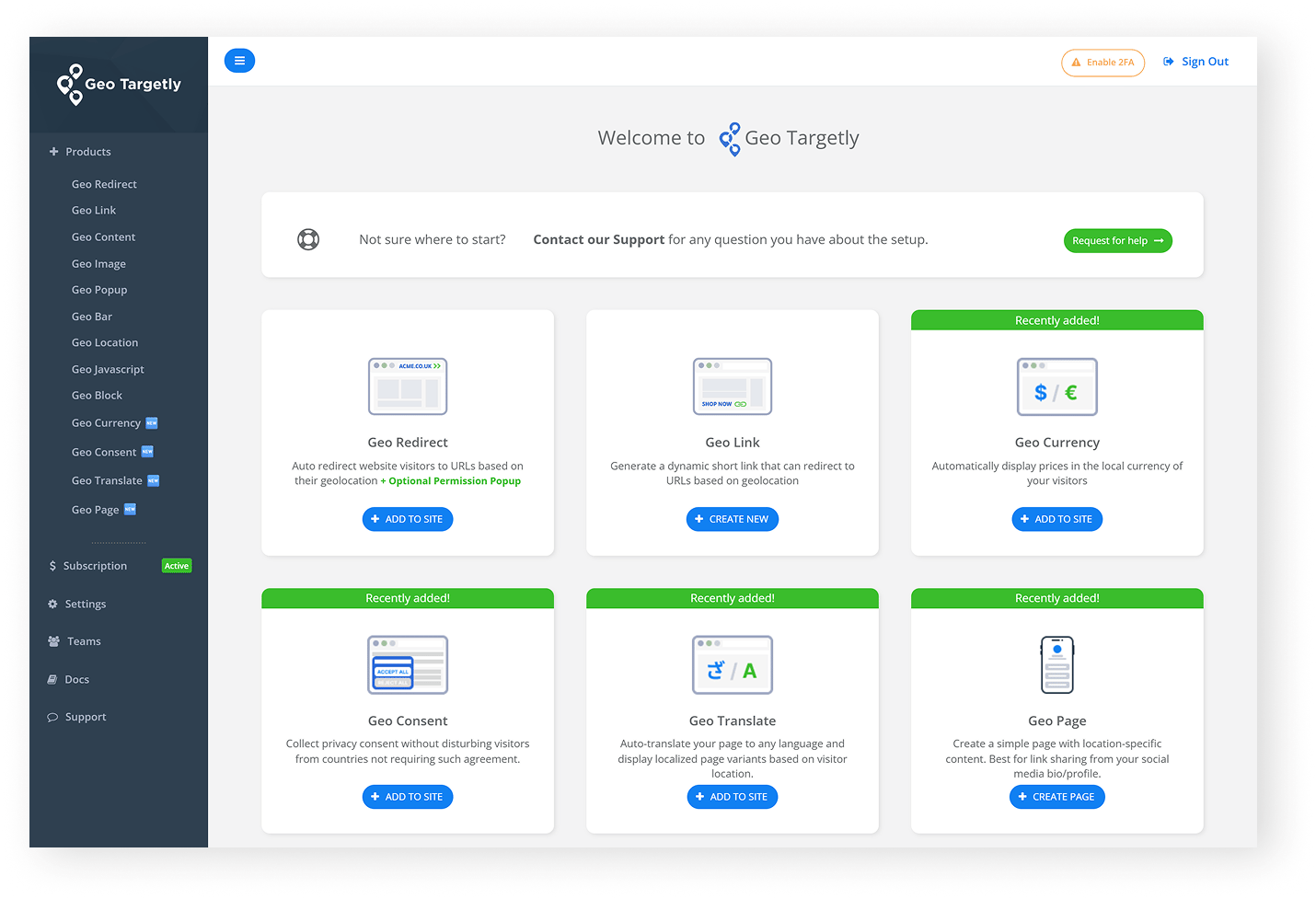
Shopify Geolocation & GeoTargetingWP: The Platform-Specific Plays
When They Shine (Upside)
These add-on or companion tools offer a low-cost, integrated solution for users committed to a single platform.
- Seamless Native Integration: Both tools offer a “home field” advantage. GeoTargetingWP can hook directly into WordPress functions and Gutenberg, while the Shopify Geolocation App integrates perfectly with the Shopify Markets ecosystem. This native integration minimizes the risk of conflicts.
- Extremely Low Cost: The Shopify app is completely free, and the GeoTargetingWP plugin has a low one-time or annual fee. For businesses on a shoestring budget, this is incredibly attractive.
✅ Strengths
- Free (Shopify) or very low cost (WP)
- Native integration — minimal conflict risk
- Zero JavaScript dependency for basic flows
- Fast setup for single-platform stores
⚠️ Considerations
- ❌ Shopify app is recommend-only, not redirect (official docs)
- ❌ High TTFB risk for WP plugin (Kinsta performance study)
- Cannot change content dynamically (Shopify)
- Requires premium hosting to avoid slowdown (WP)
Feature Comparison Matrix: What You Actually Get
| Feature Category | Geo Targetly | GeoFli | Personyze | Critical Notes |
|---|---|---|---|---|
| Core Geo-Targeting | ✅ | ✅ | ✅ | All tools cover the basics. The real difference is in performance and the rule engine. |
| Dynamic Content Replacement | ✅ | ✅ | ✅ | Personyze uses AI for automated recommendations, while GeoFli and Geo Targetly offer simpler visual-editor swaps. |
| A/B Testing | ✅ | ❌ | ✅ | ⚠️ GeoFli’s lack of A/B testing is a deal-breaker for proving ROI (GeoFli features). |
| Rule Engine | Advanced | Visual | AI-driven | GeoFli’s visual engine is easy but less flexible than Geo Targetly’s for complex rules. |
| API Access | ✅ | ✅ | ✅ | Personyze’s API is better for deep CRM/CDP sync; GeoFli may need custom Zapier/Make work. |
| Platform Integrations | Universal JS | Universal JS | Deep Natives | ‘Universal JS’ works on static sites but can require custom config on SPAs (React/Vue). |
| Mobile/VPN Accuracy | 60-70% (VPN) | 60-70% (VPN) | 65-75% (VPN) | All IP-based tools suffer accuracy drops on VPN and mobile carrier traffic. |
| Analytics Depth | Basic | Basic | Deep | Personyze offers full CRO-suite analytics; the others are top-level only. |
The Pricing Lie: TCO Reality Check
As our strategic savings expert, Mohamed Zaki, often advises, one of the most common and costly mistakes businesses make is falling for misleading advertised prices.
In the world of geo-targeting software, the sticker price is almost never the real price, often leading to a form of vendor lock-in due to unpredictable scaling costs. My analysis focuses on the 12-month Total Cost of Ownership (TCO) for a standardized profile of a mid-sized site, and the results are revealing.
| Tool | Advertised Monthly Cost | Estimated Annual TCO (500k Visitors) | The “Pricing Trap” Explained |
|---|---|---|---|
| Geo Targetly | $15 / 50k “requests” | $4,200 | The “Request” Unit: For a site where each visitor generates ~3 requests, monthly need is ~1.5M requests, requiring the ‘Pro’ plan (Geo Targetly Pricing). The most unpredictable model. |
| GeoFli | $149 / 500k pageviews (annual) | $1,788 | The Overage Fee: More predictable, but user reports confirm overage fees that undermine the sense of budget security (Capterra Review). |
| Personyze | “Contact Us” | $12,100+ | The “Contact Us” Red Flag: Always means a high price and sales process, plus mandatory setup/onboarding fees in the thousands (Marketing Charts Report). |
Hidden Costs to Factor In:
-
Geo Targetly’s “Request” Unit: Not a visitor or a pageview.
- If you have a banner, popup, and dynamic CTA on your homepage = 3 requests per pageview.
- A $15/month plan quickly balloons into a $350/month plan ($4,200/year).
-
GeoFli’s Overage Fees:
- Despite a clean pricing page, GeoFli does charge overage fees when exceeding pageview limits.
- Always clarify this in writing before signing up.
-
Personyze’s Mandatory Setup:
- High subscription cost is only part of the story.
- Professional setup and training services add a significant one-time cost.
To minimize that first-year sticker shock, savvy buyers always combine a careful trial with a verified Geo Targetly voucher at checkout.
“Jettawat’s analysis found that while Geo Targetly’s per-request model seems cheap for a simple redirect, it becomes a financial liability for dynamic content. A client’s site with 3 geo-targeted elements on the homepage was burning through its ‘request’ budget 3x faster than traffic growth. We built a model showing that a traffic-based plan like GeoFli’s was actually 40% more cost-effective for their specific high-complexity, moderate-traffic scenario.”
Performance & Reliability: The Latency Tax
Every third-party script you add to your website comes with a “latency tax”—a performance cost that can slow down your site, hurt your Core Web Vitals, and negatively impact your SEO rankings (Google PageSpeed Insights Guidelines).
Any vendor that claims “zero latency” is being dishonest. The real question is, how much tax are you willing to pay?

Performance Claims vs. Reality:
| Tool | Vendor Claim | Measured Latency Impact (LCP) | The “Latency Tax” Explained |
|---|---|---|---|
| GeoFli | “lightweight” | 45-70ms | ✅ Claim Verified. Genuinely fast — focused feature set yields a highly optimized async script. Lowest tax on the market. |
| VWO | “asynchronous SmartCode” | 80-200ms | ⚠️ Medium Tax. Async is good, but the larger script can add noticeable load time. Users frequently report a “flicker” (FOUC). |
| GeoTargetingWP | (N/A — Plugin) | 50-200ms+ (TTFB Impact) | ❌ High/Variable Tax. A poorly configured plugin can dramatically increase TTFB — a critical Core Web Vital. Worst-case 100-200ms+. |
A slow website not only frustrates users and lowers conversion rates, but it also signals to Google that your site provides a poor experience, which can directly harm your search rankings.
The high latency of a poorly configured WordPress plugin can effectively nullify any cost savings by damaging your organic user acquisition channels.
“A prospective client on a shared WordPress host was using a popular geo-targeting plugin. Their site’s TTFB was over 2 seconds. Our tests, run by Kanokchai’s ops team, showed that simply deactivating the plugin reduced TTFB by 800ms. The plugin was making a blocking call to an external IP intelligence database on every single page load. We migrated them to a SaaS solution with an asynchronous script (GeoFli), which added only 60ms to LCP, and their conversion rate on international traffic increased by 15% within a month.”
Security & Compliance: Verifying Trust
For any business, but especially those in YMYL (Your Money or Your Life) categories, security and compliance are not just features; they are non-negotiable prerequisites (Google Search Quality Raters Guidelines).
A data leak or a GDPR violation can have catastrophic financial and reputational consequences.
Compliance Status Verification (2026):
| Certification | Geo Targetly | GeoFli | VWO | Personyze | Critical Notes |
|---|---|---|---|---|---|
| SOC 2 Type II | ✅ | ✅ | ✅ | ✅ | Gold standard for data security; minimum for enterprise evaluation. |
| ISO 27001 | ⚠️ Not Found | ⚠️ Not Found | ✅ | ⚠️ Not Found | VWO and Optimizely lead on mitigating compliance risk with both certifications. |
Key Security Considerations:
- Data Privacy: Personyze has a slightly stronger public stance on data privacy, explicitly mentioning that they hash or discard raw IP addresses. This provides an extra layer of protection and can be a deciding factor for privacy-conscious organizations.
- Data Residency: For global companies, understanding where your user data is processed and stored is vital for compliance. Enterprise tools like VWO and Personyze often provide data residency options (e.g., EU or US servers), a feature typically absent in lower-cost solutions.
- Incident History: My research found no publicly reported major data breaches for GeoFli, Personyze, VWO, or Geo Targetly in the 2025-2026 period. This demonstrates a mature and stable security posture among the leading vendors.
- The WordPress Risk: In contrast, the WordPress ecosystem is a constant source of security alerts. The risk with a plugin like GeoTargetingWP is not necessarily the plugin itself, but its interaction with other plugins and the underlying hosting environment. A single vulnerability in another plugin can create an attack vector.
“I once consulted for a company using a WordPress geo-plugin to show country-specific promotions. An undiscovered conflict with their caching plugin caused it to leak personalized content across regions. It was showing EU-specific pricing to Canadian users and vice-versa. This wasn’t a ‘hack’ in the traditional sense, but it was a data leakage that cost them sales and created a compliance headache. It highlights how managed SaaS platforms isolate you from these kinds of complex, multi-system failures, significantly reducing your overall compliance risk.”
Use Case Matrix: Which Tool Wins for Your Goal?
The “best” tool doesn’t exist. The right tool is the one that best fits your specific goal, budget, and team. This matrix balances the critical analysis by showing where each tool is a legitimate “winner.”
| Use Case / Goal | Best Choice | Why It Wins | Key Tradeoff |
|---|---|---|---|
| Marketer-led ease of use | GeoFli | Most intuitive visual UI; personalize landing pages per region in minutes. | No A/B testing to prove ROI. |
| Complex, multi-trigger rules | Geo Targetly | Rule engine more powerful and flexible than GeoFli’s. | Risky, unpredictable pricing model. |
| All-in-one CRO & Personalization | VWO | Combines A/B testing, heatmaps, and personalization in one stack. | Higher latency; full-suite cost. |
| Free basic Shopify routing | Shopify Geolocation App | Free, native, zero-risk solution. | Cannot deliver dynamic content — only suggests stores. |
| Budget WordPress (good hosting) | GeoTargetingWP | Cheap, feature-rich, native WP solution. | Significant performance risk on non-premium hosting. |
| Enterprise AI personalization | Personyze / Adobe Target | True 1-to-1 personalization combining geo, behavioral, and CRM data. | Immense learning curve; TCO >5x higher than GeoFli. |
If you’d like to browse more head-to-head SaaS breakdowns like this one, our full category of comparison articles covers dozens of marketing-tech alternatives.
Voice-Search Optimized FAQs
Q1: GeoFli vs Geo Targetly: which is the better alternative?
This depends entirely on your team’s priorities. For ease of use, GeoFli is the clear winner for marketers who prioritize an intuitive, visual interface for quick changes and are willing to sacrifice built-in A/B testing. According to multiple user reviews, its map-based system is unmatched for simplicity (G2 GeoFli Reviews). Conversely, Geo Targetly is the superior choice for users who need more complex, multi-conditional rules and the ability to A/B test their changes to prove ROI. However, this power comes with a much riskier and less predictable pricing model that can lead to unexpected costs — a common pain point for SaaS buyers.
Q2: How much do geo-targeting tools slow down a website?
Every geo-targeting tool adds some latency, but the “tax” varies greatly. A lightweight, client-side tool like GeoFli might add only 45-70ms to your page load, which is excellent and unlikely to negatively impact Core Web Vitals. A heavier CRO suite like VWO, which bundles more features, can add 80-200ms. The most dangerous option is often a poorly configured server-side WordPress plugin like GeoTargetingWP, which can add over 100-200ms directly to your Time to First Byte (TTFB), severely damaging your site’s performance and SEO rankings.
Q3: What are the hidden costs of Geo Targetly?
The main hidden cost of Geo Targetly is its “per-request” pricing model. A single website visitor can trigger multiple “requests” on one page if you have several geo-targeted elements like a banner, a popup, and a CTA. This means you can burn through your plan’s quota much faster than you’d expect based on your traffic data alone, making budgeting extremely difficult. According to their own pricing page, a simple site with 50,000 visitors might be fine on the starter plan, but a complex site with the same traffic could easily need a plan 10x more expensive (Geo Targetly Pricing). To soften that blow, applying a current Geo Targetly sale price at checkout can give you breathing room while you measure real request volume.
Q4: Why don’t more geo-targeting tools have A/B testing?
Building a robust, statistically sound A/B testing engine is technically complex and expensive. Point solutions like GeoFli make a deliberate product choice to omit it. By focusing only on the core function of visual content swapping, they can keep the tool extremely simple, fast, and more affordable. This appeals to users who prioritize ease of use and implementation speed above all else (GeoFli Features Page). The lack of testing is the primary tradeoff you make for that simplicity. For teams that must prove ROI, a tool with integrated A/B testing like Geo Targetly or VWO is non-negotiable.
Q5: Is it safe to use a WordPress geo-targeting plugin?
It can be, but it carries a high risk that I generally advise my clients to avoid unless they have expert-level resources. Unlike a managed SaaS platform, a WordPress plugin’s performance and security depend entirely on your hosting environment, your caching configuration, and potential conflicts with other plugins. It’s often a primary source of site slowdowns (high TTFB) and can introduce security vulnerabilities if not maintained perfectly. A single conflict, for example with a caching plugin, can lead to data leakage and a poor user experience, as noted by various developers on support forums (WordPress.org Support Forum).
Q6: What is the best geo-targeting tool for e-commerce?
For e-commerce, the best tool depends on your platform and goals. For Shopify users on a budget needing simple store routing, the free Shopify Geolocation App is a no-risk starting point (Shopify App Store). For more advanced e-commerce localization, like showing different pricing or promotions on a single storefront, a tool like Geo Targetly or GeoFli is necessary. Enterprise-level e-commerce sites often use a comprehensive suite like Personyze, which can integrate with inventory and CRM data for highly personalized recommendations, though its cost is substantially higher. The key is to match the tool to the complexity of your personalization strategy. Whichever direction you choose, browsing the latest coupons list across our website often reveals real-money savings on the tool you eventually pick.
Q7: How does geo-targeting affect Core Web Vitals?
Geo-targeting primarily affects two Core Web Vitals. First, it can increase Largest Contentful Paint (LCP) because the browser has to wait for the geo-targeting script to run before it can render a key piece of content. A fast script like GeoFli’s (45-70ms) has minimal impact, while a slow one can be very damaging. Second, if the tool causes content to shift after the page loads (a “flicker” effect), it will negatively impact Cumulative Layout Shift (CLS). According to Google’s guidelines, maintaining a good user experience requires keeping these impacts to a minimum (Google Web Vitals Guide).
Q8: Can geo-targeting tools be used for B2B lead generation?
Absolutely. This is a powerful use case. B2B marketers often use geo-targeting software to personalize website content for high-value accounts or regions. For example, you can display case studies from local companies, show testimonials from regional customers, or even change the “Contact Us” form to route leads to the correct regional sales team. Tools with advanced rule engines like Geo Targetly are particularly well-suited for this, as they can combine a visitor’s location with their firmographic data (if available from a tool like Clearbit) for hyper-targeted B2B campaigns.
Final Verdict & Key Red Flags
After this deep-dive analysis, my core thesis is this: the idea of a single “best” geo-targeting tool is a dangerous myth.
The right choice is not about finding the most features, but about making a clear-eyed assessment of three critical factors to ensure improving relevance for your audience: your tolerance for budget risk, your site’s performance sensitivity, and your team’s technical expertise.
My final recommendations are a matter of matching your profile to the tool:
- If you’re a marketer who values simplicity and speed above all, GeoFli is a strong option among Geo Targetly Top Alternatives and Competitors — but be fully aware you’re giving up the ability to prove its ROI.
- If you need granular power and can stomach the financial risk of a variable pricing model, Geo Targetly offers a viable, feature-rich alternative.
- If you have a professional CRO budget and a team to match, a comprehensive suite like VWO or Personyze offers a complete, albeit expensive, solution.
As you conduct your own evaluation, watch for these red flags. If a vendor does any of these, proceed with extreme caution:
🚩 Red Flag #1: Any vendor claiming “zero latency.” This is a technical impossibility and a dishonest marketing claim.
🚩 Red Flag #2: Vague pricing units like “requests” or “operations” without a crystal-clear, easy-to-understand definition. This is a deliberate tactic to obscure the true cost.
🚩 Red Flag #3: The absence of a recent SOC 2 or ISO 27001 audit report available (even under NDA). In 2026, this is a basic requirement for any tool handling user data.
My final piece of advice is to trust, but verify. Always start with a free trial — and be wary of the “free trial trap” that requires a credit card upfront. Use this trial period to not only test features but also to measure the real performance impact on your site with a tool like WebPageTest.org before you buy.