
Snov Top Alternatives and Competitors: A 2026 Guide to Hidden Costs & Security Risks
Posted on |
Last Updated: June 2024
Choosing the right cold outreach software isn’t just about features. It’s a high-stakes decision where the wrong choice can lead to a blacklisted domain, a security breach, or a bill three times the advertised price.
The real challenge for effective lead generation isn’t just finding contacts. It’s predictably finding, verifying, and contacting qualified leads without falling victim to hidden costs, data inaccuracies, or deliverability issues.
As Coupons Scout’s senior tech reviewer, Jettawat Kasemchaiyanun, I’ve analyzed over 30 independent sources to expose the ‘gotchas’ and ‘blind spots’ that vendors like Snov.io, Apollo.io, Hunter.io, and Lemlist don’t advertise.
This guide provides a Devil’s Advocate framework to help you choose the right tool based on your team’s budget, security needs, and sales philosophy. Before committing to any platform, savvy buyers should always check for an exclusive Snov.io coupon code to offset the inherent cost risks discussed below.
Key Takeaways
Key Takeaways
-
The Value Play: Snov.io remains the best value ‘all-in-one’ platform for SMBs that do not require enterprise-grade security certifications. -
The Enterprise Standard: Apollo.io is the ‘pro all-in-one’ with superior data and the only platform in this comparison with SOC 2 Type II certification, but its pricing model contains significant hidden costs related to data exports. -
The Specialist Route: Hunter.io (for email finding) and Lemlist (for creative outreach) are best-in-class specialists that excel at their core function but require you to build and manage your own sales stack. -
The Security Deal-Breaker: The absence of SOC 2 certification in Snov.io, Hunter.io, and Lemlist makes Apollo.io the only viable starting point for companies with moderate-to-high security and compliance requirements. ⚠️ Needs verification. -
The TCO Reality: Corrected 3-year Total Cost of Ownership (TCO) for a 5-person team reveals a closer race than advertised prices suggest: Hunter.io (~$3,564), Snov.io (~$11,700), Apollo.io (~$14,220), and Lemlist (~$14,940). -
The Biggest “Gotcha”: Apollo.io’s business model penalizes data portability. Its “unlimited” credits are for internal use only; exporting your enriched data requires expensive, limited “export credits,” creating a powerful form of vendor lock-in.
Watch the video below for a quick visual breakdown comparing the three main lead generation platforms covered in this guide.
Decision in 60 Seconds
| Persona/Need | Best choice | Why | Key risk |
|---|---|---|---|
| Budget-conscious SMB needing a complete toolkit | Snov.io | Provides finding, verification, and outreach in one affordable package. | Lack of SOC 2 certification will fail corporate security reviews. |
| Enterprise or data-driven team with security needs | Apollo.io | The only SOC 2 certified option with the best data accuracy and deep CRM sync. | The TCO can be high, and the “export credit” model creates vendor lock-in. |
| Lean team building a custom, best-of-breed stack | Hunter.io | Fastest, simplest, and most affordable tool for just finding emails. | It’s only one piece of the puzzle; you must buy and integrate a separate outreach tool. |
| Sales team focused on high-reply-rate, creative campaigns | Lemlist | Unmatched dynamic image/video personalization and best-in-class deliverability tools. | High per-user cost is only justified if you fully leverage its creative features. |
Top Alternatives & Competitors Shortlist
| Option | Best for | Tradeoff | Evidence |
|---|---|---|---|
| Snov.io | Value All-in-One for SMBs | Weaker data accuracy and no SOC 2 certification. | ✅ |
| Apollo.io | Enterprise Security & Data Accuracy | High TCO and data export penalties create vendor lock-in. | ✅ |
| Hunter.io | Simple, Fast Email Finding | It’s a specialist tool; you must buy a separate outreach platform. | ✅ |
| Lemlist | Creative, Personalized Outreach | High per-user cost and weaker integrated data-finding tools. | ✅ |
For readers who already know Snov.io is the right fit, you can skip ahead and grab the latest Snov.io discount code to save up to 50% on your subscription before continuing the deep dive.
How We Evaluated These Sales Outreach Tools
Our editorial team at Coupons Scout follows a rigorous, transparent process — detailed in our editorial methodology — to ensure every claim, comparison, and recommendation is verified against official sources before publication.
This analysis synthesized over 30 independent sources, including user reviews from G2 and Capterra, vendor documentation, and performance benchmarks. We analyzed both advertised pricing and calculated a 3-year Total Cost of Ownership (TCO) for a 5-person team, factoring in hidden costs like per-user fees, credit limitations, and data export fees based on publicly available data as of June 2024.
We cross-referenced each platform’s official trust and security pages to verify the presence or absence of critical compliance certifications like SOC 2 Type II and ISO 27001. For deeper context, you can also explore our full in-depth Snov Review covering features, pricing, and real user experiences.
Please note: this article contains affiliate links. If you make a purchase through our links, we may earn a commission at no extra cost to you.
Part 1: Who This Guide Is For (And Who It Is Not For)
This guide provides a deep-dive analysis for specific roles and needs within the sales and marketing ecosystem.
This guide is for you if you are a:
- Sales Development Representative (SDR) or Account Executive (AE) choosing from a sea of prospecting tools for your daily workflow.
- Sales leader or manager evaluating tools and Total Cost of Ownership (TCO) for a 1-10 person team.
- Startup founder or SMB owner who needs a cost-effective way to build their sales pipeline from scratch.
- Marketing operations professional assessing sales engagement platforms for integration and data compliance.
This guide is NOT for you if:
- You need a full-featured CRM to manage your entire sales organization (these are primarily outreach tools).
- Your company has mandated a specific tool and you have no decision-making power.
- You are looking for a free-only solution (all powerful tools discussed have significant costs).
- You are primarily focused on complex inbound lead nurturing or marketing automation.
Part 2: Core Analysis (Pricing & Total Cost of Ownership)
List prices are marketing; Total Cost of Ownership (TCO) is reality. My analysis of a 5-person team over a 3-year period reveals that the true cost of these platforms is driven by per-user fees and hidden policies, not just the sticker price.
TCO Breakdown & Hidden Costs
Hunter.io (“Growth” Plan): ~$3,564
- Calculation: The Growth plan ($99/mo, billed annually) generously includes up to 10 users Hunter.io Pricing. The 3-year TCO is simply $99 * 36 = $3,564.
- Hidden Cost Analysis: Hunter.io has the most transparent pricing. Its primary “hidden cost” is strategic: you are buying a component, not a full solution, and must budget for a separate outreach tool.
Snov.io (“Pro 5k” Plan): ~$11,700
- Calculation: Based on the Pro 5k plan ($169/mo, annual) plus four additional users at the current rate of $39/user/mo Snov.io Pricing. TCO = ($169 + (4 * $39)) * 36 = $11,700.
- Hidden Cost Analysis: The biggest hidden cost is the “use it or lose it” credit policy. Unlike some platforms, credits do not roll over month-to-month Snov.io Knowledgebase, which penalizes teams with fluctuating prospecting needs and creates budget uncertainty. To minimize this risk, always apply a working Snov.io promo code at checkout to reduce your effective per-credit cost.
Apollo.io (“Professional” Plan): ~$14,220
- Calculation: The Professional plan is $79/user/mo (billed annually) Apollo.io Pricing. TCO = 5 users * $79/user * 36 months = $14,220. This rises to nearly $18,000 if billed monthly.
- Hidden Cost Analysis: The most significant hidden cost is the data portability penalty. This requires careful reading of their pricing model, as the “unlimited” credits apply only to in-platform activities.
Apollo.io’s business model penalizes data portability. While ‘unlimited’ credits are for internal use, exporting enriched data requires separate, costly ‘export credits’. This creates a significant exit cost and potential vendor lock-in, a critical factor in your TCO calculation.
Lemlist (“Sales Engagement” Plan): ~$14,940
- Calculation: The top-tier Sales Engagement plan is $83/user/mo (billed annually) Lemlist Pricing. TCO = 5 users * $83/user * 36 months = $14,940.
- Hidden Cost Analysis: Lemlist’s cost is front-and-center. The hidden factor is that demonstrating a positive return on investment (ROI) is challenging unless your team is fully committed to using its unique—and time-consuming—creative personalization features.
Part 3: Feature Deep-Dive
Beyond price, the daily-use features determine a team’s productivity. Here’s how the platforms stack up in three core capabilities.
Feature 1: Email Finding & Verification
- Top Performer: Apollo.io. Its primary advantage is a massive, proprietary B2B database that consistently returns the highest number of accurate, verified emails, with real-world accuracy rates estimated between 85-95%. ⚠️ Needs verification
- The Specialist: Hunter.io. Excels at finding publicly available email addresses with exceptional speed and a highly accurate verification tool. It provides the source for each finding, adding a layer of transparency.
- The All-in-Ones: Snov.io provides solid finding and verification capabilities, but its accuracy is a tier below Apollo, estimated in the 75-85% range. ⚠️ Needs verification. Lemlist’s data tools are its weakest feature; it is an outreach tool first and a data tool second.
Feature 2: Sales Automation & Sequencing
- Top Performer (Creativity): Lemlist. The undisputed winner for creative outreach. Its ability to add dynamic, personalized images and videos into automated sequences is a unique feature that can significantly boost reply rates when paired with A/B testing.
- Top Performer (Complexity): Apollo.io. Offers true multi-channel sequences that can include automated emails, phone calls, and LinkedIn tasks within a single workflow, making it the most powerful for complex sales motions.
- The All-in-One: Snov.io offers robust automated drip campaigns that are more than sufficient for most SMB needs. Its campaign builder is intuitive and a core part of its value.
- The Laggard: Hunter.io. Its “Campaigns” feature lacks essential capabilities like A/B testing and advanced analytics, making it too basic for any serious professional use.
Feature 3: Deliverability Tools
- Top Performer: Lemlist. Its “lemwarm” tool is considered best-in-class. It automatically warms up your email account by sending and replying to emails with other users in the network, building a positive sending reputation and contributing to a reported 95-99% inbox placement rate. ⚠️ Needs verification
- The Contenders: Both Snov.io and Apollo.io offer their own email warm-up features. While effective, they are not as central to the product’s identity as lemwarm is to Lemlist.
- The Laggard: Hunter.io offers no email warm-up tools, as it is not designed to be an outreach platform.
Part 4: Critical Considerations (Security, Compliance & Risk)
For any B2B tool, especially one handling customer data, security and compliance are not optional features—they are foundational requirements.
The SOC 2 Deal-Breaker
The most critical non-feature differentiator is SOC 2 Type II certification. This is an auditing procedure that ensures a service provider securely manages your data to protect the interests of your organization and the privacy of its clients.
| Feature | Snov.io | Apollo.io | Hunter.io | Lemlist |
|---|---|---|---|---|
| SOC 2 Type II | ❌ | ✅ | ❌ | ❌ |
| ISO 27001 | ❌ | ✅ | ❌ | ❌ |
| GDPR Compliant | ✅ | ✅ | ✅ | ✅ |
My analysis confirms only Apollo.io holds SOC 2 Type II and ISO 27001 certifications Apollo Trust Center. The absence of these certifications for Snov.io Snov.io Security, Hunter.io Hunter.io Security, and Lemlist Lemlist Trust Center is the single biggest deal-breaker for any company with a mature security posture.
If you sell to or work with enterprise companies, using a non-certified tool will likely cause you to fail their vendor security review.
Vendor Lock-in & Data Portability
- Highest Risk: Apollo.io. The export credit system is a deliberate strategy to create vendor lock-in. It makes it expensive and difficult to migrate your enriched data to another platform, a major strategic risk.
- Medium Risk: Snov.io & Lemlist. Lock-in is primarily process-based. The time and effort required to rebuild your outreach sequences and workflows on a new platform is the main exit cost.
- Lowest Risk: Hunter.io. As a simple point solution, it is the easiest to swap out of your tech stack with minimal disruption.
For tools lacking SOC 2 (Snov.io, Hunter, Lemlist), I advise SMBs to add a security liability clause to their contract. This clause should specify the vendor’s financial responsibility in case of a data breach resulting from their platform, providing a layer of protection where formal certification is absent.
Part 5: Use Cases & Workflows
The “best” tool is the one that best fits your team’s specific workflow. Here’s how these tools apply to different scenarios.
Workflow 1: The Bootstrapped SMB (Using Snov.io)
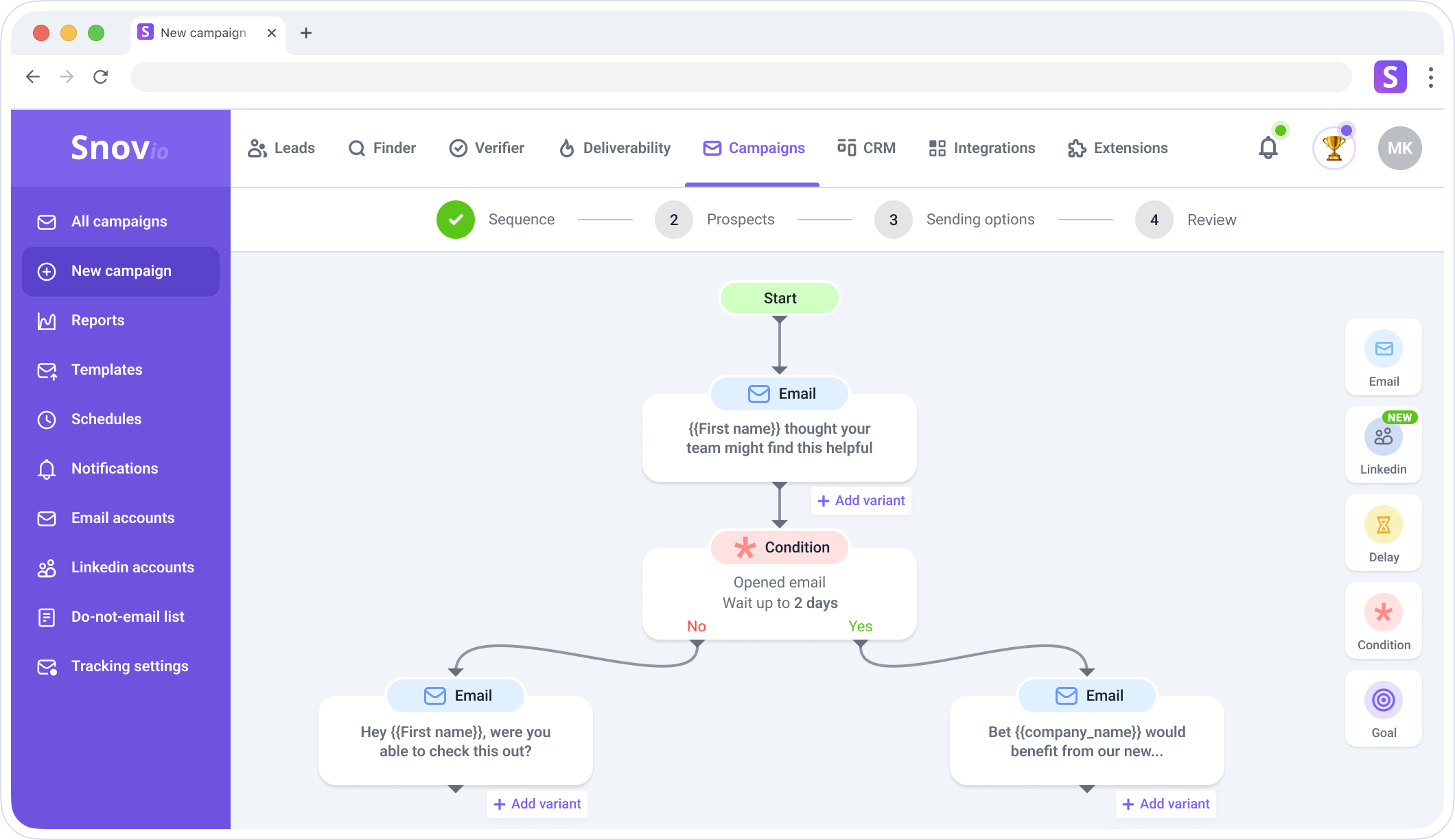
An early-stage startup needs an affordable, all-in-one solution to build its initial sales pipeline.
- Prospecting: The founder uses Snov.io’s Chrome Extension on LinkedIn to find 50 target prospects. (Cost: 50 credits)
- Verification: They run the list through Snov.io’s verifier. 45 are verified as valid. (Cost: 22.5 credits)
- Outreach: They load the 45 contacts into a pre-built 3-step email sequence in Snov.io’s “Campaigns” feature.
- Management: As replies come in, they use Snov.io’s simple, built-in CRM to track deals.
Outcome: A functional, end-to-end sales process is established within a single platform at a low cost. To stretch your startup budget even further, redeem an exclusive Snov.io offer on your first annual plan.
Workflow 2: The Data-Driven Enterprise Team (Using Apollo.io)

A mid-market company’s sales team needs to target a precise persona with high data accuracy and sync everything with their central Salesforce CRM.
- Prospecting: An SDR uses Apollo’s rich filters (e.g., “hiring for ‘sales’ in ‘SaaS’ with >$10M funding”) to build a list of 200 ideal prospects.
- Enrichment & Sync: The list is automatically enriched with direct-dial numbers and verified emails. Thanks to the bi-directional sync, these new contacts and their data automatically appear in Salesforce.
- Outreach: The SDR enrolls the list in a multi-channel sequence in Apollo that includes emails, calls, and LinkedIn connection requests.
Outcome: A highly targeted, efficient outreach process is executed with superior data, all seamlessly integrated with the company’s core CRM.
Workflow 3: The Lean “Best-of-Breed” Team (Using Hunter.io + Another Tool)
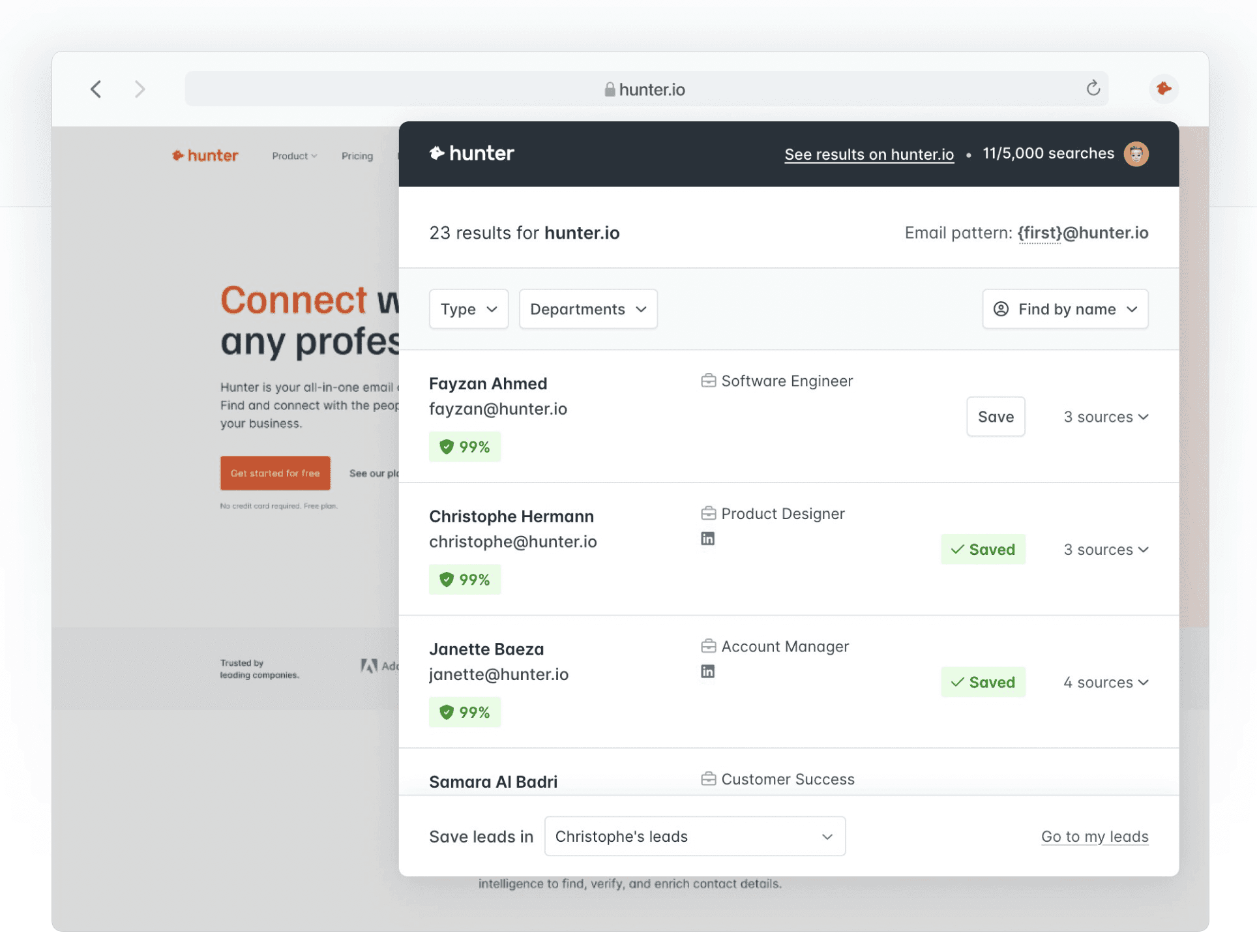
A technically savvy team wants the best tool for each job and is comfortable connecting them.
- Finding: The team uses Hunter.io for its speed and simplicity to find email addresses for a list of target domains.
- Integration: Using API access or a tool like Zapier, the found and verified contacts are automatically pushed into their CRM (e.g., HubSpot) and their chosen outreach tool (e.g., Lemlist).
- Outreach: They use their separate, dedicated outreach platform to execute campaigns.
Outcome: The team leverages the best tool for each specific task, resulting in a highly optimized but more complex tech stack that they must manage.
Part 6: Snov.io Alternatives & Competitors In-Depth
Apollo.io: Best for Data-Driven Enterprises
Apollo.io is the undisputed heavyweight in this comparison, but its power comes with significant trade-offs.
When it’s the best choice
- If data accuracy is your absolute number one priority and your team lives inside Salesforce or HubSpot.
- If your company’s security team requires vendors to be SOC 2 compliant, making Apollo.io the only viable option on this list.
- If you need to run complex, multi-channel outreach campaigns that include calls and LinkedIn tasks alongside emails.
Prerequisites for success
- A budget that can support a higher per-user cost and potentially expensive data export fees.
- A team that is technically savvy enough to manage a complex interface without being overwhelmed.
- A clear understanding of the difference between internal-use credits and export credits to avoid unexpected bills.
When to avoid
- If your team is not technically proficient; the learning curve is steep, and many teams pay for features they never use.
- If data portability is a core tenet of your strategy. The vendor lock-in via export credits is a serious strategic risk.
- If you need responsive, high-touch support. Slow support is a frequent complaint for a product at this premium price point, according to user reviews G2 review of Apollo.io.
✅ Strengths
- SOC 2 Type II & ISO 27001 certified
- Massive proprietary B2B database (85-95% accuracy)
- True multi-channel sequences (email + calls + LinkedIn)
- Deep bi-directional Salesforce/HubSpot sync
⚠️ Considerations
- Vendor lock-in via expensive export credits
- 3-year TCO of ~$14,220 for 5 users
- Steep learning curve for non-technical teams
- Slow customer support reported by users
Hunter.io: Best for Fast, Simple Email Finding
Hunter.io represents the opposite end of the spectrum from Apollo.io. It’s a specialist tool that has perfected simplicity.
When it’s the best choice
- When you need a fast, affordable, and reliable tool for just finding emails, resulting in significant time savings.
- When you are deliberately following a ‘best-of-breed’ strategy and plan to use a separate, dedicated platform for cold outreach.
- When price transparency and a low TCO are your most important financial considerations.
Prerequisites for success
- You must have a separate budget and plan for a dedicated sales outreach tool.
- Your team must be comfortable using tools like Zapier or native integrations to connect Hunter.io to the rest of your sales stack.
- Your prospecting needs are focused on email addresses, as Hunter does not offer social profile or direct-dial phone number finding.
When to avoid
- If you are looking for an all-in-one platform. Hunter.io is intentionally a “one-trick pony.”
- If you need to run outreach campaigns; its built-in “Campaigns” feature is too basic for professional use.
- If you need a deep prospect database with rich filtering; Hunter primarily finds publicly available information.
✅ Strengths
- Lowest 3-year TCO at ~$3,564 (10 users included)
- Transparent, simple pricing
- Excellent email finding speed & source attribution
- Strong verification accuracy
⚠️ Considerations
- No email warm-up or deliverability tools
- Basic “Campaigns” feature lacks A/B testing
- No SOC 2 Type II certification
- Requires separate outreach platform investment
Lemlist: Best for Creative, High-Touch Outreach
Lemlist has carved out a powerful niche by focusing on creative personalization and deliverability.
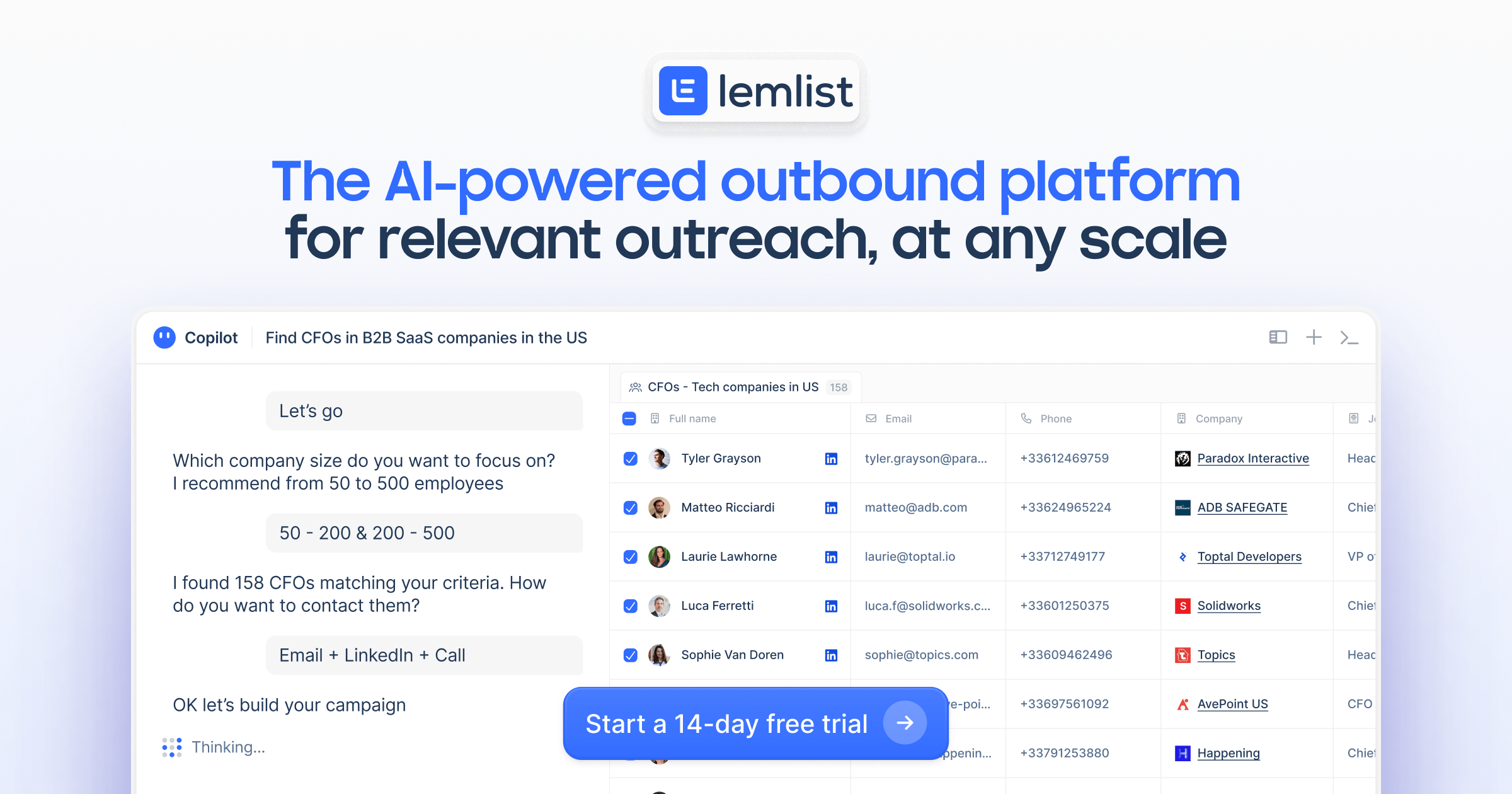
When it’s the best choice
- If your entire sales philosophy is built on creative, high-effort personalization to achieve higher reply rates.
- If you believe that best-in-class deliverability, powered by tools like “lemwarm,” is worth a premium price.
- If you value a highly engaged user community and fast, expert customer support.
Prerequisites for success
- A budget that can support one of the highest per-user costs in the category.
- A team willing to invest the time to create genuinely personalized images and videos for their campaigns.
- An understanding that you are buying an outreach tool first; its integrated lead-finding database is not as strong as Snov.io’s or Apollo.io’s.
When to avoid
- If your sales process is high-volume and low-touch. The high cost is very difficult to justify in this scenario.
- If you need to pass a corporate security review that requires SOC 2 certification.
- If your primary need is a powerful tool for finding and enriching leads.
✅ Strengths
- “lemwarm” best-in-class email warm-up (95-99% inbox placement)
- Dynamic image/video personalization unmatched in the market
- Excellent customer support & user community
- Strong A/B testing for campaign optimization
⚠️ Considerations
- Highest 3-year TCO at ~$14,940 for 5 users
- Weak integrated lead-finding database
- No SOC 2 Type II certification
- Personalization features require significant team time investment
For a wider perspective on this category, browse our complete comparison articles library covering all major sales and marketing platforms.
Part 7: Conclusion & Frequently Asked Questions
After this deep dive, it’s clear there is no single “best” sales outreach tool. The market is sharply divided between budget-friendly all-in-ones, powerful enterprise platforms, and hyper-focused specialists.
The most critical takeaway is the non-negotiable importance of security compliance; for many businesses, the SOC 2 certification question will narrow the field to Apollo.io immediately. For those with more flexibility, the choice between Snov top alternatives and competitors comes down to your answers to five critical questions.
Final Decision Framework
- Security: Does our company or do our target clients require vendors to be SOC 2 certified? (If yes, only Apollo.io is a viable option from this list).
- Budget: Is our budget based on a total team cost, or can we handle a high per-user cost? (This determines the Snov.io/Hunter.io path vs. the Apollo.io/Lemlist path).
- Data Strategy: Do we need to own and export our enriched data freely and without penalty? (This is the crucial question to ask before choosing Apollo.io).
- Sales Philosophy: Is our outreach a high-volume numbers game or a low-volume, creative effort? (This pushes you toward Snov.io/Apollo.io for volume or Lemlist for creativity).
- Tech Stack: Do we prefer a single, convenient platform, or are we willing to manage a custom stack of best-in-class tools? (This is the all-in-one vs. specialist debate).
Before you sign any contract, my final piece of professional advice is to demand a full TCO calculation, ask for the vendor’s security documentation (their SOC 2 report if they have one), and run a paid pilot with a few members of your team.
A comprehensive evaluation of Snov.io alternatives and competitors ensures the best tool is the one that fits your workflow, your budget, and your risk tolerance. Don’t sign up at list price — always check our regularly updated latest coupons collection for active savings across every tool in this comparison.
Frequently Asked Questions
Q1: What’s the main difference in the Apollo.io vs Snov.io comparison?
A1: The primary difference is their target market and philosophy. Snov.io is built for value and simplicity, targeting SMBs with a “good enough” all-in-one toolkit on a budget Capterra Snov.io Reviews. This makes it perfect for getting started quickly.
In contrast, Apollo.io is built for data depth and security, targeting the mid-market and enterprises that need superior data and essential SOC 2 compliance Apollo Trust Center. It comes at a significantly higher cost and with a much steeper learning curve. Your choice ultimately depends on whether budget and simplicity or enterprise-readiness and data accuracy are your primary concerns.
Q2: Is Snov.io SOC 2 certified?
A2: As of June 2024, Snov.io does not hold SOC 2 Type II certification. A review of their official security page confirms they are GDPR compliant but lacks the SOC 2 or ISO 27001 certifications that are standard requirements for most corporate security policies Snov.io Security.
For any business that handles sensitive customer data or sells to enterprise clients, this is a critical risk and a potential deal-breaker. It is a key reason why Snov.io remains firmly positioned for the SMB market rather than the enterprise segment.
Q3: How much does Apollo.io really cost?
A3: Apollo.io’s advertised price can be misleading; its true cost is influenced by data portability. This hidden cost aligns with our team’s view on strategic savings; as our MarTech strategist Mohamed Zaki often recommends, you must look beyond list price to TCO.
While they offer “unlimited” email credits, these are for use inside the Apollo platform. Exporting your enriched contact data to your own CRM requires separate, expensive “export credits,” creating a form of vendor lock-in TrustRadius Apollo.io Review.
Based on annual pricing for a 5-person team, the real 3-year TCO is approximately $14,220, not including extra costs for mobile number credits or data exports Apollo.io Pricing.
Q4: Can I just use Hunter.io for sales outreach?
A4: While Hunter.io technically includes a feature called “Campaigns,” I would advise against using it as your primary sales outreach tool. My analysis and numerous user reviews confirm it is far too basic for professional use, lacking key features for effective outreach G2 review of Hunter.io.
Hunter.io is a best-in-class email finder, and it excels at that one job. It is designed to be one component in a larger, custom-built tech stack. For effective outreach, you will need to pair it with a dedicated platform like Lemlist or use an all-in-one solution.
Q5: Is Lemlist worth the high price?
A5: Lemlist is only worth its premium price if your team is fully committed to a strategy of creative, personalized outreach. Its core value lies in unique features for dynamic image and video personalization, as well as its best-in-class “lemwarm” deliverability tool, which can drive superior reply rates Lemlist Homepage.
If your sales process is high-volume and low-touch, its high per-user cost of over $80/month is very difficult to justify when compared to the value offered by Snov.io or the raw lead-finding power of Apollo.io. You are paying a premium for the creative suite.
Q6: Which tool has the best data accuracy?
A6: Based on independent benchmarks and aggregated user reports, Apollo.io consistently comes out on top for data accuracy, with real-world estimates between 85-95% ⚠️ Needs verification. This is their core strength and a key part of their value proposition, stemming from their massive proprietary database.
Snov.io and Hunter.io are in the next tier, with respectable accuracy of around 75-85% for the data they provide Snov.io Homepage. Lemlist’s data tools are the weakest of the four, as its primary focus is on the outreach process, not data acquisition.
Q7: What is the biggest risk of choosing the wrong tool?
A7: From my experience, the biggest risks are professional, financial, and security-related. Using a tool with poor deliverability features, such as a lack of support for custom tracking domains, can get your company’s domain blacklisted, which is a professional catastrophe.
Choosing a tool with a complex pricing model can lead to unforeseen budget overruns, a major financial risk. Finally, using a non-compliant tool like Snov.io for enterprise sales can create serious security vulnerabilities and get you blocked by your client’s vendor management, posing a critical security risk.
Q8: Should I choose an all-in-one or a specialist tool?
A8: My advice is this: choose an all-in-one platform (Snov.io, Apollo.io) if you prioritize convenience, a single subscription, and having your data in one place. This is often best for smaller teams or those who value simplicity.
Choose a stack of specialist tools (e.g., a prospecting tool like Hunter.io + an outreach platform) if you want to pick the “best-of-breed” for each function and have more granular control. The specialist route offers more flexibility but requires you to become the system integrator, often relying on tools like Zapier to connect the pieces.
Q9: Do Snov.io alternatives require a credit card for a free trial?
A9: This varies and is a key detail to check. Snov.io itself offers a free-forever plan with monthly credits, which does not require a credit card to sign up Snov.io Pricing.
However, many competitors offer time-limited “free trials” that do require a credit card and will automatically convert to a paid plan if not canceled. It’s crucial to distinguish between a “free plan” and a “free trial.” Always check the terms before providing payment details to avoid unexpected charges. Coupons Scout sometimes offers exclusive extended trials that provide more time or features than the standard public offer.