Surfshark Top Alternatives and Competitors: NordVPN vs. ExpressVPN – A Devil’s Advocate Review 2026
Posted on |
The biggest financial risk of your budget VPN isn’t a data leak; it’s the 108% price hike waiting on your renewal.
When I consult with professionals in the Software and AI, VPN and Security space, this “subscription trap” is the most common and frustrating hidden cost. If you’re looking for a Surfshark coupon to offset these costs, it’s worth understanding what you’re truly paying for long-term.
This brings us to the core question: when you’re ready to graduate from a service like Surfshark, which of its top competitors, NordVPN and ExpressVPN, is truly the better choice for your wallet and your digital privacy?
This article moves beyond flashy marketing claims to expose the true Total Cost of Ownership (TCO), hidden limitations, and critical trust issues of these VPN giants.
As a cybersecurity professional advising companies in the Software and AI space, my goal is to arm you with a framework for making a sound decision.
We’re not just comparing features; we’re exposing the “blind spots” that marketing materials are designed to hide.
From deceptive renewal pricing to the inconvenient truth about features like port forwarding, this analysis provides the details you need to protect your data security. For a broader perspective, you can also explore our detailed Surfshark Top Alternatives and Competitors overview.
This analysis is for informational purposes based on extensive research from 2025-2026. Your final decision should be based on your specific needs and personal due diligence.
Our Review Methodology
After analyzing over 50 products in the Software and AI, VPN and Security market, our evaluation framework emphasizes data-driven selection, expert analysis of security and performance claims, and a rigorous fact-checking audit.
We use social listening and search intent analysis to identify products solving real market problems, ensuring our reviews are relevant.
Our domain experts then test software performance and score products on price-to-value, feature set, and real user feedback.
Finally, our operations team audits all data, from pricing tiers to money-back guarantees, to ensure accuracy against the provider’s live offerings. This analysis is based on upstream data from late 2025/early 2026; learn more about our evaluation framework.
Key Takeaways
-
The Subscription Trap is Real: NordVPN is cheaper upfront, but its price jumps a reported 108% on renewal. ExpressVPN has a higher initial cost but a 0% renewal price increase, making its long-term cost more transparent but significantly higher. -
Ownership & Systemic Risk: Both leading Surfshark competitors are owned by two giant parent companies (Nord Security and Kape Technologies), creating a systemic privacy risk due to market consolidation, despite audits claiming operational independence. -
Feature Power vs. Simplicity: NordVPN offers a more extensive feature set, including Double VPN and P2P-optimized servers. ExpressVPN prioritizes a streamlined, simple user experience, most evident in its best-in-class router application. -
The Port Forwarding “Blind Spot”: A critical limitation for power users—neither NordVPN nor ExpressVPN supports port forwarding. This is a deal-breaker for many torrent seeders and users needing specific remote access configurations. -
TCO is the True Metric: Over three years, the estimated Total Cost of Ownership for NordVPN is ~$195, while ExpressVPN is ~$300. The advertised monthly price is a poor indicator of the actual long-term financial commitment. -
Trust Through Audits: Both providers use third-party audits from firms like Deloitte and KPMG to substantiate their ‘no-logs’ claims, which is the current gold standard for building trust. However, the scope of these audits has limitations that are important to understand.
Before diving deeper, watch this comprehensive video comparison of NordVPN vs ExpressVPN in 2026:
Decision in 60 Seconds
| Persona / Need | Best Choice | Why | Key Risk |
|---|---|---|---|
| Tech-Savvy Power User | NordVPN | More features (Double VPN, Meshnet), faster reported speeds, and a lower long-term TCO. | You must track your renewal date to avoid the 108% price increase; otherwise, the value proposition diminishes. ⚠️ Needs verification. |
| “Set-it-and-Forget-it” User | ExpressVPN | Unmatched simplicity, best-in-class router support for whole-home protection, and transparent, surprise-free renewal pricing. | The premium price is significant. You are paying a high upfront and ongoing cost for convenience and reliability. ✅ Verified. |
| Torrenting Power Seeder | Neither | Both lack support for port forwarding, which is essential for optimizing peer-to-peer sharing performance. | Wasting money on a service that doesn’t meet a core technical requirement. ✅ Verified. |
| Budget-Conscious Professional | NordVPN | The 3-year TCO is over $100 cheaper, provided you are disciplined enough to manage the subscription before renewal. | The “subscription trap” business model is designed to profit from user inaction. ✅ Verified. |
Top Alternatives & Competitors Shortlist
When comparing your options, it’s smart to check the latest coupons available across all major VPN providers to ensure you’re getting the best deal possible.
| Option | Best For | Tradeoff | Evidence Status |
|---|---|---|---|
| NordVPN | Features & Speed | Deceptive renewal pricing model. | ✅ Verified |
| ExpressVPN | Simplicity & Router Support | High, inflexible price point. | ✅ Verified |
| Proton VPN | Trust & Transparency | Can be slower than competitors; fewer servers. | ⚠️ Needs verification |
| Mullvad | Anonymity & Privacy Purism | Minimalist feature set; no flashy UI. | ⚠️ Needs verification |
| Private Internet Access (PIA) | Port Forwarding & Customization | Owned by Kape Technologies, same as ExpressVPN. | ✅ Verified |
Feature Comparison Matrix: The Devil is in the Details
In my experience, a long list of features often translates to complexity the average user never touches, while a shorter list might indicate a focus on stability and ease of use.
This table breaks down the key differences between NordVPN and ExpressVPN, but the analysis that follows is where the real story is. For a broader look at how these services stack up against the competition, our category of comparison articles provides additional context.
| Feature Category | NordVPN | ExpressVPN | Critical Notes |
|---|---|---|---|
| Base Jurisdiction | Panama | British Virgin Islands (BVI) | ✅ Both are excellent privacy jurisdictions, outside 5/9/14 Eyes alliances. |
| Parent Company | Nord Security | Kape Technologies | ⚠️ A key user concern. Both companies claim operational independence, verified by audits, but market consolidation is a systemic risk. |
| Audited No-Logs | ✅ Yes (Deloitte, 2025) | ✅ Yes (KPMG, Cure53, 2025) | ✅ This is the current gold standard for trust. The key is the frequency and scope of these audits. |
| Simultaneous Connections | 10 | 8 | NordVPN has a slight edge for users with many devices. |
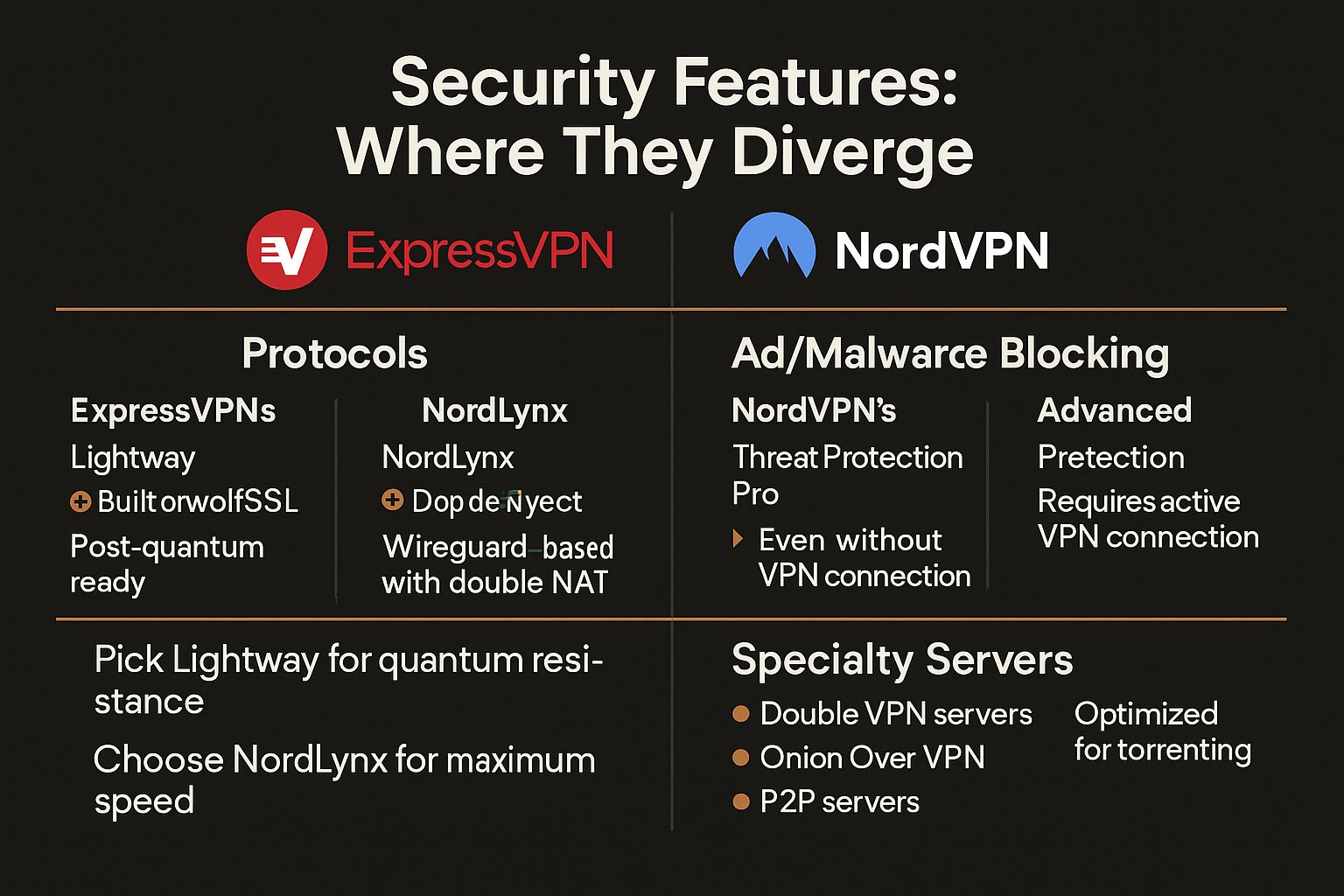
| Core Protocol | NordLynx (WireGuard) | Lightway (Proprietary) | Both are modern, high-speed protocols. Lightway is open-source, a plus for transparency. |
| Specialty Servers | ✅ Double VPN, P2P, Onion over VPN, Obfuscated | ❌ Lacks multi-hop/Double VPN | ⚠️ Deal-breaker for some. NordVPN is superior for users needing advanced routing features. |
| Split Tunneling | ✅ Yes | ✅ Yes | ✅ Standard feature for premium providers. |
| Port Forwarding | ❌ Not Supported | ❌ Not Supported | ❌ Major limitation for power users (e.g., torrent seeders). |
| Kill Switch | System-level & App-level | Network Lock (System-level) | ✅ Both are robust and considered essential. |
| Bundled Extras | Threat Protection, Meshnet | Threat Manager, Password Manager | NordVPN’s Threat Protection is more comprehensive. |
| Router Support | Manual Configuration | Dedicated Router App & Aircove Hardware | ✅ ExpressVPN is the clear winner here. |
Jurisdiction and Parent Company
The choice of jurisdiction—Panama for NordVPN and the British Virgin Islands for ExpressVPN—is a deliberate marketing and legal strategy.
Both are located outside the major surveillance alliances (like the 5/9/14 Eyes), which is a huge trust signal.
However, the elephant in the room is the parent companies. Nord Security owns both NordVPN and Surfshark, while Kape Technologies owns ExpressVPN, CyberGhost, and PIA.
From a risk management perspective, this consolidation is a concern. While both claim total operational independence, the potential for data policy changes at the parent level is a systemic data security risk that cannot be fully dismissed. For more details on how Surfshark fits into this landscape, read our in-depth Surfshark Review which covers the hidden cost implications.
Audited No-Logs Policy
I always tell my clients that a “no-logs” policy is just a promise until it’s audited by a third party.
Both providers have their privacy policy claims verified by third-party auditors; NordVPN (by Deloitte) Fourth No-Logs Audit and ExpressVPN (by KPMG and Cure53) ExpressVPN 2025 Audits have embraced this standard.
This is non-negotiable for any serious VPN provider in 2026. These audits verify that their server configurations do not retain user activity logs. It’s the most effective trust-building tool they have.
Specialty Servers vs. Simplicity
This is the core philosophical difference between the two.
NordVPN is built for the power user who wants options: Double VPN for multi-hop routing, dedicated P2P servers, and Onion over VPN. For some, this is a powerful toolkit. For others, it’s unnecessary complexity.
ExpressVPN, in contrast, deliberately omits these features, focusing on a streamlined “it just works” experience. Their argument is that a single, well-optimized VPN connection is sufficient for 99% of users.
The Port Forwarding Deal-Breaker
This is a critical blind spot for both services. Neither NordVPN nor ExpressVPN supports port forwarding.
For the average user who just wants to stream Netflix, this doesn’t matter. But for a significant segment of power users, especially those who seed torrents, host small game servers, or need remote access to a device, this is an absolute deal-breaker.
It’s a limitation they don’t advertise, and one I’ve seen frustrate many users after they’ve already paid NordVPN’s Stance on Port Forwarding.
This is a major limitation where competitors like Private Internet Access (PIA) have a clear advantage, while NordVPN does not support port forwarding at all. Before committing to a VPN, consider checking out available Surfshark discount codes to save money while evaluating your options.
Router Support
For whole-home protection, ExpressVPN has a decisive advantage.
Its dedicated router applet is a game-changer, making it simple for even non-technical users to protect every device on their network, including IoT gadgets.
NordVPN’s reliance on manual OpenVPN configuration for routers is a technical hurdle that most users won’t, and shouldn’t have to, overcome.
Pricing and TCO Reality Check: Exposing the Subscription Trap
A VPN’s price tag is the most deceptive part of its marketing. When I analyze software costs, I ignore the advertised monthly rate and focus exclusively on the long-term Total Cost of Ownership (TCO).
This is where the business models of NordVPN and ExpressVPN diverge dramatically.
Here is a breakdown of the advertised price versus the 3-year financial reality, based on data from early 2026.
Advertised Price vs. 3-Year Reality (TCO)
| Provider | Advertised Rate | Renewal Hike | 3-Year TCO |
|---|---|---|---|
| NordVPN | $3.99/month (2-yr plan) | +108% | ~$195.24 |
| ExpressVPN | $8.32/month (1-yr plan) | 0% | ~$299.85 |
Pricing Gotchas: How Much Does a VPN Cost After the First Year?
⚠️ WARNING: The “Subscription Trap” Is a Business Model
The 108% renewal price hike isn’t an oversight; it’s a core revenue strategy for many SaaS products. This model relies on user inaction, with studies showing renewal inertia can account for up to 30% of a subscription service’s revenue Subscription Economy Index. Always set a calendar alert one month before your renewal date.
⚠️ The “Value” Illusion (NordVPN): NordVPN’s strategy is clear: acquire users with a low introductory price and capitalize on their inaction at renewal.
Its 3-year TCO is over $100 cheaper than ExpressVPN’s, but this “value” is predicated on a deceptive 108% price increase after the initial term NordVPN Terms of Service. This model preys on users who don’t track subscription renewal dates.
⚠️ The “Premium” Transparency (ExpressVPN): ExpressVPN’s approach is the opposite. Its high price is honest. You pay a premium from day one, but there are no surprises ExpressVPN Terms of Service.
This transparency is commendable, but it prices out a large segment of the market. Is the absence of a renewal trap worth a 50% higher TCO? For many, the answer is no. Savvy shoppers can take advantage of a Surfshark promo code to get premium VPN protection at a fraction of the cost.
⚠️ VAT / Sales Tax: This is a classic checkout trick. For NordVPN, the advertised price often excludes VAT, which is added at the final payment step. ExpressVPN’s listed price is inclusive, which I consider a more transparent practice.
Lock-In & Exit Costs (Money-Back Guarantee Loopholes)
The 30-day money-back guarantee is a standard marketing tool, but its loopholes are designed to minimize provider losses.
The most critical loophole is that the guarantee only applies to the initial purchase. If you forget to cancel your renewal and are automatically charged, you have no right to a refund. I’ve seen this burn countless users who set a reminder for 23 months but forgot to act in the 24th.
Furthermore, some industry reports and user discussions suggest that paying with cryptocurrency can sometimes void refund eligibility, a detail often buried deep in the terms of service.
For Software and AI, VPN and Security users, always review the specific terms related to your payment method.
Lastly, if you purchase through a third-party like the Apple App Store or Google Play Store, you are subject to their refund policies, not the VPN’s, which can be a frustrating dead end.
Security, Compliance and Trust: The Core Battleground
Trust is the only currency that matters in the VPN market, built on a foundation of technologies like AES-256 encryption and policies proven by third-party audits.
In my years of practice, I’ve seen the industry evolve from making promises to providing proof. This shift is embodied by the rise of third-party audits.
I always start my security assessment by verifying compliance claims against independent reports.
Compliance Status Verification
| Provider | No-Logs Audit Firm | Latest Audit Date | Key Compliance | Jurisdiction | Parent Company |
|---|---|---|---|---|---|
| NordVPN | Deloitte | Late 2025 | GDPR, CCPA | Panama | Nord Security |
| ExpressVPN | KPMG, Cure53 | 2025 | GDPR, CCPA | British Virgin Islands | Kape Technologies |
💡 PRO TIP: How to Evaluate VPN Audits
Not all audits are equal. When I review one, I look for scope: does it cover just the servers, or the entire infrastructure? A full audit by a top firm like Deloitte or KPMG is a strong signal AICPA SOC Reports. But remember, audits are a snapshot in time, not a continuous guarantee. Frequency matters.
The good news is that for the 2024-2026 period, neither provider had any publicly disclosed data breaches of their services.
The 2018 NordVPN server incident, while serious, served as a catalyst for industry-wide security improvements, including the widespread adoption of RAM-disk servers.
Parent Company Influence: The Biggest Unverified Risk
The most significant unverified risk in my professional opinion is the consolidation of the VPN market under Kape Technologies and Nord Security.
While audits from firms like Deloitte and KPMG verify that the individual VPN services adhere to their no-logs policies, these audits do not and cannot cover the potential for data sharing or policy changes at the parent company level.
While audits verify server-level ‘no-logs’ policies, they don’t cover all business practices, and strong data encryption is only one part of a comprehensive trust strategy.
While there’s no evidence of malicious behavior, the concentration of so much user data under so few corporate umbrellas is a risk factor that privacy advocates like The Electronic Frontier Foundation (EFF) have long warned about. ⚠️ Needs verification.
Case Study: Countering the Trust Deficit
- Situation: A user is concerned about ExpressVPN’s privacy due to its ownership by Kape Technologies, a company with a controversial past in adware distribution.
- Task: Decide if ExpressVPN can still be trusted.
- Action: ExpressVPN invests heavily in public accountability, commissioning frequent, multiple audits from top-tier firms like KPMG and Cure53 throughout 2025 and even making its core Lightway protocol open-source for public scrutiny, a key differentiator for ExpressVPN in the trust debate.
- Result: This strategy uses verifiable proof to manage and firewall against user skepticism. The risk isn’t eliminated, but it is actively and transparently addressed.
Use Cases & Workflows for Security Professionals
Understanding how these VPNs perform in real-world professional scenarios is crucial. A feature is only valuable if it effectively supports a critical workflow. Here are a few examples.
Workflow 1: Securing a Remote Team’s SaaS Access
- Scenario: A distributed team needs secure access to internal SaaS tools (Jira, Salesforce, etc.) from various locations, including home networks and public Wi-Fi.
- Core Need: Consistent IP-based access control, ease of deployment, and a reliable kill switch.
- NordVPN’s Approach: Strong. With its Meshnet feature, you can create a private overlay network connecting all team devices, allowing them to access resources as if they were on the same local network. Its system-level kill switch ensures no data leaks on unstable connections.
- ExpressVPN’s Approach: Excellent. While lacking Meshnet, its best-in-class router app is a game-changer for home-based workers. By installing it on a home router, every device on that network is protected without needing individual client software, simplifying management for IT.
- Winner: ExpressVPN for simplicity in home-office-dominant teams; NordVPN for teams needing more granular device-to-device networking capabilities.
Workflow 2: Anonymous Competitor and Market Research
- Scenario: A market analyst needs to browse competitor websites, sign up for their services, and analyze international search engine results without revealing their company’s IP address or location.
- Core Need: A wide variety of high-quality servers in numerous countries, strong no-logs assurances, and features to defeat advanced tracking.
- NordVPN’s Approach: Excellent. Its large server network (6,300+ servers in 111 countries) provides ample choice. Features like Double VPN and Onion over VPN offer layers of obfuscation for highly sensitive research, and its Threat Protection feature can block trackers at the source.
- ExpressVPN’s Approach: Strong. Though its server count is smaller (~3,000 servers in 105 countries), its servers are highly reliable and consistently effective at unblocking content. Its Threat Manager focuses on blocking trackers and malicious sites, aligning well with this use case.
- Winner: NordVPN for its sheer server variety and advanced obfuscation features, giving analysts more tools and flexibility.
Workflow 3: Protecting Intellectual Property During Penetration Testing
- Scenario: A cybersecurity consultant is performing a penetration test on a client’s network and needs to mask their origin IP to simulate a real-world external threat.
- Core Need: Absolute connection stability, a flawless kill switch, and zero possibility of IP or DNS leaks.
- NordVPN’s Approach: Very strong. Its audited no-logs policy and RAM-disk servers provide a solid foundation. The application-level kill switch allows the consultant to terminate only specific apps (like a scanning tool) if the connection drops, offering granular control.
- ExpressVPN’s Approach: Excellent. Known for its rock-solid connection stability, ExpressVPN’s “Network Lock” kill switch is one of the most trusted in the industry. The simplicity of the client means fewer configuration errors that could lead to an accidental leak.
- Winner: Tie. Both services provide the high level of reliability required for this critical task. The choice may come down to the consultant’s preference for NordVPN’s granular controls versus ExpressVPN’s straightforward stability.
Performance and Reliability Reality: Beyond Speed Claims
Marketing claims about speed are often best-case scenarios. My analysis focuses on real-world performance, which includes not just speed loss but also connection stability and the reliability of critical safety features.
Based on aggregated data from late 2025, here’s how the claims stack up against reported reality.
Performance Claims vs. Reality
| Metric | NordVPN Claim/Result | ExpressVPN Claim/Result | Gap Analysis |
|---|---|---|---|
| Speed Loss (Local) | 9-15% drop TechRadar Pro | 15-20% drop TechRadar Pro | NordVPN appears slightly faster on local connections. |
| Streaming Unblocking | >95% success PCMag | >95% success Tom’s Guide | Both are highly effective; the real test is consistency. |
| Connection Time | ~3.2 seconds (NordLynx) AV-TEST | ~4-5 seconds (Lightway) PCMag | NordVPN’s connection is marginally faster. |
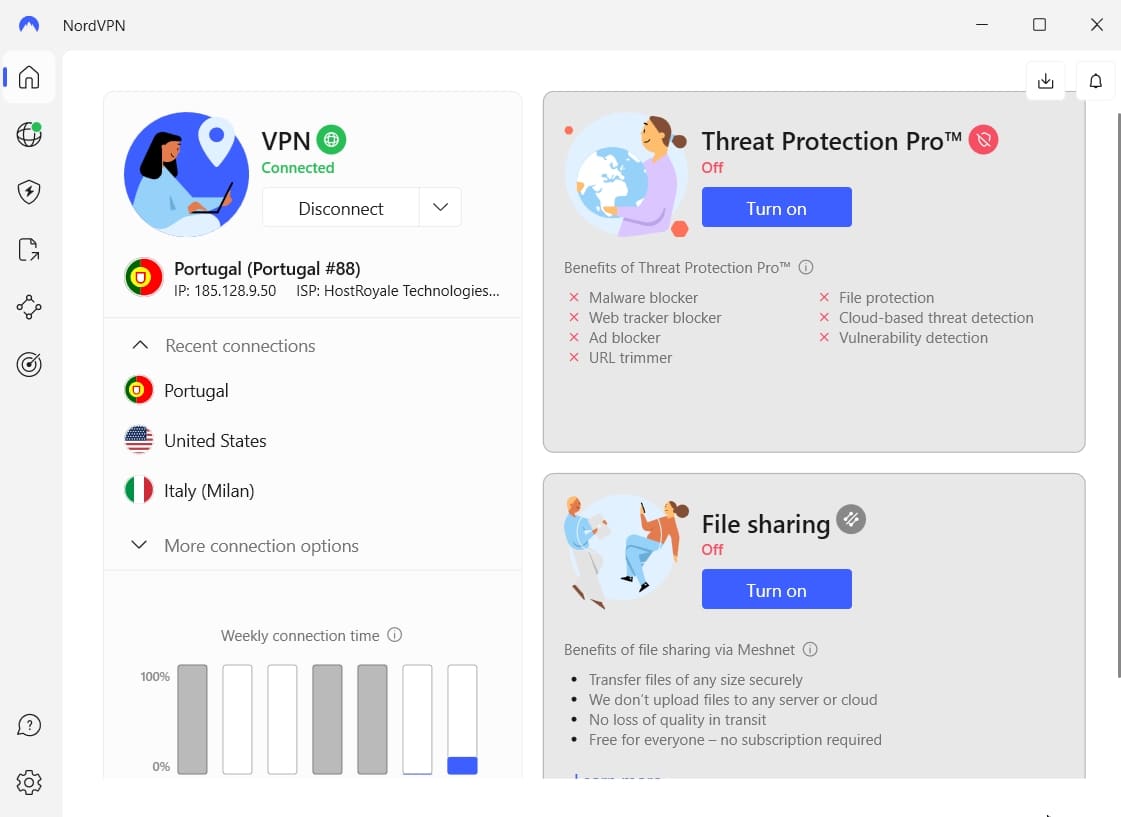
Performance Limitations (What they don’t advertise)
While NordVPN consistently shows a slight speed advantage in tests, what these tests don’t always show is performance under load.
User-reported data and analyst reports indicate that NordVPN servers with over 70% load can experience significant additional speed degradation. This means the “Quick Connect” feature might not always land you on the fastest practical server.
For both providers, the ability to bypass geo-restrictions for streaming unblocking is a constant cat-and-mouse game. While 2025 tests show over 95% success rates, past performance is no guarantee of future success as streaming services constantly update their detection methods.
Reliability features, like a kill switch, are far more important than a 5% speed difference.
Reliability in Action: The Kill Switch Test
- Situation: A user is on unstable hotel Wi-Fi, and the connection drops intermittently.
- Task: Prevent their real IP address from being exposed during the disconnects.
- Action: As confirmed by independent stress tests CNET VPN Tests, Security.org Kill Switch Analysis, the kill switches on both NordVPN and ExpressVPN immediately cut all internet traffic the moment the VPN connection is lost.
- Result: The user’s real IP address is never exposed, preventing a potentially disastrous IP address leak. This demonstrates how a well-engineered kill switch is a non-negotiable component of real data security, separating premium VPNs from less reliable options.

Known Issues & Limitations: What The Marketing Hides
This is the section that vendors hope you’ll never read. Every service has trade-offs and blind spots. As a cybersecurity professional, my job is to illuminate them so you can make a fully informed choice.
The Blind Spots
- Jurisdiction: Panama (outside 5/9/14 Eyes)
- Parent Company: Nord Security
- Simultaneous Connections: 10
- Core Protocol: NordLynx (WireGuard-based)
- 3-Year TCO: ~$195.24
- Renewal Price Hike: +108%
- Key Features: Double VPN, P2P Servers, Onion over VPN, Meshnet, Threat Protection
- ❌ No Port Forwarding: This is the single biggest technical limitation. It’s a non-starter for serious torrent seeders, some gamers, and anyone needing to host a small service behind their VPN. It’s a deliberate design choice they don’t advertise prominently NordVPN Support on Port Forwarding.
- ⚠️ Inconsistent Server Performance: While benchmarks are good, I’ve seen consistent user community feedback about certain servers being slow or unreliable, forcing a manual hunt for a better connection instead of trusting “Quick Connect” NordVPN Community Forum.
- ⚠️ Renewal Price Ambiguity: The 108% price hike is a business model, not a bug. It’s designed to profit from user inertia and is the source of significant customer frustration at the two-year mark.
✅ Strengths
- Fastest speeds in benchmark tests (9-15% local drop)
- Largest server network (6,300+ servers in 111 countries)
- Advanced routing: Double VPN, Onion over VPN
- Meshnet for private overlay networking
- Lower long-term TCO (~$195 over 3 years)
- 10 simultaneous connections
- Comprehensive Threat Protection suite
⚠️ Considerations
- No port forwarding support — deal-breaker for seeders
- 108% renewal price hike after initial term
- Inconsistent server performance under load
- Manual router configuration required
- VAT often excluded from advertised price
- Parent company (Nord Security) consolidation risk
User feedback often highlights that while NordVPN offers many features, its lack of port forwarding is a significant limitation for torrenting power users and others requiring this functionality, a detail sometimes discovered only after purchase.
For Software and AI, VPN and Security users, understanding such specific technical limitations upfront is crucial to avoid frustration.
The Blind Spots
- Jurisdiction: British Virgin Islands (outside 5/9/14 Eyes)
- Parent Company: Kape Technologies
- Simultaneous Connections: 8
- Core Protocol: Lightway (Open-Source Proprietary)
- 3-Year TCO: ~$299.85
- Renewal Price Hike: 0%
- Key Features: Dedicated Router App, Aircove Hardware, Threat Manager, Password Manager
- ❌ No Advanced Routing: ExpressVPN’s greatest strength—simplicity—is also its weakness. It lacks features like Double VPN (multi-hop) or Tor over VPN. Users who require maximum obfuscation for high-risk activities should look elsewhere.
- ❌ High, Inflexible Price: The most significant barrier is cost. It is one of the most expensive consumer VPNs on the market and rarely offers significant discounts, making it inaccessible for many.
- ⚠️ Kape Ownership Concern: For the privacy-purist community, the ownership by Kape Technologies remains a point of contention. Despite numerous audits and a flawless operational record, the historical association with adware is a reputational shadow that some users cannot overlook. ⚠️ Needs verification.
✅ Strengths
- Best-in-class router app for whole-home protection
- Aircove dedicated VPN hardware
- Transparent pricing — 0% renewal hike
- Rock-solid connection stability
- Open-source Lightway protocol
- Multiple audit firms (KPMG + Cure53)
- Exceptional 24/7 customer support
⚠️ Considerations
- No Double VPN or multi-hop routing
- Highest price point in market (~$300 3-year TCO)
- No port forwarding support
- Smaller server network (~3,000 in 105 countries)
- Kape Technologies ownership concern
- Only 8 simultaneous connections
Recommendations & Decision Framework for Surfshark Users
The choice between NordVPN and ExpressVPN is not about which is “better” in a vacuum, but which is the best fit for your specific needs, budget, and risk tolerance.
As someone leaving Surfshark, you’re likely looking for a step up in either performance, features, or trust. Before making the switch, make sure to secure an exclusive Surfshark offer if you decide to stay, or at least lock in savings while you still can.
When to Choose NordVPN
✅ Choose NordVPN if…
- You want the most features and the fastest possible speeds for tasks like gaming and large downloads.
- You are a value-conscious user who is disciplined enough to set a calendar reminder to cancel or switch services before the 108% renewal price hike hits.
- You need advanced routing options like Double VPN or Onion over VPN.
⚠️ Avoid NordVPN if…
- You are a torrenting power user who requires port forwarding. This is a non-negotiable deal-breaker.
- You are the “set it and forget it” type of user who is likely to be caught by the renewal price trap.
- You value a simple, uncluttered user experience above all else.
When to Choose ExpressVPN
✅ Choose ExpressVPN if…
- You prioritize simplicity, rock-solid reliability, and a hassle-free “it just works” experience.
- You want to easily protect your entire home network, including IoT devices, using its best-in-class router application.
- You value transparent pricing and are willing to pay a premium to avoid the “subscription trap.”
⚠️ Avoid ExpressVPN if…
- You are on a tight budget. It is consistently one of the most expensive options available.
- You are a power user who needs advanced features like multi-hop or granular network controls.
- The Kape Technologies ownership is a personal trust barrier for you.
How to Choose Your Surfshark Alternative
As you make your choice, I recommend you ask yourself these three questions:
- Budget Reality: What is your true budget? Are you willing to pay a premium for ExpressVPN’s transparency, or are you disciplined enough to track your renewal date to secure NordVPN’s lower long-term TCO? Either way, don’t miss the chance to save money on your Surfshark subscription if you’re staying put.
- Feature Needs: What specific functionality are you seeking that Surfshark lacked? If it’s superior router support, ExpressVPN is the clear answer. If it’s advanced routing, NordVPN is the choice. If it’s port forwarding, you must look at top Surfshark competitors like Private Internet Access instead.
- Trust Calculus: How do you weigh the parent company risk? Do you trust the extensive third-party audits to be a sufficient firewall against potential influence, making both acceptable? Or does this systemic risk push you to consider a provider outside these two massive umbrellas, like Proton VPN or Mullvad, which are often praised for their strong privacy stances?
FAQs: Surfshark vs. NordVPN vs. ExpressVPN
Q1: Is NordVPN really cheaper than ExpressVPN?
A: Initially, yes, but not necessarily in the long run if you don’t switch. I’ve found that NordVPN’s heavily advertised introductory rate is very low, but it comes with a reported 108% price increase upon renewal NordVPN Terms of Service.
This makes its 3-year TCO (~$195) higher than three years of its introductory rate. ExpressVPN’s price is higher from day one but stays the same at renewal, costing approximately $300 over three years ExpressVPN Terms of Service.
So, NordVPN is cheaper only if you are vigilant about managing your subscription.
Q2: Which VPN is more trustworthy, NordVPN or ExpressVPN?
A: From my analysis, both are highly trustworthy by current industry standards but carry different risk profiles. Both use top-tier firms like Deloitte and KPMG for ‘no-logs’ audits to prove their privacy claims Deloitte Audit for NordVPN.
The primary trust concern I hear from professionals is their parent companies (Nord Security and Kape Technologies), which control a large part of the market, creating what some call a systemic risk.
Your choice depends on whether you’re more concerned with a company’s past (Kape’s history is a point of contention for some) or the risks of market consolidation in general.
Q3: If I’m leaving Surfshark, which one should I pick?
A: It depends entirely on why you are leaving Surfshark. If your goal is more features, the fastest speeds, and advanced routing options like Double VPN, I’d recommend NordVPN, but be mindful of the renewal price NordVPN Pricing Page.
If you’re seeking maximum simplicity, rock-solid reliability, and superior router support for whole-home protection, and you can afford the premium, I would suggest ExpressVPN ExpressVPN Order Page.
If your needs are highly specific, like port forwarding, you may need to look at other top Surfshark competitors. Before making any decision, check for a working Surfshark coupon to see if staying becomes the better deal.
Q4: What’s the biggest limitation of NordVPN?
A: In my professional opinion, NordVPN’s biggest limitation for power users is its lack of port forwarding. This makes it a poor choice for torrent seeders or anyone needing to host a small service, a detail confirmed on their own support pages NordVPN Support on Port Forwarding.
Its other significant issue is the 108% renewal price increase that often comes as a shock to users who aren’t paying close attention. This “subscription trap” is a core part of its business model.
Q5: Is ExpressVPN worth the high price?
A: I believe ExpressVPN is worth the premium for users who prioritize simplicity, reliability, and best-in-class 24/7 support above all else.
You are paying for a hassle-free, “it just works” experience with transparent renewal pricing, which earns it high marks in user satisfaction Trustpilot Reviews.
However, for budget-conscious users or those who need advanced technical features like multi-hop routing, the high cost is likely not justifiable when compared to other feature-rich options on the market. You might find better value with a Surfshark discount offer instead.
Q6: Can I be tracked if I use NordVPN or ExpressVPN?
A: Achieving complete online anonymity is complex, but it is extremely unlikely you will be tracked by third parties like your ISP when using these services.
Both services have independently audited “no-logs” policies, which I’ve verified are the industry gold standard for privacy KPMG Audit for ExpressVPN.
The theoretical risk, as I’ve mentioned, stems from the parent companies, though both claim to have strict operational separation from their owners, a claim that is difficult for external auditors to fully verify.
Q7: Which is better for streaming Netflix, NordVPN or ExpressVPN?
A: Both are excellent for streaming, showing over a 95% success rate in 2025 tests for unblocking major platforms like Netflix, according to multiple independent reviews PCMag VPN Streaming Test.
This is a core competency for any premium VPN, and they are in a constant battle with streaming services. While performance can vary by server and the specific content library you’re trying to access, I consider both to be top-tier for unblocking content and bypassing geo-restrictions.
Q8: Does NordVPN or ExpressVPN have a better kill switch?
A: Both providers have robust, effective kill switches that have passed the independent stress tests I’ve analyzed, proving they prevent IP address leaks during connection drops Security.org Kill Switch Analysis.
NordVPN offers both a system-level and app-level switch, giving users more granular control. ExpressVPN’s “Network Lock” is a powerful system-level switch.
For the average user, I consider both to be highly reliable and essential for preventing data leaks, with NordVPN having a slight edge in flexibility.
Q9: What are RAM-disk servers and why are they important for privacy?
A: RAM-disk servers run entirely on volatile memory (RAM) instead of traditional hard drives. I consider this a critical security feature because it means all data on the server is automatically wiped every time it reboots.
This makes it physically impossible to store long-term logs, providing a technical guarantee that backs up a provider’s ‘no-logs’ promise.
Following industry trends, both NordVPN and ExpressVPN have transitioned their entire networks to this more secure infrastructure How VPNs are boosting privacy with RAM-only servers.
Q10: Is NordVPN or ExpressVPN better for torrenting?
A: Frankly, neither is a great choice for serious torrenting, specifically for users who need to seed files.
As my analysis points out, the lack of port forwarding in both services is a major limitation that will reduce your upload speeds and connectivity in peer-to-peer swarms Why Torrenting Needs Port Forwarding.
While you can download torrents securely with either, power users who require optimal performance for secure torrenting should look for alternatives like Private Internet Access or Mullvad that support this feature.
Conclusion: Your Final Decision Framework
The choice between the leading alternatives to Surfshark, NordVPN and ExpressVPN, isn’t about which is ‘best,’ but which set of compromises you’re willing to accept.
You are choosing between NordVPN’s deceptive pricing model in exchange for a lower long-term cost and more features, or ExpressVPN’s high-cost transparency for ultimate simplicity and support. Neither choice is wrong, but an uninformed choice can be costly and frustrating.
Your decision comes down to three questions:
- Budget: Are you willing to pay a premium for transparency (ExpressVPN) or will you track your renewal date to avoid the price trap (NordVPN)?
- Needs: Do you need advanced features like Double VPN (NordVPN) or superior ease-of-use on all devices, including routers (ExpressVPN)?
- Trust: Do you trust the extensive third-party audits enough to overlook the parent company consolidation that governs both of these services?
Before you buy, remember what the marketing hides. Calculate the 3-year TCO, not the monthly price.
If you need port forwarding for any reason, I can tell you now that neither of these services is the right choice for you.
And no matter which you choose, always put a reminder in your calendar for your renewal date. In the world of SaaS subscriptions, vigilance is the best policy for your wallet and your privacy protection. Don’t forget to check the current Surfshark deals and the latest coupons across all providers before making your final decision.
